A New Moon Rises

Nandrat Community College
Nandrat, Tavaris
9 February 2022, 1:49 PM

Nandrat, Vana felt, was a city that acted a bit too big for its britches. It was a pretentious kind of place, the sort of city that insisted it had a unique culture superior to everyone else despite the fact that it barely had a culture at all. It was smaller than Olara, for Akrona’s sake, and Goddess only knew how crushingly dull Olara was. There was absolutely nothing special about their local food—you could get seafood like it anywhere else on the west coast, or really, anywhere else at all. The people of Nandrat—and this extended to those in the rest of the province as well—talked a lot about their river. The Nandrat River was, indeed, the most voluminous river in the country, but it wasn’t even the longest. And after years of DNP governance, you couldn’t even swim in it anyway, it was so polluted. But, of course, that was why she was here.

As unremarkable as Nandrat was, unfortunately it was of crucial importance in the political realm—or so Vana was told. In truth, not that she would dare admit it out loud, but she was no political animal. She had ambition, surely, and ideas, and she could talk about them, but in order to be a politician, one had to have a… sense of strategy. You had to be able to know who to talk to at what time for which reason, and you had to always have some sort of response ready in waiting for any given surprise. It was exhausting work, and it made Vana feel—for the first time, really—old.

She was lucky to have Atra for help in the political department. Atra had in great abundance everything that Vana lacked, and she felt that together they made an unstoppable team. Vana had admired her for almost Atra’s entire career—when Vana was elected Matron in 2002, a 40-year old Atra Metravar had just been elected First Councilor of Crystal Province. Atra was sixty years old—well into “old” for an orc—but she looked like she was thirty. She had the energy, the drive, and the speed of Žarís Nevran Alandar but without the significant issue of youth holding her back. There were people all over Tavaris that Žarís could never, ever reach, simply because they refused to be told what to do or take advice from someone younger than them. It was a culture that venerated elders—though, that was obvious to anyone who knew anything at all about how the Church of Akrona was governed.

“Alright, ma’am, it’s almost time. There’s a mix of students and community members out there, so a very broad audience. Don’t be afraid to take some time to speak directly to different groups,” said Atra. Both of them would be speaking during the event, as was their usual. Vana stuck to broad ideals and messages of hope. Atra spoke about policy and politics.

“What are the demographics like, do you think?”

“Well, the school stopped surveying students on religious affiliation in 2017, but the numbers then showed about 60% Akronist. It’s likely to still be around there, because students at a community college like this trend less affluent. But, like I mentioned in Anara last week, we shouldn’t take that to mean we’ll get that kind of spread here. Remember, Akronists are more likely to have already made up their mind. The traditionalists who may end up living in Acronis are going to be more curious, and especially in a place like Nandrat, we really need to speak to them.”

“Understood,” said Vana, embarrassed that she had forgotten Atra explaining it before. There was a feeling in the pit of her stomach that she hadn’t felt in… decades, probably. It was anxiety, and she wished it would go away.

“Alright, here we go,” said Atra. As if she could read the Matron’s mind, she placed a warm hand on her back and the two walked out onto the stage arm-in-arm.

There was, at once, a whooshing sound as everyone in the room stood up as the Matron walked across the stage, and then a crashing roar of applause and cheers. There was quite a bit of orange in the crowd, quite a bit indeed, but it wasn’t everywhere. That said, everyone seemed happy enough; Vana couldn’t hear any boos, and there were still temples where folks booed her from time to time.

“Hello, hello, hello!” Vana called out, motioning with her hands for everyone to sit. “You are all a gift, and it is a gift to be here.” Plenty of people called out, as if by instinct, “as are you.” “Oh, I love being in Nandrat, it’s such a special city,” the Matron lied as the crowd gradually quieted. “What a pleasure it is to have the chance to speak to you all today. I’m very thankful that your professors have agreed to let you out of class to come see us. I’ll try and drag things out so you don’t have to go back.” She winked, and the crowd laughed. Suddenly, her anxiety was gone. This was where she loved to be—in front of a crowd with a heart full of vigor and a message to spread.

“I’m very excited to have the chance to speak to you today. You know, I do a lot of talking to a lot of different kinds of people, it’s perhaps the most important part of my job. And as anyone who has ever had the misfortune of being seated next to me at a table will tell you, I do enjoy talking to people very much.” There were more laughs, and Vana couldn’t help but smirk. Out of the corner of her eye, she could see Atra nodding, so she made a show of turning to her and playfully glaring. The laughter grew louder, and Vana’s smile grew larger. At that moment, Vana felt like she was 20 again.

“Anyway, as I was saying, I do a lot of talking, about all kinds of different things. I talk about theology, I talk about accounting and budgets, I talk about poverty, I talk about the environment, I talk about compassion and forgiveness… but during this particular moment in history, I’m here to talk about something I’ve never spoken much about before. I’m here to talk about that most dreaded of monsters… politics. Until last month, I had never said these words out loud with my mouth before, but I’m here to tell you that you should vote yes in a referendum. It’s quite unprecedented; not even during the crematorium votes in the 50s and 60s did the Matron participate in something as mundane and ungodly as campaigning. And it seems jarring—it certainly feels strange for me to be talking publicly about things like this—but the simple truth is that we are living in extraordinary times. So I hope you’ll forgive me for stepping into the fray, because in this moment, no one can afford to remain silent.”

The crowd had fallen into absolute silence, and Vana could see how focused they were on her. There were only a handful of people in the audience who would have been around early enough to remember the crematorium votes, but even their mention seemed to affect people. Once upon a time, Akronists had recalled the 50s and 60s as a moment of victory in the face of enormous adversity, but as time had gone on, people had begun to realize that the promised land of true equality they had expected wasn’t coming. Young people, who hadn’t lived through the troubled era before the votes, had come to see those days as a time of foolish optimism and broken promises.

Once, 1965—the year the final province legalized crematoriums and did not see it repealed again—had been called ‘the end of political Akronism.’ Looking back, though, it was clear it had only been the beginning. People had been calling for the Matrons and the Elders to speak louder and be more political for decades now, and this was the crowning moment for those people. Vana was giving birth to an entirely new era of Akronism, and she had to get it right, or the faith would be broken forever. Her greatest mission in this moment was not to convince people to vote yes in the referendum, it was to convince people that the Church could be trusted to be a political actor. And that was a far more difficult task than just getting people to tick a particular box on a ballot, especially because above all, she had to do it without letting the people realize that was what she was doing.

“What we are all tasked with is nothing less than ensuring the future of Akronism, and the future of the world. And really, I should say those in the reverse order—our world is the most important thing there is, and it’s in jeopardy today. And I don’t just mean because of the environment, either, although that is certainly incredibly important. What I really mean when I say the world is in jeopardy is that its people—we—are in jeopardy. It doesn’t even matter what religion you are, if you even have one. All of us are living on a precipice that is threatening to give way.” The Matron paused for a moment, trying to gauge the mood of the crowd. One had to tread a fine line between doom and hope. The people were still looking up at her, and there were even a few nods in the audience, so she continued.

“And you may ask yourself how this could be true. After all, we live in an era with technology far more advanced than our grandparents could have ever imagined. The amount of wealth produced on our planet is staggering, almost inconceivable. Today, we can treat illnesses that killed thousands, millions of people in the past with a single shot or course of pills. We can speak with people on the other side of the world instantly, and travel there in only a matter of hours. Some would have us believe that this is progress, that we have attained the future our ancestors dreamed of. But we haven’t. We aren’t even close, and we’ve become blind to that truth. And I have one simple word, just one single word, that sums up and proves exactly what I mean. That word is inequality.”

The applause was sudden and rancorous. People stood to clap, and there were cheers and whoops from all across the crowd. Nearly everyone was nodding now. Vana nodded along with them. It was the young people who understood this message most fundamentally, which was one of the things Vana told herself to remind her of hope when times seemed gloomy.

“Rising GDP numbers don’t tell you that today, the top 10% of income earners in Tavaris own more than two-thirds of the wealth in the entire economy. The top 1% control more than one third on their own. The top one percent. That’s about $775 billion Standard Hawking Dollars in our economy, which is more than the entire economy of Alksearia. The bottom 50%—that is to say, half of the entire country—control only 44 billion, or two percent of the economy. Put another way, for every dollar someone in the bottom half of the income distribution chart has to their name, people like Toran Nuvo Ranzalar own more than seventeen. Speaking of Toran Nuvo Ranzalar, he earned more than 350 times as much as his entry-level employees last year, yet paid less in taxes. He has something like 50 billion dollars to his name, meaning he could make a donation to this college that increases its endowment by five times and have spent only one-one thousandth of his wealth. I want you to think about how much money is in your bank account, divide it by a thousand, and think how much you would miss that amount if you donated it. Would you?”

Many in the audience shook their heads, though no one spoke. “This is a global problem, though it is particularly true here in Tavaris, a country that has been deliberately destroying its social safety net for more than twenty years for the express purpose of shoveling more money into the pockets of people like Toran Nuvo Ranzalar. They call it ‘trickle-down economics,’ because the Toran Nuvo Ranzalars of the country are meant to take all the extra money they’re earning and graciously let some of it mercifully enter the rest of the economy so we can all, allegedly, benefit. Have you benefited? Have your taxes gone down? Has your tuition decreased? Are your groceries cheaper? Something’s trickling all right, but it sure as Akrona isn’t wealth. My father was fond of a saying, and I think of it more and more these days—don’t piss on my face and tell me it’s raining.”

Once again, the crowd burst into roaring applause. The line was a surefire winner, every time. “The rich in Tavaris are getting richer, while the rest of us have to fight over continuously smaller table scraps. The wages of working people have been stagnant for years, while tax cuts for the rich mean billionaires are making more and more every year. In the past twenty years, the Tavari government has introduced co-pays for doctor visits, eye exams and dental care, meaning Tavari people who are on the public health insurance option have to pay for medical care on top of the taxes they already pay. For people who are lucky enough to be on private health plans, even those premiums have increased by, on average, more than 100% since 2002. And the government has even begun considering introducing co-pays for hospital care. Imagine going to the hospital in an emergency and getting a bill. A bill! How cruel can it get? Who is benefitting? Private hospital executives and insurance companies, but certainly not working people!”

“Not only have taxes fallen for the rich, not only have costs increased for the rest of us, but the Tavari government has actively pursued cutting down the benefits of the social safety net. Many of you are too young to remember a time when the Kingdom paid cash welfare to needy families, because that was eliminated in 2001. Nowadays, families have to navigate a dense web of red tape to be able to access a complicated, confusing system of various vouchers, all the while meeting arbitrary, ever-changing requirements to ‘prove’ they ‘deserve’ assistance. Tavaris demands that its neediest people be constantly working or searching for work, but Akrona help them if they need child care or if they are disabled, because Tavaris has cut those benefits as well. Politicians call this a victory. They say that it has shed billions of dollars in costs from the government budget, which means they have all the more to shovel into the military war machine. If you or anyone you know has ever been unsure of where their next meal will come from, you can at least feel comforted by the fact that Tavaris now has aircraft carriers.”

By now, Vana was barely hearing the applause—there was blood rushing in her ears, and she felt electrified. She had even gone off the script some, saying some of the more political things that Atra usually mentioned. Sometimes, Atra would gently and quickly touch Vana’s elbow as a signal to get back on track, but she certainly hadn’t yet. “We don’t have to take all this lying down,” Vana intoned, making the crowd grow even louder. “There is another way.”

Vana motioned with her hands for the crowd to resume sitting, because it had gotten so loud no one could hear her. “I have watched, we all have watched, as Tavaris has become a country that does not serve its people but expects its people to serve it. The Tavari government asks how much further it can cut, rather than how much more it can do. You are expected to sacrifice yourself so that the economy can grow and Toran Nuvo Ranzalar can earn a few more našdat. You are expected to abandon your principles because they are inconvenient to the state. You are expected to be grateful for the scraps you are handed while the rich eat like kings. And speaking of kings, don’t even get me started on what we are expected to tolerate from him. Tavaris is a country by and for rich people, but what I am here to offer you is a country for people!”

“More than five hundred years ago, the goddess Akrona appeared before us and charged us with a sacred mission, and while Tavaris has failed and floundered and abandoned any principles it might have had, the Church of Akrona has held fast and true to its beliefs through the centuries. And I know that some of you aren’t Akronist. I know some of you aren’t religious at all. But you don’t have to be in order to benefit from that Acronis has to offer. The proposition is simple, it couldn’t be simpler. It is: you matter. You are good enough. You deserve fair treatment. You deserve a government that devotes itself to the cause of the neediest people, not the wealthiest. A government that devotes itself to serving the people, not treating them like burdens, or like line items on a budget. Akronists believe that life is sacred, and Acronis will believe that each and every single person within its borders is sacred, too.”

“Each of you is a gift! When we say ‘you are a gift,’ we mean it! Each and every one of you is a gift from God! You, and you, and you, and you!” Vana pointed at various people in the crowd with one hand while pounding on the podium with the other. “You mean something! You have something to offer! All of you represent something special, something divine! And it’s damn time that you get treated like it!”

Vana had to stop speaking for a solid three minutes because the crowd had become so loud. They simply kept cheering and cheering, shouting at the top of their lungs. There were tears in their eyes and passionate vigor in their faces. The Matron turned to look at Atra for a few moments, and Atra was grinning from ear to ear—a rare sight. The two women wrapped arms around each others’ shoulders for a moment as they looked over the crowd. It was incredible, it was unlike anything Vana had ever seen. They had been concerned that the people in this community college gymnasium would be traditionalists who didn’t want to hear what Akronists were offering. Even if that were true, it was clear that their minds and hearts were in a different place now.

“Now, in a few moments, I’m going to hand the mic over to the honorable Atra Metravar, and she’s going to get into the specifics of what Acronis has to offer. She’s going to tell you about our plans for what welfare ought to look like, about what education ought to look like, about the things a country that shuns militarism, foreign intervention, and austerity can do for you. But I want to make one last point, and it is this: in the next few weeks, the people on the other side of this question are going to make you all kinds of promises. They’re going to give you a whole laundry list of things they claim they’ll do for you. And it’s your own decision if you believe them or not, but what I want you to do is use your eyes and your ears. Look and listen not just at what they tell you now, but what they have done in the past. The government of Tavaris has clearly laid out what its preferred way of treating people is, it’s been doing it for decades now under all kinds of political parties. The Prime Minister can dangle Constitutional reforms and budget increases in front of you all she wants, it doesn’t change what she and all her predecessors have been prioritizing for as long as most of you have been alive. Politicians have promised and failed to deliver countless tantalizing things, but us? We are promising what we have been doing for five hundred years and counting. We feed the hungry. We shelter the exposed. We have always believed that every person is equal, and that we are all one Line. The country of Acronis will not just be accountable to its citizens, it will be accountable to God, and to life itself. There can be no greater conviction, and no greater truth. What Tavaris has done, it has done for money, or for glory, or for land. But Acronis will act always, unwaveringly always, in the service of life.”

In that moment, Vana was certain that the roar of the people in that gymnasium could be heard from the Moon itself.

Vendra Harborside Park
Arktorís, Elatana
12 February 2022, 2:00 PM UTC
(6:00 AM East Tavaris Time)

Elatana was where the Tavari day began, which meant that despite it being 2 in the afternoon, for Žarís it was too damn early. She had flown in late last night—which was to say, early in the Elatanan morning—and she could never sleep on planes. She could still feel the tiredness in her eyes as she walked out onto the stage and, for what felt like the ten millionth time in the last two weeks, stepped up to a podium to give a speech. To people in the audience, the Prime Minister had simply just shown up there—that was her job, of course. She showed up places and gave speeches. No one ever thought about the logistics of how a Prime Minister arrived at places she needed to be, or when she had slept or eaten breakfast. And Žarís had to make damn sure everyone continued to think that way, because the minute even a single reporter caught the barest glimpse of tiredness, it would be in every single news headline and on every 24-hour news channel for three weeks.

“Good afternoon, Arktorís!” Žarís called out over the cheers of the crowd. Quite a few people were flying tiny Tavari flags, as had become common at these rallies. The campaign wasn’t providing the flags and she had no idea where people were getting them, but it was certainly a nice touch. Less nice, however, was the other sight in the crowd that had become increasingly common at these rallies. In the back, a block of people wearing purple—without a doubt, these were right-wing Tavari nationalists.

Žarís had always been of the opinion that being on the same side as a nationalist usually meant you were on the wrong side. They were definitely unpleasant company. One might think they would be happy at the idea of Akronists leaving Tavaris and getting their own country, but instead they viewed it as Akronists “destroying” Tavaris. Newspapers didn’t help because they always had to frame the question putting “Tavari unification” in doubt, in reference to the unification of the various Tavari chiefs under a single king in 1304. It was overly dramatic and also plainly incorrect, because Acronis splitting away wasn’t going to remove even one of the 1,152 lines from the National Diet. The Tavari nationalists ought to have known that too, but if they did, they didn’t seem to care.

“I am so delighted to see you all here today,” Žarís lied. “It is an absolutely gorgeous Saturday afternoon here in this beautiful city, and I want to thank you for spending some of it here with me. As you all know, we are living through a crucial moment in time, and it’s so important that we get this right. So let’s talk about the upcoming referendum.”

Žarís was fond of getting right down to business. It was what had first garnered the attention of Shano Tuvria, who had felt the same way. It still hurt to think about her mentor; she would never be able to forgive herself for the way she had acted when he had visited her office for the last time. She had lashed out, defensive and resentful of the idea that she needed to back down from her goals to ‘appease’ the Akronists. And now, regardless, here she was on a cross-country tour pleading voters not to leave the country, and Shano Tuvria was three nai under—she was trying to appease Akronists with her every breath, and she desperately, desperately wished Shano was still around to tell her ‘told you so.’

It still felt strange to be standing on a stage without Shano being next to her. She was, in theory, supposed to have been Deputy Prime Minister. Even after Shano had resigned to be IF Secretary-General, a not small part of her had foolishly hoped that after his six months were over he might have come back to Tavaris, and Žarís would have given him his job back in a heartbeat. She had believed in him more than any politician since her mother, and of course, she had been friends with Shano as well. Žarís wasn’t sure if she believed in an afterlife, but she did like the idea of her mother and her mentor being together again, watching over her.

“I don’t have to tell you how monumental the vote this month is, because you all already know” she said, forcing the sorrow and nostalgia to the back of her mind before it compromised her. “And you all already know what my stance on it is. I’m here to sell you on the idea of Tavaris. There’s a lot of other important voices to listen to on this question, and you know, they don’t all agree with me. The words of someone like Her Most Esteemed Beneficence the Matron carry great weight and deserve respect and a chance to be listened to. You’re going to hear from local faith leaders, too, from your local politicians and civic leaders, from members of your family, from friends and coworkers, from any number of different people whose opinions and judgment you respect. Ultimately, though, the opinion that matters most is yours. The future of Tavaris is in your hands—it’s your choice. And that’s what I want to talk to you about today: choice.”

“Choice” was an old DNP favorite, and frankly Žarís should have thought about leveraging it earlier. She could still hear Avri Takanaš’s voice recommending it in her head. She had kept almost all of the cabinet Shano had appointed in place because she had felt all of them were good fits for their positions, and the Minister of Internal Affairs was no exception. It was a broad portfolio, and Avri could very well make a good Prime Minister someday. He had been very right, of course. People liked to hear that they were in charge, that their perspective mattered. One thing that separated the DNP from the likes of, say, the Liberals was that the Liberals were fond of expert opinions and technocrats, but the DNP liked to say it stood for the grass roots. The DNP was the Democratic National Party for a reason.

“If you ask me, I’m going to tell you that the choice I think is best is to answer ‘no’ in the referendum. I happen to think Tavaris is a good idea, and a good place to live. But then, I happen to be the Prime Minister of Tavaris. What I think is more important is making sure that you, the voting public, are equipped with what it takes to come to your own educated decision. So let’s talk about some facts.”

The crowd looked like it was pretty engaged, although no one cheered for ‘facts.’ She didn’t blame them, of course. Facts were rarely flashy, but in politics they were more important than anything else—and these days, increasingly rare. “Let’s start with the economy. The fundamental foundation of the Tavari economy is stronger today than it ever has been. Our GDP has grown to more than $2 trillion Standard Hawking Dollars a year, and it has grown every year since 2010. We are living through the longest period of extended economic growth that Tavaris has ever seen. Our government has maintained budget surpluses in all but three years since 2001, and our national debt is less than 30% of GDP and shrinking. Every major global credit rating agency gives Tavaris the highest rating possible. I know there isn’t much that’s exciting about these numbers, but they’re important because they show that not only is the Tavari economy strong, it is deeply rooted, sure-footed, and capable of handling temporary fluctuations that would overwhelm countries with smaller economies or greater debt.”

Eyes were beginning to glaze over, so it was time to veer into the riskier part of her speech: the criticism. “The socialist economy offered by Acronis is a tremendous unknown. We have very little insight into the financial footing of the Church of Akrona—which stands to become synonymous with the state of Acronis—because it releases only the bare minimum amount of information on its finances. As a sovereign state, Acronis will have only the transparency requirements it sets for itself. The Tavari government has passed four separate economic and government transparency laws in the past decade. The Church Treasury is famously opaque, and as of yet, For Our Future: Acronis has made no commitments to financial transparency when or if Acronis becomes a state. The financial position of the Kingdom of Tavaris is public information and you can go online and read financial reports all the way back to the 1950s if you wanted to. But when it comes to having the information to make an informed choice, on the economy, we know absolutely nothing about what Acronis will be like. They are making a lot of promises about all kinds of benefits, but there is no way of knowing how well they’ll be able to deliver.”

“Let me put it another way,” continued Žarís, well aware that the eyes of the audience weren’t getting any less glazed. “Last year in Elatana, the government spent 89 million našdat on education. How much did the Church of Akrona spend? Zero. There isn’t a single Akronist school in Elatana, and in fact, the number of Akronist schools in the entire country has been shrinking for more than a decade as the Church—as far as we can tell anyway—has been shifting its funding priorities to political advocacy. Last year in Elatana, the Kingdom of Tavaris made a commitment to double the budget of the Elatana Community and Vocational College System. The Church of Akrona has never run a community college at all. What’s their plan for the ECVCS? They don’t have one. What’s their plan for public schooling in Elatana? They don’t have one. What’s their plan for funding special education, extracurricular programs, for teacher pay, for education standards, for testing programs? They don’t have them. Atra Metravar and the Matron even spoke at a community college in Nandrat just this week. Do you want to know how many specific plans they said they had for post-secondary education? Exactly one: they want to make it free. Did they say how they intend to pay for it? Absolutely not. They didn’t even mention secondary or primary schools. In fact, Wednesday was the first time either of them had even mentioned education. Let me take a quick poll: how many of you here think education is important?”

The crowd burst into applause, and Žarís made a show of nodding and clapping along with them. “I do too,” she said. “I sure do.” She tried to focus on the front of the crowd, where she could see plenty of parents who brought their children along with them, rather than the crowd of purple shirts in the back who probably didn’t care a lick about schools unless they were teaching Tavari exceptionalism or something.

“Let’s talk about something else that I know is important to Elatana: the military.” This time, Žarís was unable to ignore the purple crowd, because the roar of their applause was so sudden and ferocious that she couldn’t help but jerk her head up in surprise. They were absolutely screaming, and the rest of the crowd followed. Žarís clapped along with them this time, too—no Prime Minister could be caught dead missing a chance to cheer for the armed forces. And, of course, she had served herself—but that was back when conscription was mandatory. Nationalists decried the decision to move to an all-volunteer force, saying it led to a lack of patriotism and in entitled people who don’t believe their rights need to be earned. Žarís was of the opinion that rights didn’t need to be earned because that was the point of rights, but arguing with a nationalist about that was like arguing with a brick wall.

“Atra Metravar and the Tavari Communist Party are of the opinion that in the modern day, a military is unnecessary. They call it imperialism and say that it’s excessive to care about having a modern, capable armed forces capable of responding to threats anywhere in the Kingdom at any time they might arise. People in Elatana know better. People in Elatana watched Balistria rise up, murder a neighboring head of state, and attempt an invasion simply because they disliked recent political changes in Alksearia. People in Elatana are paying attention to Iphelklori. People in Elatana know that the world is an unfair place, at times even a scary place, and that part of being a responsible government is taking every action possible to ensure your people are safe. You can rest assured that so long as this island remains part of the Kingdom of Tavaris, the Kingdom of Tavaris will defend it to the last of its breath.”

Once again, the cheers and applause of the crowd were overwhelming. She couldn’t chalk it all up to the nationalists—Elatana was, per capita, the most militarized place in the country. Or rather, it had been for several decades until the recent expansion of RNB Kanor Minor in the Isles of Kanor, but that was only because the Isles of Kanor had something like 300,000 people—the smallest province-level jurisdiction in the country that just so happened to host the country’s largest military base. Still, Elatana was home to a lot of soldiers, and its economy depended on the bases, the soldiers, and their paychecks. And it wasn’t as though she were lying, or even exaggerating, about Balistria and Iphelklori.

“For Our Future: Acronis has done a lot of campaigning about government benefits. They speak a lot about housing guarantees, employment guarantees, eliminating hunger and homelessness. And these are, indeed, very noble goals. The Church of Akrona does a lot—a lot—of incredibly good work on these fronts. Some places that the Church of Akrona has not yet done much work are places like retirement benefits, or health care. Today, the full faith and credit of the Tavari government backs the retirement accounts of every Tavari citizen who seeks one. The Tavari public insurance plan ensures that there are zero uninsured people in the country and that everyone can access medical care, whether emergency or regular checkups with a primary care physician. Tavari law caps the prices of medical procedures and medication, and requires the forgiveness of any debt owed for medical care after five years, with zero tax implications. If and when Acronis enters existence, it will enter existence with absolutely none of these guarantees. The government of Acronis will need to negotiate with insurance companies and drug manufacturers. It will need to establish an effective administration for medical and retirement benefits, and it will need to be able to back up any claims it might make about guaranteeing anyone’s savings. I’m not saying Acronis couldn’t do this, but I’m saying that it takes a tremendous amount of work and a tremendous amount of coordination. Acronis will be brand new at all of this. Tavaris has been doing it for more than a century. Anyone who wakes up on February 28th in Acronis will have their health care in doubt, and their entire future uncertain. And that’s just a simple fact.”

A handsome, though much more manageable, burst of applause told Žarís that she could get into the more biting parts of her speech. She forced herself to quiet the sinking feeling in her stomach and tried not to think about how, from this point forward, the entire referendum campaign would be a race to the bottom. She forced herself not to look at the purple shirts. She forced herself to go on.

“Running a church, running a hotel company—even a global one—doesn’t mean you know how to run a country. It’s that simple. Vana Dandreal is a religious leader, not a politician. The Tavari Communist Party has never served as the national government, not even once. The Communists even shunned participating in the National Unity government of the Great War, holding the eternal mark of shame of being the only party in the diet to stand in opposition as the rest of the Diet did the work of saving the country and the world from the Seminal Catastrophe. They can talk all the talk they want. Tavaris has been walking the walk for seven hundred seventeen years and counting. Making promises is easy. Keeping them is harder, and what you need to ask yourself is: do you think they can keep them?”

“There are some other questions you should ask yourself,” she said as the applause picked up. “Because it isn’t just what Vana Dandreal is talking about that you should listen to, it’s what she isn’t. Acronis is going to be an explicitly Akronist state. I understand that many people find great value, find tremendous truth and peace, in following the traditions of the First Elders and the Church they created. But you need to ask yourself if you’re ready for those traditions to become the law. Today, if you go to Morst Feed and get a cheeseburger, that’s between you and Akrona. In Acronis, though, it’s a matter of you and the law. Will you be able to get a cheeseburger in Acronis? They haven’t said. Think about that for a moment.”

At the mention of cheeseburgers, there were a few laughs in the crowd. But people were paying attention now in a different kind of way. Sharper gazes, and a more… intense feeling. Maybe it was just the Prime Minister’s imagination. “In an Akronist legal system, the law is religious doctrine, and religious doctrine is determined by the same person who would be the head of state: the Matron. With whom, then, lies the ultimate political power? Is it the people? Is it Akrona? Who speaks for Akrona? Would you get a say in who does? Well, do Akronists get a say in that now? No. They don’t.”

Whoops came from the crowd, but they were a different tone—they were jeers, and they were coming from the crowd in purple. Žarís forced herself on.

“Tavaris has been conducting referendums for more than two hundred years. Tavaris has been conducting elections for more than two hundred years. In Tavaris, we moderate the important symbolism of the monarchy with the check of democracy, where the power lies ultimately with the people. How many referendums has the Church of Akrona held? How many Akronists have ever cast a vote for Matron, or even who represents them in the Synod, a Church body that according to its own laws is only advisory and cannot overrule the decisions of the Matron and the Elders? Is that the kind of government that you want?”

“When your government is also a Church, you don’t get to make these decisions. When your government is a Church, your government is mandating a belief, not asking you. What would happen to those Akronists who don’t agree with Church leadership? What of the non-Akronists who happen to wake up one day in an Akronist country? What is the place of an atheist in an Akronist society? How much dissent, how much robust and frank disagreement over decision-making, can happen in a country where the ultimate authority is God? The Church of Akrona for centuries has restricted decision-making to only one gender. What is the place of a man, even an Akronist one, in an Akronist society? What is the place of someone who is transgender in a country whose foundational ideals say that the body one is born in is a gift from God that should never be tampered with? What is the place, even, of a person with a tattoo, or an engraved tusk? These are questions that Vana Dandreal has not answered, and they are definitely questions that you must ask yourself before voting on the 27th. Your trans friends, your male friends, your atheist friends, and everyone else around you are counting on you to make the right choice.”

Žarís took a deep breath. “I want you to think about the most important, the most sacred, the most personal choices you have ever made as a person, and ask yourself if you are ready to have that choice answered for you by your government rather than by your own conscience. Would Vana Dandreal allow you to make the right choices for you, or for your family? Can you imagine what it would be like to ask the state to allow you to do something as deeply personal as terminate a pregnancy, even if you were raped, or assaulted by a family member? Can you imagine what it would be like if you had to ask the state and get permission to defend yourself and your family in the event a violent, armed intruder has broken into your home? Can you imagine having to ask the state in the event a family member has suffered a terrible accident and has entered a permanent vegetative state? Even if you have never had to make a choice like that, are you prepared to say you never will? Regardless of what choice you would make, are you prepared to take that choice away from everyone else?”

The crowd was angry now, and Žarís felt sick. She never wanted to give the kind of speech that made people angry. She never imagined she would be doing something like making a political issue out of abortion, which had been the third rail in Tavari politics for as long as anyone could remember. But what Vana Dandreal was proposing was a state run not by the will of its people, but by the dogma of its leadership—its unelected leadership who claimed to speak for God. As sick as she felt, the real truth was that she wouldn’t be saying any of this if she didn’t believe it. She did believe it. She was terrified for the future of abortion access, end of life care, trans people, and everything else she had mentioned. She desperately wished she didn’t have to bring it up like this, but if she didn’t, then who would?

“Choice is important. Choice is crucial. In a democracy, your choices matter. In Tavaris, your choices matter. It’s why the Tavari government proposed this referendum in the first place. Did Crystal Province hold a referendum before deciding to secede? Has any province? No, they did not. The Church of Akrona has not been in the business of asking before doing, and you must use your choice to decide if you think they’re going to start doing so now. You need to ask yourself if you are ready for casting a vote in this referendum to be the last choice you ever make.”

Howls broke out from the crowd—ferocious, outraged howls. They weren’t just from the people in purple, either. Žarís had succeeded in whipping the crowd up, as terrible as she thought the concept of it was. “Reasonable people can and will disagree about the things I’ve mentioned and everything else. I know there are people in the crowd who would answer the questions I’ve asked today differently than I would—but that’s the point. Tavaris isn’t perfect. The Tavari government has made some wrong choices in the past. But at the end of the day, at the very least, Tavaris is offering the choice. In Tavaris, you have the power, whether you’re an Akronist, traditionalist, Ademarist, or anything else. For Our Future: Acronis is offering you a wide, wide breadth of incredible opportunities, of incredible benefits. But they aren’t offering you a choice. They’re offering you the chance to join them as they make the choices for you. Whatever your religion, whatever your politics, is that what you want?”

She hadn’t intended for her question to be a call-and-response, but the overwhelming roar of “No!” that came from the crowd at that moment took Žarís aback. There were other responses too—ones that involved words like “hell” or “fuck,” neither of which she particularly cared to hear at political events.

“Tavaris knows how to run a government. Tavaris knows how to get money and resources to the people and places that need it. Tavaris knows how to keep you safe. And most of all, Tavaris gives you the opportunity to decide who’s in charge. I know that the Tavari government has made a lot of mistakes in the past, and has especially failed its Akronist population. And if you think so too, do you know what you can do? In the next election, you can kick me the hell out!” Disregarding her own rule about words like “hell,” she added some extra flair to her speech in order to keep the crowd roaring. It worked.

“What Acronis knows how to do is how to make promises. What Tavaris knows how to do is deliver! What Tavaris knows how to do is respond! What Tavaris knows how to do is listen and change and understand! Understand you! We don’t ask you to sit there and simply understand us. You are Tavaris! You are in charge! And if you want to keep it that way, come February 27th, I hope you’ll join me in voting NO!” At the last word, Žarís raised her fist in the air and shouted as loudly as she dared, and the crowd followed her.

She wanted to be proud of how the crowd was reacting to her speech. She wanted to feel as though she had managed to end the speech on a better note than some of the other places it had gone in the middle. She wanted to assure herself that the people in front were cheering just as loudly as the people in the back. But all Žarís could think about—as she walked off the stage, in the car ride to the airport, and long into the plane ride to the next speech—was that sea of purple that she had spent all that time being on the same side of. There would be more purple shirts, she knew. And there would start to be orange shirts, too—counter-demonstrators, she knew, would be her destiny after today. There would be boos, hissing, perhaps even fighting. She thought of what Jeila had told her of her violently bigoted father, and about how someone like him would be responding to this. People like him, from now on, would be acting under the pretense that the Prime Minister of the country was on their side—with every punch they threw.

The referendum would be in a few weeks, but the damage done to the civic atmosphere of the country was only just beginning, and it would take a generation to be repaired. Žarís Nevran Alandar would be reaping what she had sewn today for a long, long time. It made her feel tired, it made her feel sick, and it made her desperately long for the times when her biggest challenge was trying to get the ANG to sign onto a common currency. That felt like a century ago. In a few weeks, the ANG headquarters was likely to be in another country. None of what she had done before this would matter. From now on, she was the Secession Prime Minister. She would be the Prime Minister who whipped up nationalist rage to win votes, the Prime Minister who politicized abortions, the Prime Minister who told a crowd of thousands of people that Akronists were coming for trans people and tattoos.

But God damn it—whichever god or gods would listen—she intended to be the Prime Minister who saved Tavaris.

The Sacred Cloister
Temple of the Emergence
Crystal Coast, Tavaris

13 February 2022
11:16 AM West Tavaris Time

“That stone cold bitch! That lying, two-faced, steaming pile of-” Vana Dandreal slammed the newspaper down on her desk for what felt like the ten millionth time in the past few months.

“I know. I know,” said Atra sympathetically. “I know.”

“I have been nothing but respectful, and empathetic, and understanding… I have gone out of my way to extend every possible courtesy to that woman, and what does she do? Lies through her tusks to scare up a few votes! Outrageous!”

“It’s all she can do at this point. It’s not like she can win any votes by telling the truth.” The Communist Party leader patted the Matron on the shoulder.

“I mean… I mean… as if the Goddess-damned DNP has a leg to stand on when it comes to trans rights! We were saying in the nineteen-fucking-nineties that gender affirmation surgery was not only allowable in Akronism, but necessary! We said it was just as acceptable as an Akronist wearing eyeglasses or a prosthetic limb! I don’t even think the DNP recognized trans people existed until… until…”

“Shano Tuvria in 2017,” said Atra. “And only then because of the SPD coalition.”

“Good Goddess, was it really that late?”

Atra nodded, eyes wide. “Their platform made absolutely zero mention of trans people until Two Thousand and Seventeen,” she repeated. “And you know what I thought was rich about that speech of hers was how she even scaremongered about tattoos, despite having seen with her own two eyes that the Priestess at New National Parish has one of the most impressive traditional facial tattoos I’ve ever seen.”

“That too!” Vana’s voice was still high and shrill. Her throat was sore, even—she had been doing a lot of yelling lately, she had to admit. All the speeches weren’t helping either. The Matron slumped back into her chair and, after a moment’s pause, took her arm and brushed the newspaper off her desk and onto the floor. “That bitch,” she said again, this time almost a mutter. “Well, all bets are off now as far as I’m concerned. I don’t play that ‘they go low, we go high’ boarshit.”

“I’m already on it,” said Atra, patting the Matron on the shoulder once more. “I’ve reworked our speech for Wednesday in Anarís. And there’s something else I need to run by you. Something involving the special operations team.”

Vana looked up at Atra, her mouth thinning into a single severe line. “Very well,” she said. Quietly, she got up and did that most detestable of things that she had always sworn she would never do—she closed her door. It was a policy that couldn’t survive this campaign. There were simply things that other Elders couldn’t hear.

“What is it this time?”

“I want to send them south for a little field trip to Nakaš,” said Atra, who was now matching the Matron’s low tone of voice.

“Nakaš? What’s in Nakaš?” The Matron had a confused look on her face for a fraction of a moment before she realized.

“It’s Nevran Alandar’s home town,” answered Atra, but Vana was already nodding. “She wants to drum up fear? Well then let her be afraid.”

“Where are you planning this? They can’t be stupid down there, and I’m not changing my mind on the casualty question. If I wanted to reverse the Church’s denouncement of Ilarism, I would have.” The Matron crossed her arms. She hated these conversations.

“Nakaš Country Day Academy is where Nevran Alandar went to secondary school. Where she won all her volleyball trophies she keeps in her office. It’s a day school, so all the kids go home when classes are done. But maybe if something were to happen in the gymnasium, maybe take out some of the plaques that have her name on them, she’ll get the message. And for what it’s worth, Nakaš Country Day isn’t one to hang pendants in their windows either.” Atra pulled out an old Rekelta burner phone from her pocket. “The team is already on standby. All I need to do is send a text.”

Vana sighed. “And the gym will be empty?”

“Nothing scheduled today, and if there’s people in it, they’ve been told to find somewhere empty.”

The Matron was silent and unmoving, lost in thought for a solid minute. “Go,” she said, and then nodded at the door. “And you too. Go.” She waved her hand in dismissal and turned away from Atra, done with her for the day. In fact, she would try not to speak to her until their speech on Tuesday. She didn’t want to see her, or think about her, or really see or be seen by anyone else for a while. She hated these little ‘special operations,’ and even if they had to be done, she reserved the right not to like it.

Atra did as ordered, making sure to be out of the eyesight of the Matron and anyone else when she sent the text. Plausible deniability and all. She made sure to take the lesser-used hallways on her way out so fewer people would know that she had ever been there that day. It was just days before the full moon, and the entire temple was busy in preparation—there were dozens of people milling around that weren’t normally there, making it easier to get lost in a crowd. Easier to be unsure if you saw someone or not. Of course, it didn’t make it any easier on Atra’s conscience, but that was only because she had abandoned hers long ago. She had made her peace with Akrona a long time ago, and even if she had to live another life after this one, at least she was leaving a better world for herself the next time around.


National Highway T1
Somewhere near Eštakai
Ino Province, Tavaris

7:49 PM East Tavaris Time

“Why couldn’t you spend some of that money from our new benefactor on getting an updated fucking national highway vignette, Vedra?” Kantora spat from the back of the car as she stared at the flashing blue and red lights in the rearview mirror.

“As if I drive to fucking Nakaš every day? How the hell was I supposed to know we were going to need to be on the other end of the country tonight? Besides, a vignette for driving on the T-roads is four hundred našdat!”

“For a year! You can get a 30-day permit! And if you weren’t gonna put down the cash, maybe you could have at least avoided going 40 kph over! The GPS even told us there was a speed trap-”

“Shut up, Kantora, you’re not helping! And the dumb fucking boar is walking up. Everyone shut up.” Vedra spat angrily as she dug into her pocket to pull out her driving license. Or rather, ‘Vedra’s’ driving license. Her name wasn’t Vedra. In fact, she didn’t even have a driving license. Why they had chosen her to be the driver was anyone’s guess, but obviously they wouldn’t be making that mistake again.

The soldier of the Royal Tavari Marshalls, decked out in his camo fatigues with an LR10 automatic rifle strapped to his back, as was the Tavari law enforcement custom for some goddess-forsaken reason. Other countries had police officers that were semi-military; Tavaris had soldiers that were semi-police. When he reached the door, Vedra dutifully lowered the window and held out her driving license, along with the car’s registration and insurance paperwork. She didn’t even know who owned this car, it had been lent to her for ‘special operations.’

“Good evening,” the Marshall said in a stern, even voice as he grabbed the proffered documents. He had buzz-cut short hair and the square, blocky kind of jaw that reminded her of how the inbred royal family all had the same face. This guy was probably a Nuvo. “Do you know why I pulled you over?”

“I admit, corporal, I don’t,” Vedra lied.

“Sergeant,” the Marshall said, his voice now even more stern. “Radar shows you were going 141 kilometers per hour. The speed limit in this zone is 100.”

“My speedometer showed me at 99, and I was simply matching traffic,” said Vedra.

“Right.” The Marshall did not sound convinced. “Are you aware that your car doesn’t have the right permit to drive on the national highway system?”

“I… Look, sergeant. All of us are on the way to a hospital in Nakaš because my mother is in bad condition and we’re afraid she isn’t going to make it. I didn’t have time to wait at the Interior Affairs Ministry to get the right sticker. I’m sorry.” Vedra spoke with much more venom in her voice than she did sadness or urgency.

“Which hospital would that be?”

Vedra blinked. “Nakaš Priority Health West, you dumb fucking boar, what is this, an interrogation? Do I need a spirits-damned lawyer? Do I need to fucking Goggle it for you?” Vedra always did her homework, and this buzz-cut boy was getting a bit too big for his britches.

“I’m just doing my job, ma’am. I’m very sorry to hear about your mother, but there’s other drivers on the road and you need to take better care to drive safely. I’m sure your mother doesn’t want you, or someone else’s mother, getting hurt on your way to see her.”

“I’m sure she doesn’t want some stupid soldier wasting my time, either! Can’t you just write me the damn ticket instead of preaching at me? I don’t have a lot of time here. I don’t care about the stupid money.” Vedra was staring the Marshall right in the eyes, with her eyes as wide open and sharp as she could make them. Eventually the Marshall blinked and tore a piece of paper off of his little pad.

“Please drive safely from now on. Wishing the best for your mother. Take care.” The Marshall handed Vedra back her license and registration, along with a ticket for four hundred našdat.

“Four hundred našdat! Unbelievable,” said Vedra as she went to turn the car back on.

“Interesting, that’s just as much as the national highway vi-”

“SHUT UP, Kantora!”


Nakaš Country Day Academy
Endrokai Township
Ino Province, Tavaris

8:41 PM East Tavaris Time

“What a fancy place this is,” Vedra muttered to herself. “Wish my secondary school had had, like… a fucking fountain. And gardens and shit.”

“Right? And that isn’t even the only fountain, I saw another one when we were driving in.” Kantora whispered as she peered around the corner of the stone building they were currently crouching behind. “We’re clear,” she said.

“Ademar H. Uktavas, these fucking people. Can’t wait to blow this shit up. Are Devri and Nakandi in position?”

“Yeah, I see them over there. They’ve already put down their package,” said Kantora as she shrugged off her backpack and set it under an immaculately trimmed shrubbery. “They’ve flashed me the thumbs up, so they’re clear too.”

“Alright, let’s make our discreet exit.” Slowly rising to their feet, Vedra and Kantora meandered away from the gymnasium in the vague direction of a cluster of flower bushes. Devri and Nakandi were to do the same but in the other direction—if anyone asked, they were simply taking a nice evening walk through the beautiful grounds of their favorite local hundred-thousand-našdat-per-year private secondary school. The grounds weren’t open to the public of course—such a classy establishment wouldn’t dare make anything public—but this time if an officer stopped them, Vedra would be polite and understanding and happily remove herself from the premises as quickly as possible while apologizing profusely. Of course, they had seen nary a rent-a-Marshall, not even a token security force. Most rich people were dumb like that and, of course, everyone knew that the bad things only happened out west, where all the crazy Akronists lived. Nothing like that could ever happen here.

Vedra couldn’t stop herself from sneering as she walked out of the campus, thinking of the bourgeois excessiveness of a school that had “grounds,” as opposed to her secondary school that had had three parking lots and a patch of grass. By the time she had reached a public street, her expression was so severe that people walking past her were startled.

“Doing okay there, Vedra?” Kantora was feigning a voice of sweet concern.

Forcing her face back into something approaching a neutral expression, Vedra nodded. “Sorry. I was just thinking about secondary school.”

Kantora laughed. “Fair enough. There’s D and N.” She gestured down the block, where the other two operatives of tonight’s little mission had just exited from the school’s other gate. Two gates! Vedra’s school hadn’t even had a fence.

“Alright, time for phase three. What restaurant did you say we’re going to meet at?” Vedra looked up and down the street. It was a cute little street that offered several interesting places to establish an alibi.

“The absolute last place anyone would ever look for Akronist terrorists,” Kantora muttered under her breath, clearly trying not to laugh. “Ronald’s South Hills Steakhouse.”

The two women burst into laughter so loud that people on the other side of the street turned to look at them. It would be only the first startling sudden noise they would hear that night.


BREAKING: BOMB BLAST AT NAKAŠ SECONDARY SCHOOL

NAKAŠ, Ino Province– A massive explosion rocked the Nakaš Country Day Academy in Nakaš on Sunday night, demolishing the school’s gymnasium and injuring at least 14 people. The gymnasium was empty at the time of the blast, with the injuries reported being of people who were impacted by debris elsewhere on the campus grounds according to the Royal Tavari Marshalls, who have opened an investigation into the blast.

“At this time, we are treating this blast as a terrorist attack, given that it bears several signature hallmarks of the known terrorist group, the Fist of the Moon,” said Maj. Vendrakar Tivriš Lendõvra, public information officer for the Marshalls in Ino Province. Maj. Tivriš Lendõvra declined to say what those hallmarks were, citing “operation security,” but he did note that the school was the alma mater of Prime Minister Žarís Nevran Alandar, making it “a likely political target.”

According to the Marshalls, all 14 victims are in stable condition at local hospitals and all are expected to make full recoveries, though at least two people sustained “significant injuries.” They also noted that the school’s gymnasium has been completely demolished, and that there is “significant” damage to surrounding areas of the campus. Power is out for about one hundred customers in Endrokai Township due to damage to a transformer and junction box on the campus of the school.

“It was absolutely horrifying,” said Evri Landrat Ventovar, 38, who had been walking her dog near the campus when the blast occurred at approximately 8:50 PM. “One moment I was walking with my little Tootsie and the next moment I was flat on my rear end with ringing ears and the sky was full of smoke and ash.” According to Ms. Landrat Ventovar, car alarms started going off all along the street and at least one shop along the street had a shattered window. “Never in a million years would I have expected something like this to happen here. This is a safe community, or at least it used to be.”

The Office of the Prime Minister did not respond to requests for comment by press time, but Minister of Internal Affairs and Improvements Avri Takanaš stated that “All government resources necessarily will be and are being leveraged to investigate this attack, and the instigators will be found and brought to justice.” Mr. Takanaš noted that, with 14 injuries, the blast was the most injurious terror attack to occur in Ino Province since 1958. “This kind of violence is unacceptable in a civil society, and no good person on any side of any political question wants people to get injured. The Fist of the Moon bring shame to Akronism and to all the people of Tavaris.”

16 February 2022


Awkward Divisions Form as Matron Flubs Speech in Roundtable With GCP Leader

ANARÍS, Metrati Anar– It was an awkward moment for Her Most Esteemed Beneficence Matron Vana Dandreal in Anarís on Wednesday when, in the middle of a roundtable panel discussion with Tavari Communist Party (TCP) leader Atra Metravar and Goddess and Country Party (GCP) leader Takani Võdraž, a line from the Matron got a sharp rebuke from one of the people sharing the stage with her. An attendee of the panel, which was advertised as a chance to learn specifics about what the government of Acronis will look like, asked “Given the predominant position of the Tavari Communist Party in the formation of Acronis, what will the economy look like? Will it be centrally planned?” The question was addressed directly to the Matron, who responded “Yes, the new Acronis will be a constitutionally socialist state with, for example, fully nationalized industry.” To this, Mr. Võdraž of GCP—an Akronist party of the political right—responded “The hell it will! Over my dead body!”

The line got a laugh out of the crowd, but the Matron and the rest of the panel were silent for several awkward moments as they tried to figure out how to respond. While the Matron stammered, Ms. Metravar of the TCP took the mic to say “As you can see, Acronis will be a country of rigorous and open political debate—in contrast to what Žarís Nevran Alandar may have you believe when she lies to you in her speeches.” The panel then moved on to other topics, and there were no further arguments between the panel speakers on the stage, but the event showcased what is likely to be a fractious debate between factions of political Akronists during the referendum campaign and beyond.

An overwhelming majority of political Akronists are aligned with the Tavari Communist Party, especially since the collapse of the center-left Orange Left party in the second half of the last decade. Since 2018, surveys have regularly shown an almost two-to-one divide among those who identify as political Akronists in favor of the TCP compared to the GCP. A survey conducted by the Independent in December of 2021, just before the recent push for secession began, showed 65% support for the TCP, compared to 31% for the GCP, with the remaining 4% split between the Socialist Party for Democracy, Green Tavaris, and Orange Left.

“In many ways, the TCP consolidation of political support under its umbrella is one of the most successful political campaigns in Tavari history, and is perhaps the greatest achievement of [TCP leader] Atra Metravar,” said Professor Devro Kantošek, chair of the Social Sciences faculty at Tavaris Central University. “Without such dominance, it’s entirely likely that the push for secession could not have gained so much momentum so quickly, but it’s quite clear that TCP has long since reached its cap and has nowhere else to grow. The remaining Akronists are certainly not communists, and while a minority they may be, that’s going to cause problems not just during this campaign but will surely be a major issue in the coming Acronian government.”

Notably, the question about the economic regime of Acronis did not get an actual answer during the roundtable, and For Our Future: Acronis declined comment for this story, citing a coming “constitutional framework document” soon to be released by the campaign that they say will answer the question. With just two weeks to go before the referendum, though, many in the voting public are beginning to show concern about whether or not they will really know what, exactly, awaits them if they vote yes on February 27th.

“It’s hard to imagine voting in favor of seceding from Tavaris if I don’t know what the country I’m going to find myself living in is going to look like,” said Õndri Broσvek, 28, of North Nandrat Twp., who identifies himself as both a political Akronist and a TCP member who intends to vote in the referendum. “When I voted for TCP, I was voting for them to be the government of Tavaris. I might be a member of the party but I can’t just take their word for it when it comes to something as serious as creating a whole new country. What rights am I going to have on February 28th? What worker’s protections? Are they going to empower the working class? Are they even going to have elections? No one’s been able to give me a certain answer yet, and if I don’t get one, I’m going to have to vote ‘no’ regardless of my religion.”

Aladra Narai Vokavar, 54, of Nandrat, a DNP member who identifies as atheist, agreed. “I consider myself open-minded, and I am prepared to vote yes if I believe what Acronis offers me will lead to a better life than what Tavaris can offer. But right now, Acronis isn’t really offering anything specific. I’m not going to throw it all away just for some vague promise of respecting the environment or more fairness.” She said that she found the disagreement between the Matron and Mr. Võdraž of GCP “concerning,” saying “This isn’t amateur hour. This is the big leagues. We’re talking about secession from a seven-hundred year old country, the largest economy on this half of the continent. I have a family to feed and bills to pay. If they don’t have it together, then I’m voting with Žarís, because say what you want about her, she has her [expletive deleted] together.”

For its part, GCP has acknowledged in past statements that it is “in political terms, the junior partner of the political Akronist coalition.” In an article GCP placed on their website late last month entitled “What is GCP’s Role in Planning the New Acronis?” the party stated that “It is an obvious political truth that, among the elected governing bodies that are taking these actions, GCP has fewer representatives than those of our partner party, the Communist Party. This is the nature of our democratic system —for which we have unwavering respect—and as a result of this, GCP will need to make compromises on political issues in order to reach common ground. However, the same is true of our partners, and what we will never, ever compromise on is our values. We will stand up for Akronists of the right and for the interests of all Akronists.” The GCP declined comment for this story.

“Akronist secession would not really be feasible without GCP cooperation,” said Dr. Kantošek of Tavaris Central University. “Perhaps Crystal Province alone might be able to secede with Communist political will alone, but economically crucial provinces such as Ranat, governed by GCP, and Nandrat, governed by the DNP, would essentially be out of reach. It is only through leveraging the absolutely immense political capital of a grand coalition across the entire political spectrum that the secession movement has been able to make these demands and see them met in this campaign. When the entire political Akronist universe is marching together in perfect lockstep, Žarís Nevran Alandar has to listen to them. But if it’s only one political party, well, they can be shoved to the side as fringe. Ultimately, if Takani Võdraž says no to nationalization over his dead body, well, it’s likely that TCP is going to have to give it up. Either they lose the state-planned economy, or they lose everything.”

17 February 2022


New Poll Finds Nandrat Exactly Tied, Territories In Flux


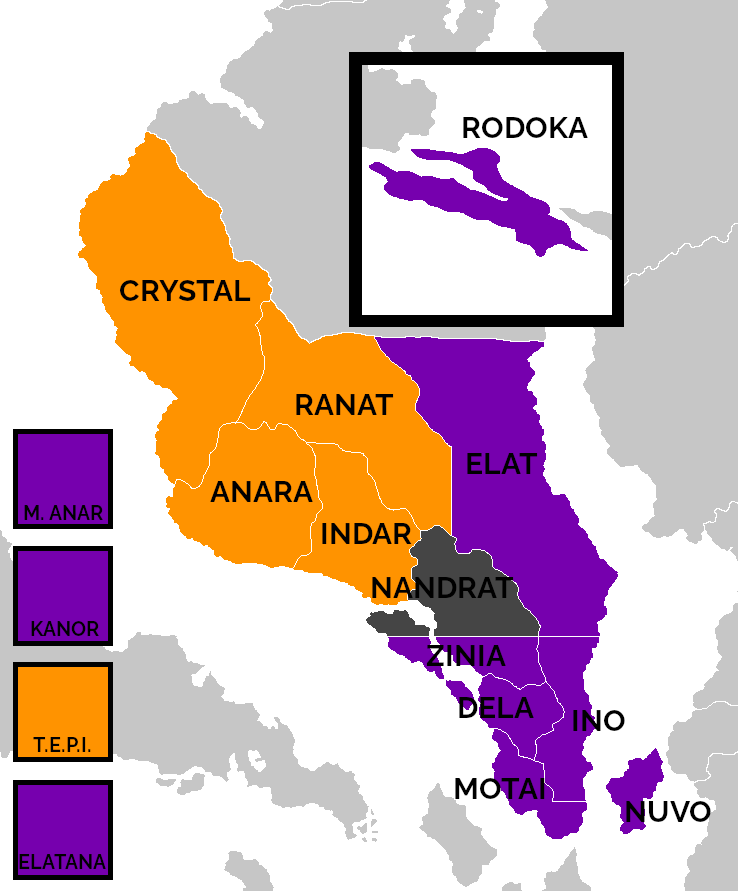
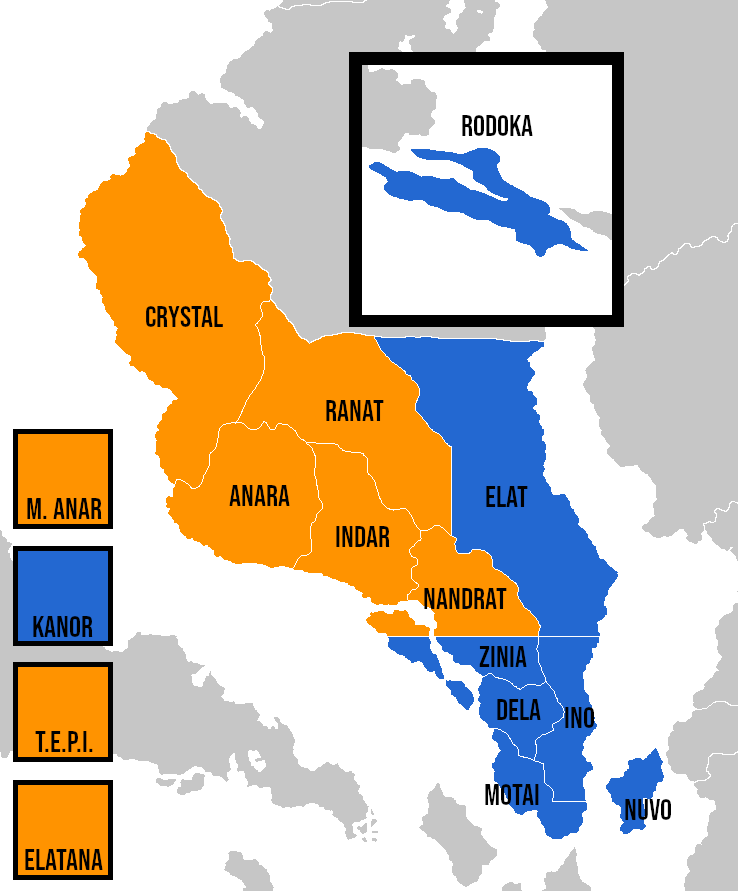
SOURCE: Tuvria Institute, TCU/Nandrat Independent poll, 14-17 Feb. Provinces in orange saw a majority in favor of a “yes” vote, while provinces in purple saw a majority in favor of “no.” Nandrat, in gray, was tied.

NANDRAT– In a recent poll conducted by the Independent in coordination with the Shano Tuvria Institute for Politics at Tavaris Central University, more questions were raised than were answered, with the vote of Nandrat Province split precisely down the middle at 50% yes to 50% no. The poll, which was conducted both over the phone and online between 14 and 17 February and released on Thursday, was the first by the Independent not to include an option for “unsure” or “don’t know,” instead asking voters to answer exactly what they will see on their ballots on the 27th, which is now less than two weeks away.

In Nandrat Province, out of 564 respondents polled, exactly 282 answered yes and 282 answered no, producing an even split that poll coordinator Dr. Vonar Ašaštra described as “pretty rare.” Noting that even a narrow margin that wasn’t evenly split could still be described as inconclusive due to the poll’s 3.7% margin of error, he said “I can’t think off the top of my head I saw a ‘tie’ result that was actually, truly tied. It’s also rare in actual votes. Tavari law states that, in the event of a tie, the winner is determined at random—but there aren’t any recorded instances of this ever happening in a referendum, and only twice for elected officials. We conducted this poll because we wanted to know which way the provinces were leaning, but in Nandrat’s case, all we can say is that we don’t know. It’s anyone’s game.”

Results were also close in other jurisdictions, with both Ranat Province and the unprovinced territory of Metrati Anar showing results within the margin of error. The nominal lead in Metrati Anar for “no” is a change from past polls, which have mostly slotted the Akronist-majority archipelago in the “yes” column. Metrati Anar, however, is known to be a relatively difficult place to poll. “Given its large proportion of military presence, its population tends to cycle quickly except in the city of Anarís, but even there, response rates have always been low. There is some truth to the anecdote that Metrati Anar operates on ‘island time’ and tends not to answer their phones particularly urgently,” said Dr. Ašaštra.

In Ranat, the least-populous of the provinces with an Akronist majority, the result was narrowly in favor of secession. Dr. Ašaštra notes that there appears to be a trend in that province away from secession, which may relate to its Goddess and Country Party (GCP) majority in government, unique among the Akronist-majority jurisdictions. “As time has gone on in this campaign, we’ve begun to see some rifts forming between the Akronist left and the Akronist right. Ranat, which tends to be dominated by rural conservatives as well as agri-business interests, is probably the least likely to agree with the solidly left-wing proposals that For Our Future: Acronis has tended to lean on.”

Voters in Ranat and elsewhere were likely not assured by Her Most Esteemed Beneficence the Matron on Wednesday when she and GCP leader Takani Võdraž publicly disagreed on the nature of Acronis’ economic system—while the Matron appeared to endorse a centrally planned economy with nationalized industry, Mr. Võdraž quipped in response “over my dead body!” For Our Future: Acronis has not yet released a formal economic plan, but says that a forthcoming “constitutional framework document” will be released that will “answer economic questions as well as all other questions regarding the institutions of Acronian governance.”

In other provinces, the results were generally unsurprising, although there continues to be uncertainty regarding how Elatana will vote. While the recent poll shows Elatana in the “no” column, it is the narrowest result outside those within the margin of error, and the territory has flip-flopped in polls from various pollsters during the campaign. Voters there may have taken a recent speech by Prime Minister Žarís Nevran Alandar to heart, when she warned that while Tavaris was willing to offer citizens political choice, Acronis offered religious dogma that could be less flexible. Her threats that things like transgender rights, abortion access, and even thje ability to get tattoos were loudly decried by the yes campaign, who called her speech “outright lies.” TCP leader Atra Metravar said on Wednesday that “Akronist commitment to ensuring access to gender-affirming healthcare has been rock solid since 1998, whereas the Democratic National Party dragged their feet on the issue until 2017.”

As the vote approaches—now just ten days away—it is becoming clear that partisanship and political uncertainty are increasing rather than decreasing. As terror attacks like the one in Nakaš on Sunday become a more regular occurrence, tensions in the country have risen to a level not seen for more than sixty years, if ever. One statistic that Dr. Ašaštra noted was the poll’s refusal rate: the number of people who declined to give an answer to the poll when asked. “More than 13% of people we contacted refused to give an answer, and while we eventually did contact enough people to make statistically significant projections, something that this tells us is that, simply put, this referendum is rapidly becoming a question people wish they didn’t have to answer.”

POLL RESULTS

Province
Yes
No
Responses

Anara
68%
32%
504

Crystal
77%
23%
569

Dela
39%
61%
411

Elat
40%
60%
399

Elatana
48%
52%
377

Indar
65%
35%
489

Ino
37%
63%
355

Isles of Kanor
19%
81%
251

Metrati Anar
49%
51%
195

Motai
41%
59%
416

Nandrat
50%
50%
564

Ranat
51%
49%
444

Rodoka
34%
66%
389

T.E.P.I.
68%
32%
108

Zinia
32%
68%
349


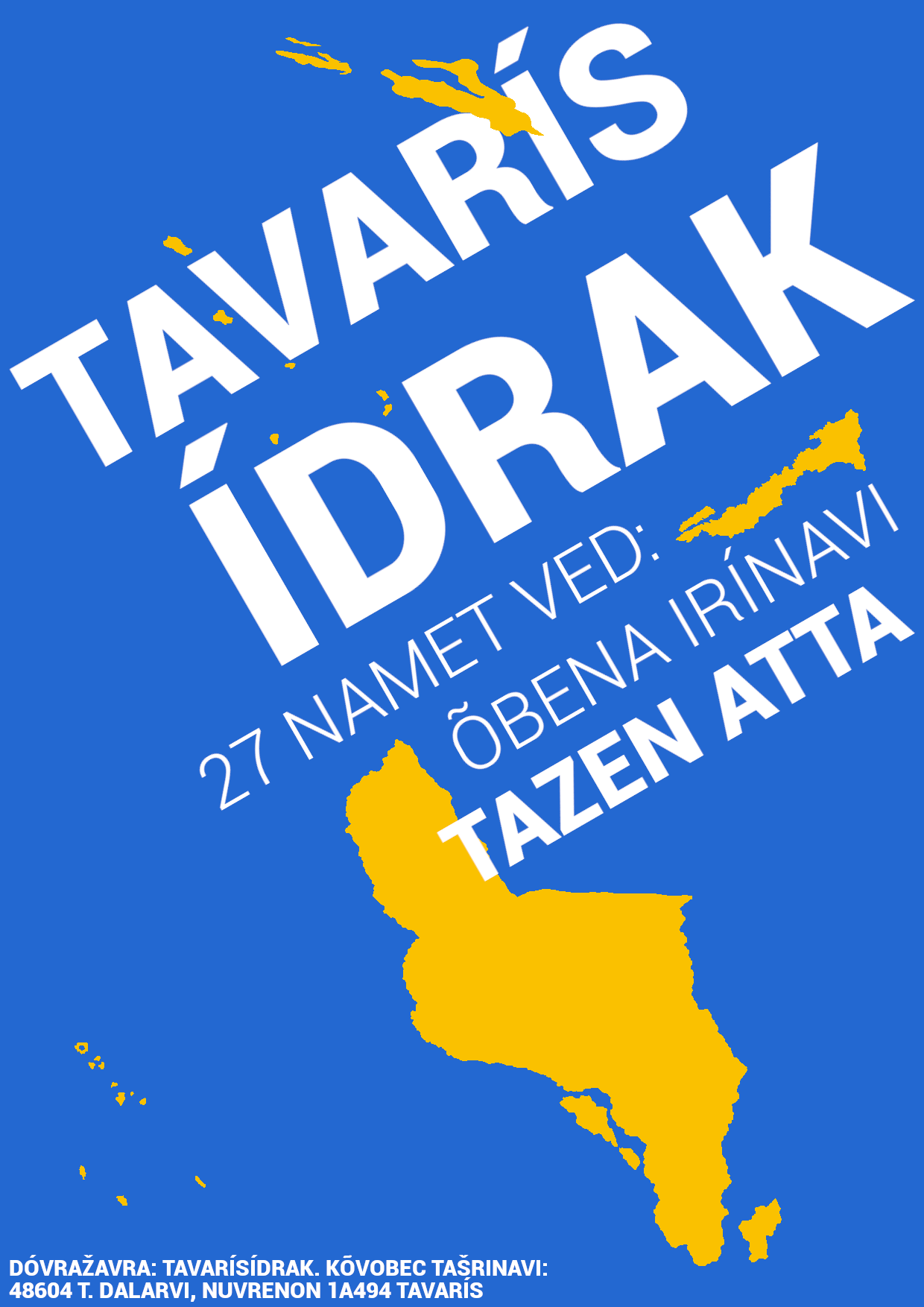
A campaign poster in favor of a “no” vote on the Acronis Independence Referendum of 27 February 2022.

Translation:

"Tavaris Together

On February 27th: Keep Our Family United

Payor: TavarisTogether. Registered Address:
48604 Dalarvi St., Nuvrenon 1A494 Tavaris"

Office of the Prime Minister
Government Center One
2 Palace Square
Nuvrenon, Tavaris

18 February 2022
6:16 AM East Tavaris Time

It was officially one year since Žarís Nevran Alandar had become Prime Minister of the Kingdom of Tavaris, but it felt like it had been at least ten. She was certain, positively certain, that the gray hairs she was now seeing in the mirror in the mornings had not been there even a month ago—and the hairs that weren’t gray were coming out of her head practically in clumps on her hairbrush. She hadn’t slept more than three hours a night in weeks and she had long since stopped noticing the fatigue behind her eyes, the ever-present dull ache in her joints, and the near-constant nausea. All of a sudden, Žarís knew exactly why, out of 64 people to hold the post, 38 Tavari Prime Ministers had died in office.

And none of them had even had a secession referendum to put up with, let alone the likes of Vana Dandreal who, despite her elven origins, was almost certainly the second coming of Matron Ilara Lendreaž, the most political political Akronist to have ever lived. Matron Ilara had presided over the burning of Rodoka, but Vana Dandreal was burning down the entire country.

Today, however—or at least for the moment—Žarís had to shove the referendum to the back half of her brain, because there were other things on the agenda. The rest of the world didn’t stop just because the Tavari government was busy, which was especially the case this week. Now, apparently, was the time that Axdel absolutely had to go and just blow up the entire Puntalia agreement, dragging the UCA and who knew who else back into what had been the closest Urth had come to global war in decades back in 2020. If the past year had felt like a decade, then 2020 could have been a century ago.

The Puntalia treaty was bullshit, of course. Tavaris hadn’t even wanted to sign it in the first place, but it was the only option at the time. They couldn’t afford to get bogged down in a war, she recalled bitterly. That was three wars ago, two of which Tavaris was still in with no end in sight for either. At least the occupation of Cavellan was drawing down and she’d soon have more room to breathe in Suvania and Ni-Rao. Even Reijia had begun to lose patience with her, with Tavari military presence in the Strait of Khaj having been at treaty minimums for well over a year. If she could go back in time and tell herself of everything that was on her plate, Žarís would have refused to believe herself. Surely things couldn’t get so bad so quickly, could they?

A single sardonic laugh escaped her mouth, momentarily snapping her out of her thoughts. “Are we still making this call to Diego Corbinn, or what?” She asked out loud in a voice far sharper than she had meant it.

“Andel says they’re running a few minutes behind,” came the response of a meek-sounding aide. “The line is ready and waiting though.”

“Thank you, Žandra,” said Žarís, trying to sound gentler.

“Er. It’s Taša,” came the even meeker response.

The Prime Minister let her head fall to her desk with a single loud thump. “I’m sorry,” she said into her desk. Someone please kill me, she thought to herself.

“Don’t worry, ma’am. It’s early.” Taša sounded genuinely apologetic, which was probably more than Žarís deserved, considering Taša had been on her communications team since 2017.

Apparently sensing an opening, Saima Viha Kerska—the Minister of Rodokan Affairs as well as Minister of the Environment—poked his head into the office. “Ma’am?”

“Saima,” said Žarís, motioning with her hand. “Come on in, I’m waiting on the President of Axdel to pick up the phone.”

“I just need a moment,” said Saima as he ducked into the office and took a seat in front of the Prime Minister’s desk. And he did indeed duck—despite being a human, Saima Viha Kerska was nearly two meters tall, and was in fact taller than Žarís, who was not a short orc. He, like Žarís, had been an athlete back in the day, though Saima’s sport of choice was basketball. Žarís was quite fond of him and hoped some day to see him run for party leader. Athletes, she felt, had a strategic way of looking at things that Žarís thought government needed more of.

“What’s up?”

“Well, I wanted to bring a few things to your attention. I spent the last few days in Sinajärv with Ivi Laar and the RNTA,” began Saima, referring to the Presiding Chief of the autonomous Rodoka Native Tribal Administration.

“How’s the lime crop doing?”

“Great, and oranges are up, too—though the Council isn’t over the Moon about the recent deal with Antora, they’re a competitor in citrus. But that’s not really what I want to talk about. Actually, I want to talk to you about the election they’re having in a few months.”

“Oh, are we due for another one? I like Ivi.”

“Me too, and she’s running again, but the gossip in Sinajärv is that Rodokan nationalism is on its way up. Papers for a ‘Sovereignty Party’ have been filed. Most folks in the RNTA are officially unaffiliated, so a new political party is raising a few eyebrows.”

“Sovereignty Party,” Žarís repeated, deciding she didn’t like the feeling of saying it out loud. “Is it… a popular idea?”

“Ivi says more than a few chiefs are talking about it a bit more than she would like. You know, the Rodokan Sovereign Wealth Fund has taken quite a hit in the recent economic downturn. A lot of folks up there are feeling a little chained down,” said Saima.

“The našdat being down makes their exports cheaper, doesn’t it? And with the rest of the island now out of the oil business, they have the oil market up north locked down. I didn’t think they were that upset.” The Prime Minister crossed her arms.

“I guess the feeling among a lot of folks up there is that they aren’t in control of their own fate, and it’s got people anxious. And, of course, they see us offering independence to Akronists. Why not them?”

“If we lose Rodoka too, I may as well just pack it up,” said Žarís, letting her head hit the desk one more time, and then another. “Spirits forgive me. What a mess this all is.” She was much more nauseous now than she could possibly hope to ignore.

“Ivi’s on our side, and so’s Jan, the Chief of Viha. And it really does help that you’ve got Jaak Vahi back on the Security Council, it really does. And like I said, so far it’s all just gossip. They don’t go to the polls for a few more months. But there’s one more thing I want to mention.”

“Well, Diego Corbinn still isn’t on the phone, so I’m all ears,” the Prime Minister answered, still feeling sick.

“Folks up north are getting a bit frustrated with Suvania. We aren’t making much progress, or at least we aren’t according to them. There’s still quite a lot of anger about the AoP up there.”

Žarís blinked. “The Native Rodokans? I didn’t… I… well, forgive me, Saima, but the AoP attacked an Akronist temple in Tavari Rodoka, I didn’t think they… well, cared.”

Saima nodded sympathetically. “You know, it took me by surprise too. But an attack on Rodoka is still an attack on Rodoka in their eyes, especially considering the RNTA doesn’t have its own military or security. If Tavaris doesn’t answer a threat in Tavari Rodoka, it doesn’t inspire much confidence in Native Rodoka. I talked to more than one chief who said they want to see a real Tavari smackdown in Suvania. They want people to know that you don’t, er, well, I was told to tell you this verbatim: you don’t fuck with Rodoka.”

“Well, we’ve got a bit more breathing room troop-wise with Cavellan drawing down,” Žarís said, yet more nauseous. “Tell the chiefs up north that we have our sights set on victory in Suvania and we aren’t backing down. If they ask about troop movements…” She sighed. “Well, tell them it’s classified for now.”

“Right,” said Saima, standing up and offering a slight bow to the Prime Minister. “I’ll get out of your hair, good luck with Corbinn.”

“Thanks, Saima,” she said, forcing a smile as he turned and left. After he was gone, Žarís allowed a moment of silence before asking “Any updates from Andel?”

“Nothing yet, ma’am,” came Taša’s reply.

Žarís sighed and stood up, hoping that doing a little bit of moving would dispel some of the nausea. The sun was coming up now and the sky had gotten appreciably brighter than it had been when she had come into the office. Her office overlooked the set of gardens that was often called “the backyard” of Government Center One, a verdant patch among a sea of concrete that reached to Government Center Two, another large office building, in the distance. It was no match for the gardens at the Royal Palace, of course, but it was pretty enough. It didn’t do much to lighten the Prime Minister’s spirits, though. She wished it would, because it wasn’t like anything else would.

She had signed up for this, of course. The moment she shook Shano Tuvria’s hand and took the Deputy PM job, she had signed up for all of this and whatever even worse the universe could throw at her. She wouldn’t have taken the job if she didn’t think she could handle being Prime Minister someday, and she would have resigned if she didn’t think she could do it now. She was long past pride or honor at this point—nothing about her mattered. Tavaris mattered. The sixty-six-and-a-half million people out there mattered. People in other places mattered too—the Puntalians suffering under a Rodenian regime, for one. The Suvanians facing a civil war, for two. The Raonites, the people in Cavellan, in Helslandr, in the former Balistria, they all mattered, and all of them were affected by things that happened in this room. Žarís knew she was capable of serving them well, but spirits above did she feel like shit doing it.

There was just the slightest hint of a morning breeze out in the backyard, with the leaves and blossoms almost imperceptibly fluttering. She ought not to take it for granted that she could have such a view outside of her office—she did, after all, live in a country that met all the qualifications of a tropical paradise, and it was the dry season to boot. Or rather, the drier season—down south didn’t have the truly distinct “dry” and “wet” seasons that they had in the west. It rained a lot in Tavaris—they didn’t call it a “rainforest” for nothing—but even then, they were warm rains, not the cold, dreary rain you got in places like Cryria.

“Oh, shit, Cryria,” Žarís said suddenly. “Taša, this is out of the blue, do you know when the last time we’ve been in touch with Cryria was? About the state visit?”

“We haven’t since, ah… since Prince Otan started picking up for…”

“Right,” said Žarís, forcing herself not to think of Otan’s father lest she feel even sicker. The Crown Prince was doing well, all things considered, standing in for the King at most public events. To everyone’s surprise, the King had even permitted Prince Otan to take his stead at the upcoming Equinox Festival—a religious rite that the staunchly observant King had once attended on the day his own mother had passed away. Prince Otan, by all accounts, was looking forward to the event, though gossip was that he was a bit heartsick lately. The Tavari Ambassador to the Global Community of Monarchies had had very little time with other royals lately, least of all the one he was due to marry.

“Well… we’ll have to soon. Make a note, would you?”

“It’s in the book, ma’am,” said Taša. “Andel says fifteen minutes for Corbinn. I have the Ambassador from Asilica out here, would you like me to send him in? Oh, hang on… he says he doesn’t want to trouble you. He says he can come back another day.”

“I will graciously accept his offer and appreciate his patience,” said Žarís, who was fairly sure the Ambassador from Asilica had only rhetorically offered to delay—she was calling his bluff anyway. She needed a little breathing room in her schedule and it was rare people offered to delay of their own accord.

“Yes, ma’am,” her aide replied. “You’ve got tomorrow after the Council of State meeting, or Monday afternoon after the call with Ayaupia.”

“Let’s shoot for Monday, I need to get with Nama about Suvania tomorrow,” she said. “Apparently,” she added with more than a shade of bitterness.

“Acknowledged,” said Taša.

Once again, there was silence. It was brighter still, and there were already a few people out walking from one building to another. Not too many, of course—most government workers were quite strict 8-to-5 folks, but the non-civil-service people were beginning to make their way in. Folks like poor Taša who directly reported to ministers, or even the ministers themselves. Žarís thought she could make out Nama Oren Kantoreš’s severely permed silver hair out there, but whoever it was was too far to be certain. The fact that she had started regularly arriving at the office before Nama was unsettling, since most people were under the impression the Minister of Defense lived in Government Center One.

In her pocket, the Prime Minister’s phone buzzed. She pulled it out—it was a text from her father. “Good morning, princess. Have a good day,” it read. It was the same text message that her father sent her every single morning when he woke up, and yet it was at that moment that Žarís Nevran Alandar burst into tears and collapsed to the floor. She stayed there, sinking into the plush purple carpet, bawling at the top of her lungs until her eyes ran dry. She pounded her fist onto the carpet a few times for good measure, and even let out a low, anguished scream before lifting her head back up. Someone tapped her shoulder and she turned to see the soldier who carried the nuclear suitcase standing above her with a box of tissues in his free hand. A touching gesture from the single-most terrifying individual in the Tavari military.

“Thank you, Major,” Žarís sniffed. She took the box and stood up, seeing no fewer than three aides now standing in her office with horrified expressions on their faces. Two of them also carried boxes of tissues in their hands.

“It’s alright, it’s alright,” Žarís said, suddenly embarrassed. “Everything’s fine. I just… yeah.”

“We all need a moment sometimes,” said Taša, who quickly returned to her post along with all the others, not a shred of judgment from any of them.

“Thank you, daddy,” Žarís texted back to her father. She didn’t usually respond—he was well aware that she didn’t even always have time to look at her personal phone, let alone text back—but today she wanted him to know that she appreciated him. He had always called her “princess,” no matter how high on the political ladder she ascended nor how many candles were on her birthday caek. Ever the student of history, her father had named her after Princess—later Queen regnant—Ažarís, the 24th monarch, who had reigned at the turn of the 17th century. She was the only one of her name, with no Tavari royal after her bearing her name, and Žarís’ father thought she ought to have a tribute. She had long gotten used to it, but somehow that small, common little token of love had simply been too much for the Prime Minister to process at that moment. Lately, Žarís hadn’t had much room for emotion at all.

At the precise moment Žarís sat back down in her chair, her phone rang. “It’s Corbinn,” said Taša from the outer office.

“Mr. President,” said Žarís without a moment’s pause, switching to her political voice without even having to think about it. “Thank you for taking my call. I want to assure you, at the very first, that Tavaris stands with you and the UCA. We will be pulling out of the treaty immediately, we’re behind you 100 percent. Oh? What’s that?” The Prime Minister paused, as Corbinn had spoken at the same time she had. “How am I doing?”

Žarís let out a single laugh, one much like the laugh that had startled her earlier that morning. “Oh, you know. Just peachy.”

Temple of the Poetic Edicts
Dõlobar Township
Nandrat Province, Tavaris

20 February 2022
5:46 AM West Tavaris Time

“Did you know we’re doing this on the Prince’s birthday?” Antovar’s voice was hushed, but serious in tone, from the back of the cluster of people currently queuing up to crawl through a basement window.

“Are you… are you fucking… what?” Evran spluttered.

“I’m just saying, he’s had kind of a raw deal through all this, y’know, and we’re supposed to be on their side, right? The royal family?”

“Ancestors above. I mean… you can fucking leave if you don’t wanna do it. Just fucking give us the gasoline in your bag.” Evran was speaking through a clenched jaw. “The Prince will be fine.”

“Would you be doing this today if the Prince were straight?”

Evran whirled around and stared Antovar in the face, his eyes wide open in pure incredulousness. “Holy shit, Antovar, I’m a nationalist, not a fucking bigot. I don’t hate people, just Akronists. Come on, man, I was the best man at Nendran’s wedding. The one where he married a man?”

“Oh. Right,” Antovar said in a quieter voice. “Look, I just-”

Evran clapped his hands on the sides of Antovar’s face and leaned in so close their noses were touching. “Antovar,” Evran said severely. “If you need to bail, you need to bail right the fuck now, because we are literally about to do it. We said we weren’t going to be like those dumb fucks in Višara. We said we were going to be smart about this. You are not being smart right now, Antovar. You’re being a fucking dumbass. Now is not the time to grow a conscience, not even about your little celebrity crush. Now, I’m going to ask you for the only time. Do you need to bail? Or are you going to shut up and do your job?”

“I’m going to shut up and do my job,” Antovar said sadly.

“Good.” Evran patted Antovar on the cheek and turned back to the window. “Does anyone else need to bail?”

The group of black-clad orcs was silent. Thankful that the idiocy had ceased, Evran crawled into the window and bade his teammates to follow. They had an important job to do today. It was long past time that the loony moony weirdos stopped being the only ones talking with bombs.

Evran and his three friends had made the trip to Nandrat from their hometown in Dela Province because they wanted their statement to have an impact where the vote was actually in doubt. If they scared even one Akronist from going to the polls, they would have succeeded—and they intended to do more than just that. They had selected their target very carefully; this particular parish was too small to justify one of the Quill mercenary security details the Church had apparently ponied up the cash for—which was horrifying and ought to have been a major news story, but the entire press was in Vana Dandreal’s pocket, of course. However, despite its small size, the Temple of the Poetic Edicts was on the national register of historic places, a list that no Akronist pile of trash deserved to sully. It had been built in 1500 and was the oldest standing Akronist temple in Nandrat. It had stood for 522 years too long, and it would be standing no longer by the end of the day.

Honestly, they were doing the historical preservation community a favor as far as Evran was concerned. The building was clearly dilapidated, or close to it. The stone facade was crumbling and weathered and the inside was even worse. The tile floor in whatever room they had just crawled into was older than his parents and was chipped and cracked even more than his grandpa’s tusks. There were old folding chairs leaning on the walls and rickety tables strewn about the room in no particular alignment. This was probably where they fed the homeless people or whatever. The room was certainly sad enough for it.

“Okay, there’s clearly a bunch of load-bearing columns in this basement, which makes our job easier. Honestly, this place would probably just collapse in on itself without us anyway. Really, we’re doing everyone involved a favor here,” said Evran. “We don’t even have to be here long, just put the backpacks down and spread a bit of gasoline. Really we don’t even need that, it’s not like the place won’t catch fire without-”

“We try to do our best to keep this old house standing,” came a quiet, trembling voice from a distant corner of the room. Evran and most of his compatriots jumped at the sudden sound.

“Oh, shit,” said Evran.

“Indeed,” replied the quivering voice. It came from the oldest orc Evran had ever seen—if he wasn’t a man he could probably have been an Elder. “It appears I picked a bad day to show up early for koki club.”

Evran made a sour face. Koki was a traditional Tavari game, played for a thousand years longer than these moon idiots had even existed. It was a game of strategy and skill, a game the greatest minds in Tavari history spent their entire lives learning. The truest koki players even made the board and the tokens themselves, carving them from boxwood and ebony with a knife and their own two hands. It was said—as an old wife’s tale, anyway—that the tendency of koki players to spend all day at their boards, chewing a particular kind of stimulant leaf that grew up in the mountains to keep alert, had ended up causing that leaf to become known as koki leaf, and eventually koka and its byproduct, cocaine. Koki was not a game for cultists to play, and the fact that people like this ancient codger were playing it on these rickety little folding tables, sitting on these dinky chairs in this dingy, decrepit basement made him sick.

“You showed up at quarter to six in the morning for koki club? What time does it start?” Dovar, from behind him, sounded just as sick, as well as more than a little suspicious.

The man was silent for a moment, but eventually broke into a gap-toothed smile. “Alright, you got me,” he said in his still-trembling voice. On closer inspection, his hands were shaking a bit, too. He probably just sounded like that all the time. “I’m here keeping an eye on things. We’ve been doing shifts. I’m the lucky one, it would seem.”

“Look, old man. Why don’t you just head on home and you can live to see the new temple they build,” said Evran. “No one needs to get hurt today.”

“I don’t think so,” the old man trembled.

Evran scoffed. “Oh, don’t be such a hero. You’re gonna lay down your life for this dump? We came here to do a job. We’re going to do it whether you’re here or not.”

“I would lay down my life for a garbage dump if it was a house of Akrona. As I am sure you would do for any shrine of the noble path of the Tavat Avati.”

“Keep that name out of your mouth,” Dovar barked.

“If our ancestors are truly watching over us, as the Tavat teaches us, then I believe mine would be proud of me. Would yours?”

“My ancestors are smiling as wide as can be, old man,” said Evran, grinning to match them. “Yours are about to see you again unless you get out of here.”

The old man held his arms out to gesture at the room. “Better not keep them waiting then, eh?”

From the back of his group, Evran could already hear Antovar wavering. “What did I say earlier? What did I say? Too late now.” Evran whirled back on his heel to point in Antovar’s direction. “Old man says let’s get it over with. It’s rude to keep an elder waiting.”

“My name is Šendral. What’s your name?”

“Žaris Nevran Alandar,” Evran quipped while looking back over his shoulder.

“Oh, then it’s quite an honor. You know, I was so sorry when your mother passed. I would have liked to have seen her as Prime Minister, but you’re doing an excellent job yourself.” The man spoke evenly and calmly, despite the tremble. It was hard to tell if he was joking or just demented.

“Oh, and you’re a DNP voter? Even worse,” said Evran as he turned back around. “Look, I’m only going to give you one more chance.”

“I’m afraid if you intend to do what you came here to do, you’re going to have to kill me.” Šendral’s voice was still even and deliberate. “It will be easy, won’t it? Just set your bags down by the load-bearing columns and crawl back out the window. Or even walk right out the front door. There aren’t any cameras.”

“Alright, fine,” said Evran, refusing to acknowledge the slight quivering in his own voice. “Boys? Let’s not keep Mr. Šendal waiting.” Evran shrugged off his backpack and held it by its top loop, staring at one of the columns rather than meet the old man’s eye.

No one moved.

“Young man, you have a very impressive tattoo on your face. Even just the parts I can see that aren’t under your mask.” Šendal was looking at him, Evran knew, but he refused to look back. That was what he was telling himself. He was refusing, not unable.

“Thanks,” Evran croaked, then cleared his throat. He willed his feet to move and then dropped his backpack down to the floor next to one of the columns, which had once been painted white but was now a dull, rusty brown with a few flecks of off-white paint on it. “Well, gentlemen?”

Still, no one moved.

“Oh, come on,” said Evran walking up to Dovar—who had previously been so ferocious—and gesturing at his backpack that was loaded with explosives.

Dovar grimaced. “I d-don’t know what to tell you, man,” he said. His voice, too, was shaking as he stood fixed in place.

“There isn’t any shame in changing your mind. I promise I won’t tell a soul that you were here. You are very brave for standing up for what you believe in, but you will be infinitely braver for having the courage to change your mind. The Tavat Avati tells us that a change of heart is the language in which the ancestors speak to us.”

“You know an awful lot about the Tavat, Mr. Šendal,” said Antovar, whose voice matched the old man’s vibrato.

“Well I don’t know if this will make you less or more angry, but as a matter of fact, I observe both traditions. There is nothing in one that requires one exclude the other. Akrona, if you like, is simply the spirit of the Moon who took up a second job.” Šendal chuckled. It was, somehow, in spite of everything, the warmest laugh Evran had ever heard.

Evran snatched the backpack out of Dovar’s hand and marched to another corner of the room, away from the old man and his stupid voice, to set it down. “Enough of this,” he said. “Nut up or shut up,” he said in Staynish, borrowing a favorite phrase from a language he otherwise tried not to use.

“You can really be both?” Antovar’s voice had somehow gotten even dumber.

“Yes,” intoned Šendal sagely.

“No!” Evran barked.

“Man, why don’t we just leave? You don’t wanna do this either.” Σendor, who had so far managed to stay quiet, finally spoke. He had not even taken off his backpack, and Evran noticed that he was now standing back next to Antovar. Dovar, too, appeared to have moved backward. “We haven’t even committed a crime yet. Well, trespassing I guess. Breaking and entering. But we didn’t even break the window. We can just leave.”

“I shan’t tell a soul I saw you,” Šendal said again. “Your ancestors will still be smiling upon you if you walk out the door. I promise they will.”

“You don’t know a single damn thing about my ancestors,” Evran said, pointing his finger now at the old man and baring his teeth. “You’re a sad, crazy old man with nowhere else to be, one foot in the grave and deciding to just roll over into it. And you’re doing it to defend the people who are tearing our country apart so they can make a twisted, Communist mockery of it and spit on all the graves of every actual Tavari person who ever lived in our West.”

“I’m not sad at all,” said Šendal plainly. He offered another toothless smile. “You know,” he said before Evran could speak again, “I’m actually planning on voting no in the referendum. If you’ll let me, that is. I am, after all, a DNP voter.” The old man winked a wrinkly eyelid over a cloudy eye.

“See? Look. Let’s just le-” Σendor began, but Evran grabbed him by the collar and shook him.

“Shut up! We’re not leaving! We’re blowing this disgusting pile of filth sky high so Akrona can get a better fucking look at it. Now take your stupid backpack off, walk it over to your favorite corner of this ugly, stupid room, and join me in walking away and having zero fucking compunction over gently nudging a practically dead man into the grave he clearly wants to be in.”

“N-No!” Σendor stood steadfast, his eyes wide. Yet another shaky voice to add to the choir of cowards. “I… I’m going home! Or I’m going… somewhere else! I’m not killing an old man. We picked an empty, tiny temple at 6 in the morning for a reason!”

“Yeah,” said Antovar, whose voice was no longer shaking. “Come on.” He shrugged his backpack back up and made a move toward the stairs, apparently ready to take up Šendal’s offer of just walking out the front door. With a stern look on his face, Dovar made to join him, while Σendor shoved at Evran to break free of his grasp.

“Don’t you fucking push me, you coward,” Evran spat, grabbing Σendor even harder. He had a head in height on Σendor and was practically lifting him off the ground. “You’re not going anywhere, and neither are-”

Suddenly, a jerk at his own collar stunned Evran into dropping Σendor and clutching at his throat—someone had just grabbed at his own collar. He turned to see it was Antovar of all people, who was already holding the backpack Evran had set down. “It’s over. Let’s just let it be over. Come on.”

“You dumb fucking quee-” Evran had pulled back his fist to punch Antovar in his stupid fucking face when Dovar swept his legs out from under him with some kind of crazy martial arts kick from Taiyō or something. Evran collapsed to the ground, smacking his head on a table leg as he fell and only barely managing to prevent himself from busting his head open on the floor by spinning over rapidly and catching his fall with his hands. His wrists hurt like hell from the force, to say nothing about the back of his head. His mask had come undone in the struggle, revealing the rest of his very identifiable facial tattoo to Šendal.

“Two people are dying today!” Evran roared as he lunged at Dovar, aiming to rip his face off with his tusks. But Antovar and Σendor simply grabbed at his arms and held him back, leaving Evran with spitting in Dovar’s face as his only option. “Idiots! Cowards! Bleeding heart, idiot cowards!” He struggled to no avail.

“Fucking yikes, dude,” said Σendor.

“Indeed,” agreed Šendal.

“I’ll show you yikes,” growled Evran. “I’ll fucking show you yikes.” With all the strength he could muster, he yanked at his arms to wrench free from his captors, determined to break free even if it meant dislocating his shoulders. All that he managed to accomplish, however, was that the cheap little prepaid cell phone he had rigged as the detonator fell from the pocket of his hooded sweatshirt down toward the floor.

“You’re fucking ki-”


SUICIDE BOMBERS TAKE OUT HISTORIC TEMPLE IN NANDRAT

DÕLOBAR TWP., Nandrat– The historic Temple of the Poetic Edicts in Dõlobar Township in southern Nandrat Province was blasted into rubble early Sunday morning in what Royal Tavari Marshalls are calling an “anti-Akronist suicide bombing.” The temple, which was on the historic register as the oldest extant Akronist temple in the province, was almost entirely unoccupied at the time of the blast except for four perpetrators, all now dead, and one parish member who Marshalls said “miraculously” survived the blast.

“At approximately 6 in the morning, local time, a bomb blast occurred at the Temple of the Poetic Edicts, which almost entirely leveled the structure. Remains of four individuals have been identified and are believed to be those of the perpetrators. There was one parish member inside the temple at the time, who it appears miraculously survived the blast after a set of several tables apparently flew up during the blast and formed a kind of shield around the parish member,” a statement from Royal Tavari Marshalls public information officer Maj. Endra Nalõvor said. Neither the perpetrators or the surviving victim were identified in the statement, but Maj. Nalõvor noted that the survivor had been airlifted to CrystalHealth Hospital in the City of Nandrat with “significant broken bones and other serious injuries,” listing the survivor in critical condition.

Officials from the Church of Akrona identified the survivor of the attack as Šendal Šonai Kobedvra, 72, of Dõlobar Twp. Priestess Dalarai Etendrí of Poetic Edits parish said Mr. Šonai Kobedvra is a lifelong member of the parish who, along with a number of other members, had volunteered to serve in “watch shifts” in the case of exactly this kind of anti-Akronist attack. “Obviously we’re in the worst time in living memory for anti-Akronist violence, and Šendal was one of our very brave volunteers who agreed to watch over the temple to try and deter people from doing exactly this. It’s heartbreaking to have lost the temple, but a building can be rebuilt, and we all care far more about Šendal, who is a tremendous treasure to the temple and the entire community. We’re praying for him and we’re so relieved that he survived this terrible attack.”

The Royal Tavari Marshalls declined to speculate on why this particular temple was targeted, but the bombers acted only days after radical Ilarist Akronist terror cell “Fist of the Moon” conducted a bombing in Nakaš last Sunday that injured 14 people, making it that province’s most severe terror attack since 1958. The Nandrat bombing is only the most recent of a spate of bombings and other terror attacks that have rocked the country since the recent movement for Akronist secession rose to prominence. A temple in Motai, Višara Province, was burned to the ground in an attack in December for which National Party leader Devran Oren Tavandra is under arrest for inciting.

“If anyone thought that this is going to scare us into silence, then they died in vain,” said Deledra Tankani, 54, of Dõlobar Twp., said. Ms. Tankani lives only two avnai down the road from the temple and says her windows and porcelain flatware trembled in the blast. “I know what my answer will be next week in the referendum, and absolutely nothing is going to stop me from getting to the polling place. I don’t care how many bombs the fascists set off. They can’t stop this movement.”

Priestess Dalarai of Poetic Edicts parish agreed. While she declined to say how she planned to vote in the referendum, she did say “We will not cower in fear, and we will not be silenced. We will make our voices heard in this referendum and take our stand in the true, peaceful, democratic way, no matter who may try to oppose us. No weapon fashioned against life shall prosper.”

“We decry this senseless act of violence and any and all acts of terrorism, which are unacceptable in every sense of the word. Regardless of whether or not the perpetrators still live, there will still be an investigation into this terrible crime in order to determine if these individuals acted in connection with any group or network of criminals as well as an investigation into how they acquired the materials for what we believe at this time to have been improvised explosive devices used in the attack,” said the Office of the Prime Minister in a written statement. “The thoughts of the Prime Minister and the entire Kingdom are with the Poetic Edicts parish community and in particular the survivor of the attack, who we hope continues to thrive and stand proudly knowing that they defended their community.”

21 February 2022


Acronis Unveiled: Constitutional Framework For Proposed New Country Released


The proposed flag of the People’s Communion of Acronis. SOURCE: For Our Future: Acronis

CRYSTAL COAST– On February 27th, voters will head to the polls to decide whether or not to join a country whose full name we now know: the People’s Communion of Acronis. In Tavari, the country will be known as Žan Drakar Acronís, using the word “žan” that is also used to mean “Line” and “clan,” defining the country as a single clan—a single family—under the goddess Akrona. Its flag will be an orange Akronist diamond, displayed whole to represent “the completed dream of the nation of Akrona,” on a field of grey meant to represent stability and to call back to the stone the First Elders used to build the very first Akronist temples more than five centuries ago.

The Constitutional Framework Document has been ratified “in principle” by the political leadership of the three Tavari provinces that have passed resolutions of intent to secede, Crystal, Anara, and Indar. According to For Our Future: Acronis, the text of the country’s actual constitution will be presented to the Legislative Councils or Assemblies of all jurisdictions who vote to secede in Sunday’s referendum. The Framework Document was released in three languages, Tavari, Staynish, and Rodokan, each clocking in at more than 10 pages with a 2 page executive summary that will be available in polling places for voters to read when casting their votes.

The Framework devotes significant attention to the process of transition from Tavari governance to Acronian governance, a process that it says will happen in phases. The People’s Communion of Acronis will legally enter into existence the moment that the results of the referendum are formally certified by the Tavari Bureau of Elections, a stance that the Tavari Ministry of Civil Law has also endorsed. However, Tavari law will still apply over Acronis until the provisional Acronian legislature—which will consist of all members of the previously-elected provincial Legislative Councils and territorial Assemblies of those jurisdictions who voted to leave—votes to “assume competency” over a sector of law or otherwise passes overriding legislation. The Framework does state that some changes will be made effective the moment Acronis begins to exist, such as an immediate ban on petroleum extraction in Acronian territories and a “moratorium” on abortion except in the cases of rape or incest or to save the life of the mother.

As expected, the Framework states that “the Acronian State and the Church of Akrona shall be synonymous and considered one single entity,” and also states that “Akronism shall be considered to be the state religion and the state’s guiding philosophy and set of ideals.” The Matron of the Church of Akrona shall be the country’s Head of State, but an elected Chief Administrator will be the country’s Head of Government. The Framework lays out a “dual government” system in which certain matters are accorded the status of “civil law” and shall be the responsibility of the Chief Administrator, Cabinet, and elected legislature, while other matters will be accorded the status of “moral law” and shall be the responsibility of the Elders and the Matron. The document makes no changes to how Elders and the Matron are elected, but does explicitly mandate that the civil government be elected by the populace of the country.

As an example of the split between civil and moral law, the Framework states that legislation regarding “crimes against people” (the document cites murder, assault, or domestic violence as examples of these) is the responsibility of the Elders, whereas “crimes against property” such as theft, embezzlement, or arson not causing injury to people would be the responsibility of the civil government of the Chief Administrator and the legislature. Elections for the true legislature, which will be called the Synod, will be held “within 120 days of the certification of the referendum results.” The Framework states explicitly that Acronis will be “a multi-party, democratic state” and also requires the legislature to be “elected through a system of geographic districts,” explicitly banning the hereditary Line-based system used by the Tavari National Diet.

The issue of socialism—which forms the most significant cleavage issue between the Akronist left and Akronist right—is also broached by the Framework, which says that “socialism will not be entrenched in the text of the Constitution itself” but will instead be a matter “for the elected civil government to decide as policy.” The Constitution will, however, contain provisions explicitly granting the Acronian government the right to nationalize industries and establish economic plans “should the government of the day choose to exercise these rights in any capacity it may see fit.” This effectively punts the ball on nationalization and other socialist goals to the new Acronian legislature in what is sure to become the country’s first major political challenge.

In matters of the military, the Framework states the defense of the country will be a civil, not moral, matter. The Chief Administrator, not the Matron, will be the Commander-in-Chief of the Armed Forces and, much like the Tavari constitution does with the King, explicitly states that the Matron “shall have no role, ceremonial or formal, in the military chain of command.” Unlike Tavaris, however, the Framework states that law enforcement and the “maintenance of general public order” shall not be military matters. Unlike the Tavari system in which soldiers of the armed forces act as police officers, a separate civilian police force is to be established in Acronis. The Acronian military is almost certain to consist of former Royal Tavari Armed Forces soldiers, of whom a significant number are expected to leave upon the inception of Acronis. Exactly how soldiers and military equipment will be transferred from Tavaris to Acronis “is a matter that will need to be negotiated between the sovereign governments of Tavaris and Acronis and cannot be dictated by the Constitution,” according to the Framework.

The Framework also deals with several various administrative minutiae, such as declaring that the Tavari Našdat will remain the currency of the country “unless and until the legislature changes this,” stating that Acronis will not attempt to claim the status of “successor state” to Tavaris and will need to re-apply to international organizations like the International Forum, stating that the People’s Communion of Acronis will assume ownership of all Silver Court-owned assets in its territory, and establishing that Acronis will assume the public debts of all jurisdictions that become a part of the country but that any public debt held by the Kingdom of Tavaris itself “will only be assumed by Acronis on negotiation with Tavaris.” Economic experts have said it is likely that Acronis will agree to assume some portion of the Tavari public debt as a payment-in-kind for receiving military assets and other publicly owned infrastructure from the Kingdom of Tavaris, like highways and railways.

One area that the Framework says very little is on the rights of non-Akronists in Acronis. The Framework states that the Constitution will establish a set of “basic, fundamental rights” that all people within the borders of the country shall be afforded, and commits the country to “respecting all principles of sapient rights.” Species-based discrimination is to be constitutionally banned “except in cases as may be necessary to address past historical inequities.” However, almost no specifics as to how an individual’s religious status will affect their relationship with the Acronian state are laid out in the Framework. In a statement, For Our Future: Acronis says that “in general, this would be a matter to be determined by legislation and policy, except in that, as the Framework already makes clear, fundamentally recognized basic sapient rights must and will always be respected.”

“We think that the proposed Constitutional Framework makes clear that a vote in favor of Acronis is a vote in favor of a more restrictive, less democratic state,” said TavarisTogether spokesperson Navadra Lendrat Kantoσar. “The document’s lack of specificity in how the country will respect basic rights is highly concerning, and it also makes quite clear that, despite the yes campaign’s claims to the contrary, the Prime Minister’s concerns about abortion access in Acronis were not misplaced.”

“In summation, the document makes a decent enough foundation for creating a country, but the biggest concern is that the Framework is not necessarily binding. It hasn’t been ratified by any legislature, only by First Councilors and other provincial-level Ministers,” said Dr. Kantra Dendoro Entavi, professor of constitutional law at Crystal Coast University. “It seems its authors wanted the document to remain under wraps until they wanted to release it, perhaps to conceal what amount of disagreement about its provisions exists among Akronist political leadership. They won’t be able to conceal that forever, though, and the Framework itself tees up a few big early battles, namely in central economic planning, nationalization, and civil rights. Above all, what voters should take out of this document is that the referendum is only the beginning of political debate in Acronis, nowhere near the end.”

26 February 2022


In Final Poll, Akronist Unity Remains Steadfast as All Akronist Jurisdictions Choose “Yes”


SOURCE: Free Press/NovaNuvar survey, 23-25 February. Orange indicates a jurisdiction with a majority choice of “yes” and blue a majority choice of “no” in the question: “Should this province (or territory) become part of an independent country called Acronis?”

CRYSTAL COAST– The Free Press’ final poll of the contentious Acronis independence referendum, released on Saturday, shows a solid wall of Akronist agreement in favor of exiting the Kingdom of Tavaris, with every Akronist-majority jurisdiction in the country preferring “yes” to “no.” The entirety of what is currently known as “Western Tavaris,” consisting of Crystal, Anara, Indar, Ranat, and Nandrat Provinces, is in the “yes” column, as are three territories: Metrati Anar, Elatana, and the Tavari East Pacific Isles. Nandrat in particular, should the survey results hold true, would be a significant win for Acronis, considering it—unlike its fellow western provinces—is home only to an Akronist plurality, not a majority.

Opponents of the referendum may find solace in these results due to the remarkably narrow margin in several jurisdictions. Nandrat was the narrowest in Saturday’s poll, with 50.2% “yes” compared to 49.8% “no.” Like the ballots voters will use in polling places tomorrow, no “unsure” or “unknown” option was presented as part of the poll. Elatana, which has resisted pollsters efforts to nail down a concrete, stable prediction, was also within a single percentage point, showing 50.4% “yes” to 49.6% “no.” Ranat, whose poll results have shown a gradual decline in support for secession, came in at 52.1% “yes” to 47.9% “no.” Metrati Anar narrowly escaped a margin of less than five percentage points, with 52.8% to 47.2% in favor of “yes.”

“It would appear that Žarís Nevran Alandar’s efforts to scare voters away from Acronis may have backfired to some extent, as we’ve seen an uptick in support in Nandrat as opposed to a decrease. Her attempt to cast the Church of Akrona as an anti-progressive institution garnered fierce pushback from the Church, who instead has made pains to remind voters that its record in social issues is actually more solid than the Prime Minister’s party,” said political analyst Vedrik Teldonaž, senior fellow at the Institute for Political Akronist Research at the University of Tovar. “Of course, that all said, these margins are narrow. No one should be discounting the likelihood of any outcome in these closely-matched jurisdictions like Nandrat and Elatana,” Mr. Teldonaž cautioned.

For Our Future: Acronis agreed with Mr. Teldonaž’s assessment. “The Prime Minister’s campaign of lies has blown up in her face. Voters in Nandrat and in every province know that the Church of Akrona is one of the most progressive religious institutions in the world. No one in Acronis is going to be banned from buying cheeseburgers or getting tattoos, but they will have a guarantee that they will have food on their tables, a roof over their heads, and a government that cares more about them than it does money or corporate interests,” said campaign spokesperson Nadra Ventovat.

TavarisTogether, on the other hand, said that nothing should be considered certain when it comes to poll results. “The only vote that actually matters is the one tomorrow, and tonight people across the country are going to go to sleep thinking about what they really, truly want for their future. We’re confident that, at the end of the day, people will vote for stability and for the assurance of democracy and empowerment rather than promises of benefits that may or may not ever materialize,” said Navadra Lendrat Kantoσar, chief spokesperson for TavarisTogether.

The campaign for Acronian independence has been the most contentious, and indeed the most violent, that Tavaris has seen for more than sixty years, with some even remarking that they feel this campaign exceeds the era of crematorium referendums in tension. Lašra Õžranat, 79, of Anara, was a teenager in the late 50s, when provinces across the country legalized (and often then re-banned and re-legalized) crematoriums in repeated contentious votes. “In those days, maybe some folks on the street got roughed up, maybe some windows broken, a few fires. That was what we faced back then. Today there are bombings. Back then, we had hooligans. Today we have terrorists. It’s very scary, and regardless of how one might feel about the referendum, it should be plain as day to everyone that this isn’t what Akrona wants.”

In another survey run by Mr. Teldonaž of the University of Tovar, more than 78% of voters nationally said that occurrences of political violence had no effect on their decision-making process in the referendum. On the contrary, 64% of people said that the violence actually affirmed their resolve to make the choice on which they had already decided. Ms. Õžranat agreed—though she declined to say what her decision was, she said “No one can scare me into doing what they want. I know what my choice will be on Sunday.”

“Acronis, should it come to pass—and I think that much is certain, even if its borders may not be—will be entering the world in an atmosphere of chaos,” said Mr. Teldonaž. “I doubt this is what the Matron and the leaders of the Communist Party wanted, with the continued bombings. And what people should really begin to consider is what is going to happen to the people of one faith who wake up on Monday in a country of a different faith. Akronists are at or near 40% of the population in every province, but it’s virtually certain that places like Nuvo and Ino will never secede. What will happen to those Akronists? What will happen to the traditionalists in Crystal? The truth is that we’re faced with what could be an entire generation of sectarian uncertainty. Tavari—and Acronians—should prepare for more contention in the future, not less.”

POLL RESULTS
Province
Yes
No
Responses

Anara
67.3%
32.7%
515

Crystal
78.1%
21.9%
622

Dela
38.4%
61.6%
498

Elat
41.3%
58.7%
506

Elatana
50.4%
49.6%
510

Indar
65.9%
34.1%
497

Ino
40.2%
59.8%
448

Isles of Kanor
19.5%
80.5%
413

Metrati Anar
52.8%
47.2%
454

Motai
41.2%
58.8%
520

Nandrat
50.2%
49.8%
586

Ranat
52.1%
47.9%
490

Rodoka
33.2%
66.8%
488

T.E.P.I.
64.9%
35.1%
238

Zinia
30.7%
69.3%
487

Prime Minister’s Official Residence
300 Zaram Avenue
Nuvrenon, Tavaris

26 February 2022
9:00 PM East Tavaris Time

Žarís Nevran Alandar stared at the clock as 8:59 became 9:00 PM in the eastern Tavaris time zone, which indicated that polls were now open in Elatana for the vote that would break apart the Kingdom of Tavaris. At the beginning of this campaign, her worst fear was probably losing Nandrat. By now, her worst fear was that the bombings wouldn’t stop no matter which provinces left.

She was seated at the desk in her bedroom, her office away from the office, in theory trying to read a set of reports out of Lower Suvania. She had read the same three lines five or six times, and eventually she closed the folder and turned away from her desk entirely. Behind her desk was a window that looked out over the street—from a safe distance, through heavily tinted glass that meant at this hour she could barely see anything at all. There were streetlights in the distance, and she could see a car or two parked out on the street, but there weren’t any people out. There didn’t tend to be people out and about on this block, what with all the security people had to get through. In truth, Žarís felt bad for the people who had to live next to the Residence. She probably didn’t make for a great neighbor.

When she looked out the window, something felt different. It was as if she didn’t recognize what she was looking at. Nuvo Province, the home of the dynasty of the same name, was obviously not going anywhere, but that hardly seemed to matter. Over the course of a few months, the entire country had changed. It felt irrevocable. It felt inevitable. Maybe it wasn’t even really a “change,” just that an accumulated layer of dust had obscured the faults that were now fully exposed for everyone to see. Wounds that had been festering for decades. Centuries. Maybe Tavaris didn’t deserve to make it out of this.

The Prime Minister shook her head to dispel the thought. A gentle hand touched her shoulder and Žarís turned to see her wife standing behind her with a warm smile on her face. “Why don’t you change into your pajamas? You’ll feel better,” Linai suggested in a quiet voice.

Žarís chuckled. “I suppose you’re right,” she said. She was still in her suit, jacket and all, and all of a sudden she was hyper-aware of how uncomfortable she was. The Prime Minister walked over to her closet and pulled out her favorite set of silk pajamas—lilac purple, patriotic without being excessive about it, and elegant to boot. They had been a gift from Linai, who knew Žarís’ secret love of creature comforts. Peeling off her suit jacket and blouse, she sighed in relief and took a moment to relish the comfort and not think about anything else. By the time she had slipped into her pajamas, she already felt so much better she could have fallen asleep standing up right there.

Linai was still standing by the window, pulling the drapes shut and putting away things like scattered pens and pieces of paper. She knew not to touch the top secret folders, which were colored in an aggressively dull charcoal gray, but she knew exactly where everything went and she had everything in order without Žarís even having to ask. Linai, in her quiet way, had a way of telling Žarís that it was time to stop working for a bit. Žarís had a habit of thinking that she was always working, because she was “always on the clock” as it were. But she was only mortal, and one of the things the Prime Minister loved most about her wife was how she found a way to remind her of that in a way that made her feel loved rather than guilty.

Žarís sat down at the edge of the bed, glancing at her work phone for the last few moments she knew Linai would let her look at it. “A few precincts in Elatana are opening late, I just want to check on it,” she gently said to her wife to stave off a dirty look.

“Tell your office to call you for anything that needs your attention and put the phone down for a moment,” Linai said in a voice that might have been described as stern.

“I’m doing it, I’m doing it,” said Žarís with a smile on her face and a pair of flying thumbs on her phone keyboard. “Linai is putting on the lid,” she texted to Taša.

“Yes ma’am :)” was the quick reply, as if Taša had been expecting it.

Žarís set her phone on the bedside table and walked away from it, instead deciding where she wanted to be was with her head nestled in the crook of Linai’s neck. Linai wrapped her arms around her wife and held her silently, swaying from side to side just slightly. Žarís had long since consigned herself to being single forever, but the first time she had gotten a hug from Linai she knew she wanted to be with her forever. She had been the chief of her security detail at the time, and it had even felt a little thrilling to be having a fling with someone under her employ, but of course Linai did the right thing and resigned. She had a much safer job now advocating for deaf and hard-of-hearing veterans, and one of the things Žarís loved the very most about Linai was that she made it feel okay to simply just… be quiet for a little while.

“I love you,” Žarís signed after pulling away for a moment. In Tavari Sign Language, it was a very simple gesture—a hand clasped over the heart and then moved outward. Her wife reciprocated, but then wrapped her arms around her again and held her for another few moments. By the time Linai finally relented, Žarís felt like she had lived in her arms her whole life. It was magical what a hug could do.

“I’m going to get us some ice cream,” Linai said. “Rodokan lime?”

Žarís grinned. From the very day she had started living in the residence, its freezer had always been stocked with Rodoka lime-flavored ice cream. There was no greater dessert on Urth—except, of course, Rodoka lime pie. “Of course,” she said. With a smile and a nod, Linai went downstairs, leaving the Prime Minister to herself.

Giving in to her love of plush comforts, Žarís let herself collapse onto the pile of pillows at the head of the bed. One day, just one day, she wished she could do all her work from her pillow pile. It was the 21st century, surely she could do anything that needed doing remotely these days. There were mornings where she practically had to be dragged out of her bed, and they had been happening more and more lately. With the pillows and the exquisite softness of her silk pajamas, though, it was hard to think of bad things. The bad things, she decided, could be safely shuffled over to the mental pile of things that didn’t need to exist, while she could safely and comfortably focus on the only things that did need to exist—her wife, her bed, her pajamas, and ice cream.

When her wife returned, though, she came accompanied. The Prime Minister blinked to make sure she was seeing what she thought she was seeing, because what it looked like was Jeila Telan Vandrovat with a bowl of ice cream in one hand and a bottle of wine in the other. But that couldn’t be true, could it?

“Don’t you dare get up,” said the Deputy Prime Minister quickly, holding out her hand with the bottle of wine in it to implore Žarís to stay in bed. “I just wanted to check in.” She paused and then nodded toward the bowl. “You don’t mind, do you?”
 
“Not at all, it’s just…”

“What, you didn’t think I ever ate anything with flavor?” Jeila arched an eyebrow for a moment but couldn’t prevent herself from breaking into a grin. “I indulge from time to time,” she said. “Why, just the other day, I let myself use a blue ink pen instead of black.”

“Jeila, I… can’t tell if you’re joking,” the Prime Minister admitted.

“Oh, just eat your ice cream,” said Jeila, still smiling. Linai, also grinning, was holding out a bowl with three generous scoops, and Žarís wasted no more time in indulging herself. Jeila set the bottle of wine down on the bedside table and winked—it was a Benesuolo red, her favorite.

“I just got back from Ranat, it was a good atmosphere, less orange this time,” said Jeila. “But I promised your wife I wouldn’t trouble you with details. Us lackeys can handle the specifics at least until the morning, I think. You deserve some rest.” In the middle of speaking, Jeila stopped to look down at her bowl of ice cream in shock. “This is absolutely delicious! My goodness, Rodokan lime flavored ice cream, I never knew! But anyway, there’s a little delay in some parts of Elatana but otherwise everything’s quiet.”

“I did see that, but there’s usually a few precincts in any given vote that start late for whatever reason. People wake up late, people forget to plug machines in, that’s normal.”

“You know, I do want to say, I know this has been exhausting, and I know we’ve got a ways to go, but I think we’re doing a good job. I think we’re doing what we can. I hope you aren’t being too hard on yourself. Any Cabinet who inherited the country at the time we did would have faced all the difficulties we did, and you should be proud. You’ve led us well, Žarís.”

Žarís stared into her bowl of ice cream for a moment. “The bomb in Nakaš really got to me,” she finally said. She hadn’t said it out loud to anyone—she hadn’t even admitted it to herself yet.

“They can’t win,” said Jeila firmly. “The terrorists, I mean. They’re lashing out because they know that ultimately, they can’t win.”

“We shouldn’t be having terrorist attacks. Countries aren’t supposed to have bombings. Tavaris is falling apart. It’s collapsing in front of us.”

“We are having a struggle for civil rights. And you know what? We made mistakes, and every past government made mistakes, and these are the consequences. We are reaping what our forebears sewed with their indifference. But it doesn’t mean the country is falling apart, it means people are angry. When you’re angry, it always feels like you’ll be angry forever. But you never are. People want answers. People are demanding change. If we give it to them, then the anger will fade. And we are, Žarís. Yes, this is a terrible, terrible moment. Yes, there are great risks that we’re facing. Yes, it’s crucial that we make the right decisions here. But there is a way out of this, and we’re on that way because of people like you.” Jeila emphasized her last word by pointing her spoon toward Žarís with raised eyebrows.

“I appreciate the vote of confidence, and I hope you don’t discount yourself in that regard. But I can’t help but think about how… I mean, we’re failing at keeping people safe. That’s probably the main duty of a government. We should be able to prevent this. We should be stopping these people before they strike.”

“We’re only seeing the ones we miss. When we prevent an attack, we don’t see anything,” Jeila said simply. “Of course, one bomb is one too many, but if you get mired in that, you’ll drown. You can’t wallow in missteps or failures. You just have to try harder the next time.” Jeila sighed. “It isn’t an easy lesson to live through learning. But if you’re spending your time beating yourself up about your mistakes, you aren’t focusing on stopping the next one.”

“I know,” said Žarís with a sigh. “I know.”

“You. Are doing. A good job.” Jeila gesticulated with her spoon severely. “And tomorrow, you’re going to wake up and continue to do a good job. And on Monday, you’re going to wake up and do a good job again, no matter what the results end up being. Because you are good at what you do. No Prime Minister can stop every crime. No Prime Minister can be everywhere at once, or have perfect intelligence of everything happening. I’m not being a yes-woman here, I’m stating facts. And if there was no hope for Tavaris, if all was lost, then no one would be voting no. If Tavaris were a lost cause, the polls would be 90 to 10 for yes. Yes votes are under-performing the Akronist population percentage in every poll in every province. That means something. It means there are Akronists who wake up, turn on the morning news, and have more faith in you than they do in Vana Dandreal.”

“Alright, alright,” Žarís relented. “I’ll admit there’s a bright side. It just feels so far away.”

“That it may be, Prime Minister, but we can reach it if we work together. And I’m with you every step of the way, all the way to the end. Especially if there’s more ice cream in it for me.” Jeila chuckled. The Prime Minister joined her, and so did Linai, the laughter slowly building until it filled the entire room. They laughed for what felt like ages, until there wasn’t a single dry eye in the room.

“I’ll get out of your hair,” said Jeila after a long, contented sigh. “Promise me you’ll try to get some sleep, and I’ll get with you tomorrow morning.”

“What I’ll promise is that this bottle of wine will be finished before the night is done,” said Žarís with a sly grin. “And I’ll see you at 6 am sharp.”

Jeila matched the Prime Minister’s grin. “You’ll see me at 5:45, because you and I both know neither of us will be able to keep ourselves out of the office tomorrow.” With a wink, Jeila departed, leaving Žarís with a peculiar, strange feeling she hadn’t recalled feeling for a while.

It was hope.

The Sacred Cloister
Temple of the Emergence
Crystal Coast, Tavaris

26 February 2022
8:00 PM West Tavaris Time

“Did you see the poll in the Free Press? Looking good. Looking real good.” Atra held a rolled-up copy of the paper in her hand, but of course there was already a copy on the Matron’s desk.

“Ah, Atra. You’re arriving just at the moment the polls are opening in Elatana,” said the Matron, who looked up from a book. She had her reading glasses on, and somehow they made her sharp blue eyes even sharper. Atra couldn’t tell what the book was, but she had never seen the Matron casually reading anything before. Always the newspaper, or some report, or a budget or something. Without offering to explain what she was reading, Vana slid a bookmark in the page and set the book on her desk. “Yes, I did see the poll. Pulling ahead in Nandrat gives me quite a bit of hope.”

“That little stunt Žarís pulled is gonna blow up in her face,” said Atra with what could only be described as mischievous glee. “We’re awfully good at blowing things up, aren’t we?”

With a single click of her tongue, Vana Dandreal deflated Atra faster than an Antoran jouster attacking a balloon. Her hand flew to her face to remove her glasses and she stared into Atra’s eyes with such a force, such a cold fury, that Atra could have almost thrown up. “Did you just… make a joke about… How dare you. How disgusting. You enjoy this, do you?”

“I… I…”

Vana rose to her full height and stared down at Atra without losing even a flicker of intensity. Her lips were a thin line and her voice was a hoarse, harsh whisper when she spoke again. “What we have permitted, what we have sanctioned, what we have encouraged, will weigh on my conscience for the rest of time. It keeps me awake at night, knowing what we have ordered people to do. Do you have any idea, any idea… Why, the absolute gall, the nerve of you to make such a crack.”

“It… I…”

“You listen here, girl. I’ll tell you again what I told you the first time, since apparently you need it repeated. What we do, these ‘special operations,’ is work to ensure the continuance of the greater community of Akronists. We answer threats to Akronism. We proactively address threats before they occur. We target people and places specifically, and we cause the minimum amount of harm to generate the effect we need. When a lithium mine threatens the whole Nandrat River, we accept the harm to a few people at a construction site, and we know that Akrona will tend to them in recompense. When a political movement threatens the safety of Akronists, we accept the harm to a few people so that it is known that we are not targets that refuse to strike back. And we remember that every life—every life—is a gift, and that every injury or loss of life is a wound to Akrona as much as it is to any mortal person. And we do not delight in wounding the Goddess. We do not make funny little wise-cracks. We do what must be done for the greater good.”

“Yes, ma’am, I-”

“Do not speak to me,” the Matron spat. “Get out of my sight. Speak to me again after you’ve said the Canticle of Apologia seventy-seven times and not one fewer.”

Silently, Atra turned and left, having been reduced from a sixty year old political tycoon to a stunned, whimpering child.

“Disgusting,” Vana said to herself one last time before sitting back down at her desk. She herself did the Canticle of Apologia at least once a day—it was a long and rambling rite full of lamentation and wallowing. It was one of her least favorite parts of the canon of Akronist liturgy, and she took great pleasure in making Atra suffer in it for such a comment.

She thought about picking up her book again, but she didn’t have the heart for it any longer. It was an old treatise on the Assumption of the Mantle, one of the more esoteric segments of Akronist belief that the Matron only indulged in when she knew there was nothing else that demanded her attention—which was, of course, almost never. All of a sudden it occurred to her just how much of a liability she had made for herself in the form of Atra Metravar and the so-called Fist of the Moon.

Had she known the Prime Minister would buckle so quickly, she never would have sanctioned the ‘special operations team’ at all. The first time she approved an attack, in the Nandrat River National Forest, it was to stand up for the last old-growth forest in Nandrat Province and to stop what was poised to be an irreversible expansion of mining in the region. She had foreseen a long, grueling battle—years and years of protracted debate and acrimony between Akronist interests and life on one side and the gruesome, never-sated greed of capital on the other. When she had decided that Acronis was necessary, she had expected to see it perhaps in a decade or two. But here it was, less than a day away.

Somehow, she didn’t feel like she was on the edge of a victory. Shouldn’t she have been excited? The polls were great, the people were excited, and they were about to be better able to do the mission of God than any Akronist had ever been. They were on the edge of eradicating homelessness, eradicating hunger, eradicating poverty. They were about to have the chance to prove to the world that governments could meet the needs of their people, and that you could put life first and still have a prosperous society. These were all the things she had decided were so important that life could be put on the line. And she was right. But somehow, when she looked back on the campaign, she couldn’t shake the feeling that it wasn’t what she had wanted. That it didn’t have to be like this.

Did they really need to injure 14 people in Nakaš, of all places? Did they really need to tacitly endorse copycat violence in Elatana just to take advantage of the political convenience it offered them? Did they really need to create an entire organization—an institution that gathered staying power with every new day the Matron let it exist—dedicated solely to, well, there was no other way to put it, terrorism? All of these things had produced gains, most certainly. They furthered the cause of Akronism and, on net, brought the world closer to Akrona. But were they necessary? What would the future look like because of these actions? What could the future look like if they had never happened?

It was pointless to prognosticate, and Vana tried to dispel the urge, but it was stubborn and lingered. Radical politics had their place, she was more than aware, but they had the tendency to be difficult to settle once awakened. Some day, the Fist of the Moon would have to stand down, and that would not be an easy day. And there was the risk, of course, that they could get arrested, and the news would come out that there had been interaction with the upper echelons of the Church. Not that Vana was unprepared for such a thing, she certainly wasn’t, but the tremendous damage to the faith people had in the Church would take a generation to heal. The greater good was not always the most visible good. People didn’t want to look farther than a few tanai in front of their own noses. They didn’t want to delay cheap gratification now for a greater, more noble gratification later. It was Vana’s job to guide them there as Matron, and the Fist of the Moon was indeed part of that. But you couldn’t fit that kind of nuance in a news clip or a newspaper article, now could you? And that meant no one would ever hear it.

It was a hard job, being Matron. It was a tremendous responsibility, and a singular one. A lonesome one. The Matron had to be the one who stood for what was right, stood for what was good, even when no one else did. The Matron had to be the one who made the hard choices, who made the choices for people when they didn’t know what was in their own best interest. She was responsible for the souls of hundreds of millions of people the world over. It wasn’t always a good time. In fact, it wasn’t even always satisfying. But someone had to do it.

Doing so while being head of state of an explicitly Akronist country would make it easier, she reminded herself to steer her mind back in the direction of optimism. It was time to end the centuries of oppression and disregard of Tavaris. The vote tomorrow was not just a secession, it was a liberation. It was a tremendous opportunity and a glorious moment. And it was essentially certain that, once the ballots were tallied, an Acronis would exist somewhere. The question, simply, was where, and that would be answered soon enough. A tremendous light was on the horizon, right within reach. She could have reached out the window and grabbed it, it was so close. A sleep or two, and then the liberation of Akronism and the dawn of the era of life. There would be guilt. There would be regret. But it had bought the most tremendous victory Akronism had ever achieved. There would still be questions for future generations to answer, but what she had done was equipped them with the best possible toolkit.

Wasn’t it?

Yes.

Yes, it was.

Doubt, Vana made herself remember, was the enemy. Doubt was not truth, it was fear. One shouldn’t be hopelessly optimistic of course, but you could not lose yourself in pessimism either. The reason Acronis was so inevitable was because Vana and her team had made it so. The decisions she had made were simply some of the same kind of hard decisions that came with the job. She was good at her job, and she had never, ever done anything without having had a reason to do it. She had always weighed the pros and cons, and she had always withheld granting permission unless she knew what she was approving was something that needed to be done. Second-guessing would get her nowhere and would help no one. Acronis was her chance to put more roofs over heads and more food in people’s bellies than had ever previously been possible. And not just her chance, either. If they played their cards right, Acronis would stand for generations. Acronis was not just her legacy. It was the inheritance, the destiny, of every Akronist.

This was far bigger than just a handful of people, Vana reminded herself. The perspective of the past few months was a poor one for considering the totality of what was about to happen. This was an unfortunate era when the Church had to dabble in politics to get work done, and politics made for messy, gruesome business. Politics sullied everything they touched, even her. Even the Church. But the Church would rise above it, the Church could heal the damage done, and because of the work Vana was doing now, the Church would be more capable of healing itself and healing society. This moment was the bottom of the climb, not the top. The rising, the building, is what came next. Building something new was not always a pretty process, and right now, Vana was down in the dirt—but she was laying the foundation. The real monument, that which would stand the test of time, was to come.

Vana decided now was the time to pick her book back up. The Goddess Akrona had existed prior to the moment she appeared before those seven women bathing in the sea. At some finite point in time, Akrona had “assumed” the “mantle” of the deity of life—the Assumption. It wasn’t clear when that finite moment in time was, and there were all kinds of theories. It was equally unclear which finite moment in time Akrona began to exist at all—Vana was fond of a theory that Akrona entered into existence when the Moon formed, but she didn’t necessarily think it was true. Regardless of when, exactly, those moments were, it was a truth of Akronism that for some amount of time, life on Urth existed in a period where Akrona was capable of protecting it, but she did not yet choose to do so. Some Akronists called this “the Flaw.” Vana was not one of them.

The so-called Flaw, Vana knew, was simply the result of a situation just like the one Vana found herself in now. Akrona, in her wisdom, had known that she could only assume her mantle, and could only emerge to the sight of sapient-kind, at the right time, and that time was not necessarily that which the people alive at any given time might find the most “convenient.” One had to make choices based on the greatest good, even if it was not the most immediate good. In much the same way that there were times a parent had to risk their child scraping a knee or bumping their head to learn a lesson, there were times when the interests of life now had to be subordinated to the interests of life in summation. One did not even have to subscribe to what was called “Ilarism” to think so. Any Akronist who ever let their child ride a bike without training wheels understood the basic principle at work.

The Matron picked her book back up and cracked it open, setting the bookmark to the side. She deliberately placed it to cover the headline of the newspaper on her desk. That wasn’t important. Akrona was important. Politics were temporary.

Acronis would be forever.


Welcome to Public Broadcasting Tavaris’ live coverage of the Acronis Independence Referendum! Follow us here for breaking news updates from across the country as Tavaris votes in what has turned out to be one of the most contentious, and in some cases violent, political issues in generations.

Our coverage begins when polls open in Elatana at 6am UTC, which is 10:00pm ETT (UTC -8:00)/9:00pm WTT (UTC -9:00), and will run for the duration of the voting and tabulation. Polls are scheduled to open at 6am and close at 8pm in their local timezone, and tabulation will begin immediately thereafter.


[26/2 9:07P WTT] BREAKING: Polls Open Late in North Elatana Autonomous Zone

AKTORÍS– Polls in Elatana were scheduled to open at 6am local time on the 27th, which is 10pm on the 26th in East Tavaris/9pm on the 26th in the West and in the East Pacific Isles. However, polling officials in the North Elatana Autonomous Zone report that their tabulation machines did not properly activate at the correct time due to a “time zone encoding error.”

“It appears that the tabulation machines sent to us were set to East Tavaris Time rather than UTC,” reported North Elatana Press Secretary Erique Kandrovar. “This is a simple error to fix, and indeed right now most precincts have already been repaired. Voting will instead take place from 7am to 9pm local time, so voters will still have a full 14 hours to make their way to the polls.”

[27/2 6:41A WTT] BREAKING: Election Officials in Ranat Report “Significant Technological Errors”

RANAT– Election coordinators in Ranat Province are reporting “significant” errors with voting equipment, with at least two indicating that the voting machines “may have not been properly formatted for the new election.” According to Kondrova Nadri Velovra, Deputy Administrator for Elections in Ranat: “it appears some voting machines cannot properly process ballots because they are expecting ballots from last year’s cannabis referendum and not the current referendum. We are leveraging all resources to get everything working properly.”

[27/2 9:13A WTT] BREAKING: Marshalls Deployed to Dravai, Motai Polling Places

DRAVAI– The Royal Tavari Marshalls report that they are deploying soldiers to various polling places “in and around the city of Dravai” as well as at least one polling location in Višara due to “possibilities of violence or intimidation at these precincts.” Dravai, unlike the rest of Motai Province, is majority Akronist. Voters are reporting having seen “menacing” and “hostile” figures dressed in purple and black at some polling locations in Dravai, according to various posts on the social networking service Pigeon. These colors are traditionally associated with Tavari nationalists and may indicate an attempt by nationalists to prevent Akronists in Dravai from voting. No such figures have been reported in Višara so far, but one voter on Pigeon reported seeing Marshalls at one polling location. A deployment in Višara had not been confirmed by the Marshalls as of press time.

[27/2 12:01P WTT] BREAKING: Polls in Elatana Close, Exit Polls “Inconclusive”

ARKTORÍS– Polls closed in the unprovinced territory of Elatana at 9:00pm local time (1pm Eastern/12pm Western) and tabulation has started. No actual election results may be released until every polling location in the country has closed, meaning it will be at least until 8pm WTT/9pm ETT that actual results will be known. However, the News has conducted an exit poll of the territory and the results are so close that they fall within the margin of error. Respondents to the exit poll, who were randomly selected from voters exiting their polling location and given the survey verbally, 48% of voters selected “yes” and 52% selected “no.” However, News reporters conducting the survey encountered a higher rate of refusal to take the survey—more than 35% of those they asked—than ever before, and the margin of error in the survey is a remarkably high 9%, meaning the true result could be anywhere between 57% of voters selecting “yes” or 39% selecting “yes.”

[27/2 1:23P WTT] BREAKING: Street Fights Break Out At Višara Polling Places

VIŠARA, Motai– Anti-secession protests became massive brawls at two polling locations in the city of Višara, the Royal Tavari Marshalls report. In both occasions, the instigators of violence are believed to be Tavari nationalists, with observers noting the presence of the three-striped Tavari Nationalist flag. “A bunch of people got off a temple bus to try and vote and the nationalists just went wild. It was terrible,” reported voter Kantakra Narai Qoσani, who along with several others watched the violence from inside the polling location—a secondary school gymnasium—after Marshalls ordered them not to exit the building. Ms. Narai Qoσani criticized the Marshalls, saying “They kind of took their sweet time responding.”

A fight was also reported inside another polling place, the Višara Youth Sports Complex, which hosted several precincts in one large building. Marshalls there reported “a brief scuffle between two groups of people that was broken up and led to several arrests.”

[27/2 2:20P WTT] BREAKING: Explosions Rock Nandrat, Fist of the Moon Claims Responsibility

NANDRAT– Three separate bomb blasts, coordinated to go off simultaneously, shook the city of Nandrat at approximately 2:14 PM local time. There have been no reports of injuries, as the bombs appear to have been set in abandoned or otherwise unpopulated areas. A statement emailed to TV from a regular Fist of the Moon contact claimed responsibility for the blasts, saying “The traditionalist trash in Nandrat should stay home if they know what’s good for them.” Several buildings in downtown Nandrat have entered into lockdown, raising concerns that this—in addition to the blasts themselves—are a tactic to inhibit voters opposed to the referendum from casting ballots.

[27/2 3:14P WTT] BREAKING: “Unprecedented” Long Lines Reported in Several Provinces

CRYSTAL COAST– Voters in several provinces are reporting significant wait times to cast their vote, with one voter in Crystal Coast saying “It’s absolutely unprecedented, I’ve never had to wait three hours to vote in my life.” Another voter at the same location said “Not even during the crematorium votes were things this bad.” TV has received reports from Crystal, Anara, Indar, Nandrat, Motai, and particularly Ranat that voting took them multiple hours. Ranat Province is worst of all, with voters reporting wait times of more than five hours in some cases. Ranat is still struggling with the technical issues reported this morning involving improperly set-up vote tabulation machines. Election officials in each of these provinces have reached out on television and online to remind voters that as long as they are in line before poll closing, they will be able to vote after poll closing time, but that voters must arrive before 8pm local time. Voters that arrive at or after 8pm will be turned away.

[27/2 3:57P WTT] BREAKING: Fourth Bomb Blast in Nandrat Injures 3, Places City on High Alert

NANDRAT– A small bomb exploded across the street from a polling place near the city’s central business district, this one inside a storefront under construction. The blast knocked down a scaffold, causing injuries to three people who had been standing nearby, per a report from the Royal Tavari Marshalls. All three victims are receiving medical treatment, and one is reported to be in “near critical” condition. “This was a very small bomb that does not appear to have been designed to cause widespread shrapnel damage. However, the collapse of the scaffold did cause significant injury to one person and less serious injuries to two others,” said the Marshalls, who have deployed additional security to the nearby polling place. As with the earlier blasts, the Fist of the Moon claimed responsibility for this explosion.