The wail cut through the morning silence of the town, instantly catching the attention of nearly everyone there. Samatar Mariam awoke with a start at the sound, at first unsure what he was hearing, but then quickly realizing what was happening as the moaning was joined by screams of anger and grief. The forty-six year old man got out of bed as quickly as he could, throwing on whatever clothes he could find, then racing out the door. He had to quickly stop back in to grab his small medical kit, telling his scrambling wife to bring the rest of his essential tools as quickly as she could get them together.
Samatar made it only a few meters out the door before realizing he would not need his kit, nor any of his other tools. He was the only doctor in 130 kilometers, and probably the best one in Eastern Oynenyua, but not even he could bring someone back from the dead. And the boy being carried into town by a growing crowd of locals was most certainly dead. The 17-year-old’s body was covered in burns, probably from an airstrike. But it was the rigor mortis – apparent even thirty yards away – that made it clear to Mariam that the kid was dead.
The rapidly growing crowd of people carrying the body were not carefully observing to determine whether the child was dead, however. They were instead wailing in grief, screaming in frustration, or, perhaps more commonly, yelling in anger. Perhaps that anger was unjustified – Samater knew, as did everyone, that the child liked to think of himself as hardcore, that he liked to hang out with the OTA militants. Samatar knew that the child might have been a militant himself. So did most of the villagers. But they did not care. They were angry. They were angry a child was dead. They were angry because another foreign oppressor had murdered one of their own. They were angry because once again they were forced to live under the rule of outsiders. But more than anything else, they were angry because they had now lost all hope of leaving behind the insurgency, and the accompanying bloodshed and poverty, of the 1960s through 1980s.
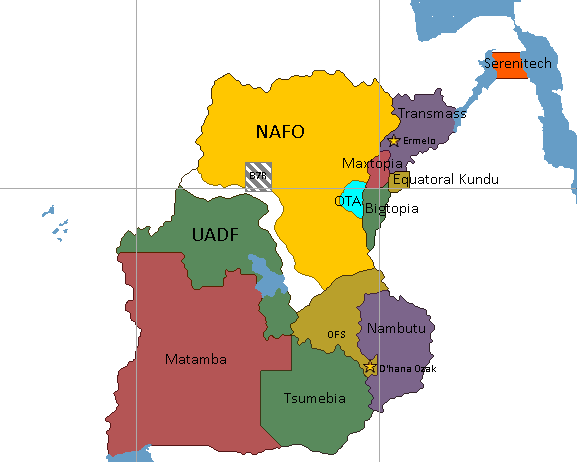
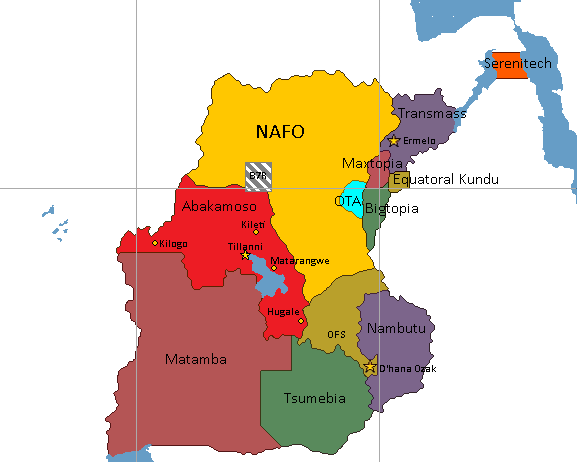
Mariam lived in only a small town, but it was larger than a foreigner might expect. Some six hundred people lived there. And most were now pouring onto the town’s main street, joining the funeral procession. They proceeded to the village’s main intersection, the place that served as its town square. In times past, the town’s leader would have met them there. But there was no leader to meet them now. Samatar had witnessed the capture of the town’s leader, the similarly named Samakab Waaberri. No one had heard from Waaberri since – ironically, the moderate that probably would have argued for peace with the NAFO had quite clearly been killed by them. The town’s other leaders had certainly been killed by them – either by Rhodesian special forces operatives before the invasion or by NAFO operatives during it. The Rhodesians had taken over what little governance there was here – but what was needed now was not a military administrator, but a local elder to calm the crowd. No such elder existed.
Samatar would later marvel at how things might have turned out differently. Had the Rhodesian-NAFO patrol come into town even half an hour later, emotions might have simmered enough for an incident to be avoided. Had the better-trained Rhodesians been leading the convoy, they might have handled the situation well enough to avoid violence. Had the NAFO commander been more patient, even he might have been able to avoid violence. And, of course, an educated person like Doctor Samatar Mariam would admit – had the NAFO commander been more human, he might have been able to avoid violence. But as it was, the convoy arrived just as emotions were running their highest, a NAFO vehicle was at the head, the NAFO officer was impatient, and the NAFO officer was a felind. And when those things came together, it spelled disaster.
It started with a sound not all that unusual – the honking of a horn. The NAFO commander did not plan to stop in this village, and indeed, did not want to stop in this village. He did not want to get bogged down – and for good reason. Getting bogged down in East Oynenyua often meant opening yourself up for an ambush. But the honking was ignored by some, and responded to angrily by others. And the escalation from there happened in what seemed like seconds. Yelling from both sides. The brandishing of a gun by one of the dismounting NAFO troops. A racial epithet towards the NAFO officer. A warning. An angry crowd advancing on the NAFO troops as the Rhodesians scrambled to get out of their vehicles, as the Rhodesian officer scrambled to get control of a situation that his NAFO counterpart had horribly bungled. A Rhodesian officer scrambling as he was pelted by rocks. And then, when one of those rocks hit one of the NAFO troops in the face, a burst of gunfire.
And then, panic.
The crowd broke up instantaneously, villagers scrambling in every direction, leaving the boy behind. The gunfire stopped almost as quickly as a Rhodesian non-com screamed for the NAFO troops to disengage. But the damage was done. What was one body moments ago was now three. But one of those bodies was still twitching. Samatar broke off at a run towards it, his wife – who doubled as his nurse – sprinting behind him. The NAFO troops raised their rifles, viewing Samatar as a threat, but the Rhodesian officer stopped them. Perhaps he recognized a medical kit. Perhaps he had done his homework and knew who Samatar was – something that would not be particularly surprising, given that Samatar was the only person with a post-graduate degree in 150 kilometers. Or perhaps he just wanted to avoid more bloodshed. Whatever the reason, the NAFO troops didn’t shoot.
Samatar reached the twitching body – a woman in her mid-thirties – at about the same time as the Rhodesian unit’s medic. Samatar’s Codexian was rusty, but the medic understood the doctor enough to follow his direction. Doctor, nurse, and medic scrambled for the next few minutes to stop the woman’s bleeding, to stabilize her, to give her plasma – something provided by the medic, of course, as Samatar’s run-down clinic had nothing of the sort. Somehow, between the three of them, they saved her. The doctor let out a sigh of relief as he realized she’d make it.
But that relief did not last long. The villagers understood the difference between the Rhodesians and the NAFO. The Rhodesians were deadlier in a firefight – but the NAFO were deadlier outside of it. And with the Rhodesians now clearly in charge, the risk of being shot had dissipated. And so, at the urging of some of the more…insurgent locals…the villagers had quickly retaken the square, reforming their mob, chanting at the convoy. As Samatar, the medic, Samatar’s wife, and a Rhodesian soldier carried the woman towards the armored vehicles, rocks began to fall again. They pelted everything – even the doctor and his patient. And these were not pebbles. Some were the size of baseballs. Some larger. The crowd was advancing quickly, blatantly ignoring the Rhodesians’ warnings. Teargas cannisters rolled into the crowd as Samatar was reminding the medic to be wary of fragment still in the woman’s leg – he’d cut himself on the loose piece of metal, and so he knew it was sharp enough to cut her femoral article. Of course, there was little the medic could do about it. She’d need surgery.
The convoy was leaving less than a minute later. It was the smart decision – a couple dozen soldiers could disperse a 300-400 person mob, but it’d take a lot of time. Time the woman didn’t have. And more than that, it’d probably mean killing more villagers. The Rhodesians were smart – they knew to pull out for now, to let emotions dampen, and then to come back in full force. The molotov cocktail that bounced off one of the armored vehicles as it drove away only confirmed the need to get out.
The crowd had dispersed by the time that greater Rhodesian force arrived several hours later. The towns-people eyed the foreigners with disdain, but kept their distance. They’d already said their peace – by attacking the convoy, and after it had left, by burning down the small government building the Rhodesians had constructed there. It was mostly just a warehouse – a warehouse holding supplies for the locals, in fact, supplies the doctor had taken advantage of on more than one occasion. But that morning, it had been nothing more than a sign of the occupation. And so, consequences be damned, the villagers had burnt it down.
And many saw it as a victory. But deep, deep down, most of them knew it was just another in a litany of defeats. The defeat of having autonomy taken away again. The defeat of having their leaders kidnapped or killed. The defeat of a foreign occupation. The defeat of the boy’s death, or of the death of the other crowd member. And more than anything else, the defeat of returning to the constant violence, tragedy, and warfare that had defined this village – and indeed, most of East Oynenyua – for decades.