
The Nuvrenon News: News from Tavaris


Tavaris Declares War on Suvanian Socialist Republic

NUVRENON-- In a tense and acrimonious debate—just the most recent in a year that seems to have been full of them—the Diet of the Kingdom of Tavaris has voted to authorize King Zaram V to declare war on the Suvanian Socialist Republic, commonly known as Upper Suvania. The final outcome of the vote was 732 Delegates in favor to 440 opposed.

“Whereas the Suvanian Socialist Republic is actively provisioning aid, comfort, succor, and support to the organization known as the Army of Progress, and whereas the Army of Progress has declared responsibility for the bombing of the East Parish Temple in Lantaž, Rodoka, which killed 38 Tavari citizens, the Diet of the Kingdom of Tavaris finds that the Suvanian Socialist Republic is an active threat to the security of the country and is therefore an enemy of the Kingdom,” said the resolution. While Tavari law does not permit the declaration of war on non-states, the resolution added that the Army of Progress itself—an international secular terrorist organization that has largely assumed control of the Tsaizal province of Lower Suvania—is also an “enemy of the Kingdom.”

In the vote, a large majority of the governing Democratic National Party voted in favor, joined by every member of Republican Alternative and the Tavari Nationalist Party, all three of which being considered to be on the right of the political spectrum. All but 8 members of the Goddess and Country Party, a party of the Akronist right, supported the measure as well, as did 43 of the 113 members of the Liberal Party. The remaining members of those parties joined the entirety of the Tavari Communist Party, Green Tavaris Party, and the Socialist Party for Democracy in voting against the resolution.

While the result of the vote is a victory for Prime Minister Žarís Nevran Alandar, the leader of the DNP, it does not come without political costs. 52 members of the DNP voted against the measure—despite the fact that the vote was not declared to be an “open vote.” This means that those 52 members are subject to removal from the DNP for disobeying the voting instructions of party leadership. While Ms. Nevran Alandar did not mention the defection in her public comments, some of the Delegates themselves have indicated they may leave the party of their own volition.

“I joined the DNP and I ran for this office because I wanted to expand the Tavari profile in world affairs through diplomacy and peace, not from the barrel of a gun,” said Del. Tovrai Anandra Kantažt, a DNP member who voted against the measure.

Criticism from the opposition was even more harsh. “In less than a year’s time, the DNP have put Tavari soldiers in four wars on four different continents,” said Del. Atra Metravar, leader of the Tavari Communist Party and Leader of the Opposition. “I speak four languages and I don’t have words in any of them for how outrageous this is. All of this is senseless, useless violence done not in the name of protecting Tavari security but for sheer, unabashed politics.”

Ms. Nevran Alandar fought back during the session perhaps more passionately—and more angrily—than she has ever been seen to speak in the Diet. “The honorable leader of the King’s most loyal opposition accuses me of playing politics while spitting on the graves of 38 dead Tavari citizens who were slaughtered en masse for the crime of being Akronist, and I, for one, am absolutely disgusted,” she said to roars of whooping applause from her party. “The honorable Delegate from Line Lanaš [referring to Ms. Metravar, who does not use her Line name] has stood here in this house and told each and every one of us that she would let the murder of Akronists go unpunished.”

Notably, the vote in the Diet split the Akronists along partisan lines, with most right-leaning Akronists in support and the Akronist left in opposition. In recent months, the trend has been for the Akronists in the Diet to largely vote together, despite their political differences. The Church of Akrona has not announced a stance on the question, stating only that “the Church deplores violence and urges all parties involved to seek a peaceful resolution wherever possible.”

Little public opinion polling has been done on the question of involvement in the war in Suvania. Known as the Third Suvani War, the conflict is primarily a civil war between two factions each claiming to be the legitimate government of the country of Lower Suvania. Upper Suvania has entered the conflict seeking to invade and conquer Lower Suvania, with assistance from the Army of Progress. Tavari involvement comes as something of a surprise to political observers; while some public figures in the Goddess and Country party had called for intervention, there had been little acknowledgement of the issue from the governing DNP until an emergency cabinet meeting called on Sunday afternoon.

“Žarís Nevran Alandar was never known to be a war hawk, but it’s worth noting that Minister of Defense Nama Oren Kantoreš, the architect of Tavari involvement in the Arkian Civil War, has become one of her most trusted advisers,” said Dr. Valdra Katani Nokoš, a professor of political science at the Royal College of Nuvo. “It can certainly be argued that her deployment of the military abroad is just another leg of her stated agenda to raise the Tavari global profile, but there is also something to be said about her declining poll numbers and the increasing sectarian tension in western Tavaris. Whichever side you fall on the question, we all know that wars are distracting.”

In Electoral Stunner, Nationalists Win Control of Motai Legislative Council

VIŠARA, Motai-- For the first time in the party’s 122-year history, the Tavari Nationalist Party (TNP) will form the government of a province, taking 27 out of 50 seats—an increase from just two seats prior—with 32% of the vote. The victory came as an absolute shock to polling firms and everyone who had paid close attention to the election, as opinion polling had indicated an average of just 12% for the Nationalists.

Motai Province is the only one of Tavaris’ twelve provinces to elect its legislature using the “first-past-the-post” system in which the winner of the seat is the candidate who receives the highest number of total votes. Unlike elections for the Diet and in every other province, voters cannot rank their choices numerically, meaning that it is possible in Motai for a candidate to win election to a seat while having fewer than 50% of total votes cast.

Because of this unique electoral system, politics in Motai have long been considered unusual—in place of the multi-party framework at the national level, since the 1961 Province Reorganization Act, Motai has been dominated by only two parties: the Socialist Party for Democracy (SPD, formerly known as the Social Democratic Party), and the Conservative Party, which no longer exists anywhere in Tavaris outside Motai Province. Motai’s two-party system has been in place for so long that national-level parties like the Democratic National Party or the Liberals haven’t run candidates there for more than a decade.

This year’s elections were made very different by the addition of just one new party: the Tavari Communist Party (TCP). The last time TCP ran candidates for the Motai Legislative Council was 1993, but as TCP has seen a groundswell of support across the country, primarily from Akronists—enough to raise them to the status of Official Opposition—they decided to once again run a slate in Motai. Notably, Motai Province is proportionally the least Akronist province in the country, with just 31% of residents professing membership in the Church of Akrona. At the time, TCP leader Atra Metravar said “We believe that we have a message that can resonate with anyone of any religion or no religion at all, and we want to give people in Motai a chance to choose us, if they so wish. A little extra choice never hurt anyone.”

TCP won no seats in the election, but appears to have taken enough votes from SPD to reduce their ability to contend with other parties. And TNP jumped at the chance to portray TCP’s entrance into the race as Akronist “encroachment,” as described by TNP’s leader in Motai, Devran Oren Tavandra, who is slated to become First Councilor. “They have come here to silence us, take away our traditions, and use as pawns and tools in their plan to break apart the greatest country on Urth,” said Mr. Oren Tavandra, a first cousin of Minister of Defense Nama Oren Kantoreš, in a speech in September.

His message appears to have resonated with voters particularly on the political right. The previously-governing Conservative Party fell from 29 seats to just six, with all 23 seats it lost going to TNP. The SPD won 17 seats, unchanged from the 2017 elections, while Republican Alternative and The Liberals both lost the one seat they each held on the Legislative Council, also to TNP.


Something New at Royal Rodokan Coffee Company: Actual Rodokan Coffee

SINÄJARV, Rodoka-- For the first time in 379 years, the https://tep.wiki/wiki/Royal_Rodokan_Coffee_Company will offer something for sale it has never sold in its entire history: Rodokan coffee. That is to say: coffee from Rodoka. If you are already asking yourself “didn’t they do that this whole time,” know that it has long been a common misconception that the popular international coffee shop chain based in Crystal Coast serves coffee grown on the island of Rodoka, but it is incorrect. “The company has its name because it brings coffee to Rodoka, or rather, that is what it was established to do in 1642,” says Levadra Tokašt, the company’s Chief Marketing Officer. “Nowadays, we sell to a lot more places than just Rodoka, but until today, the coffee had always come from central Tavaris.”

Coffee is one of Tavaris’ largest exports, and the purported superiority of Tavari coffee to that grown anywhere else has long been something of a mark of Tavari national pride, along with chocolate and rum. However, according to Royal Rodokan, it isn’t just the Ranat Plateau that grows good coffee. “The Native Rodokans started growing and brewing coffee at the same time we did, if not even earlier, and they have always made high quality, good coffee,” said Ms. Tokašt. The problem was that, until recently, it had been impossible to scale Rodokan coffee to any significant level because of the island’s very limited growing area for coffee plants. Only the higher elevation, hillier areas of the province can grow coffee “that meets premium standard,” according to Royal Rodokan.

Recent advancements in agriscience and consolidation of the formerly fragmented Rodokan coffee industry have both contributed to massive growth in the province’s coffee output. Strong financial and political support from the Rodokan Native Tribal Administration also contributed to the industry’s rapid expansion, including large investments from its Sovereign Wealth Fund. (Notably, the RNTA Sovereign Wealth Fund is the largest single shareholder of the Royal Rodokan Coffee Co.) These advances have made it possible for the company to begin sourcing coffee from Rodokan plantations—and they jumped at the opportunity to, according to Ms. Tokašt, “delight in something new.”

“I mean, my goodness, we haven’t introduced a new line of coffee since 1895. There are so many other places now to get good coffee, right here in Tavaris. And it has come time to stand up and say that Rodoka is Tavaris,” said Ms. Tokašt. “Tavaris looks different now than it did in 1642, and it’s still changing. We want to celebrate the change.”

And for those who dislike change, worry not—the company will still be offering its traditional roasts, “Classic,” “Ebony,” and “Queen Melora,” in all its stores worldwide, with all three continuing to be made from coffee grown in central Tavaris.


Cannabis Legalized in Tavaris By Fewer than 8,000 Votes

NUVRENON-- In the closest result ever recorded in the history of Tavari referendums, the Cannabis Legalization and Taxation Act of 2021 was approved by 14,941,129 voters, compared to 14,933,574 who voted to reject it. That’s 50.01% in the yes column and 49.99% in the no column, a margin of 7,555 votes—a figure representing just 0.0001% of the total Tavari population. The total turnout for the referendum was 75.83%, the highest for a national referendum since 1967.

While the results issued by the Bureau of Elections are technically unofficial, 100% of precincts have reported their results, and the numbers are unlikely to change when final certification is complete, unless either one of the registered referendum campaign organizations requests a recount. With certification scheduled to be complete by the 31st, Tavari could be toking up legally as early as November 1st. The act legalizes cannabis for both medical and recreational use by adults over the age of 18 and establishes a 17% excise tax on all recreational cannabis sales. Tavari adults will be able to legally possess up to 0.5 ívotemo (176.25 g) of cannabis—in total, including both live plants as well as flower or other prepared cannabis products—at a time, and the act calls for a national system of licensed cannabis dispensaries and “cannabis smoking lounges” to be set up by the end of 2024.

It was widely expected for the vote to be close, with opinion polls regularly within the margin of error, though most pollsters had settled around an average figure of 52-53% for yes and 47%-48% to no. The issue has been a contentious one in Tavari politics for several years, as cannabis has seen a gradual shift toward legalization worldwide, but with some particularly powerful interests in Tavari politics opposed. In particular, the Church of Akrona strongly opposes legalized cannabis, due to religious beliefs that using psychoactive substances or other narcotics weakens one’s connection to Akrona.

“As a private organization and as a member of Tavari society, the Church of Akrona strongly opposes legalized cannabis and all other efforts to increase the availability of dangerous narcotics,” said Her Beneficience Vana Dandreal, the 37th Matron of the Church, in a statement. “While the Church will continue to believe this, and will continue to advocate for cannabis to be restricted, the Church also recognizes that the democratic will of the people has been expressed and respects that legalization will be the law of the land.”

Prime Minister Žarís Nevran Alandar, who strongly campaigned in favor of the vote, said she was “incredibly pleased” to see the measure had passed. “It is long past time for the Kingdom of Tavaris to get out of the way of personal choices like whether or not to smoke cannabis, and the income this will generate, as well as the cost savings from no longer having to pursue and incarcerate cannabis users, will be so much better spent in places like education and social services, where Tavari need it most.” She was unconcerned by the particularly narrow margin of the vote, saying “People who don’t wish to smoke cannabis are not only free but welcome to continue avoiding it. Public smoking remains strictly illegal. I respect the views of those who voted against, but the good news for them is that nothing will substantially change.”

Dr. Katai Dondru, professor of political science at the University of Nuvrenon, said “there are two surprises in these results: the first being the number of Akronists voting in favor against church doctrine, and the second being the number of Native Rodokans voting in opposition.” In all but two provinces (Zinia and Rodoka), the percentage of no voters was within 5 percentage points of the percentage of Akronists in that province. Among those 10 provinces, 8 were within 3 percentage points. Crucially, however, in nearly every province, the percentage of no voters was lower than the percentage of Akronists, meaning a small margin of Akronists in each party voted in favor—just enough, apparently, to tip the scales. Notably, the numbers appear to indicate that as many as 10% of Akronists in Zinia Province voted in favor of legalization—a fact that one person on the social networking platform Pigeon ascribed to the fact that “there isn’t anything else to do in [expletive deleted] Zinia.”

“Turnout was massively high, but especially in Akronist-majority provinces. Crystal Province had 82% turnout, which is unheard of, compared to numbers in the high 60s to mid 70s for most non-Akronist majority provinces. Even so, however, Akronists make up only about 45% of the Tavari population, meaning they had very little margin to work with in terms of losing support, and it appears that mostly younger Akronists may have defied the line just enough to hamper the Church’s opposition,” said Dr. Dondru. It is likely that the margin of defeat would have been higher if not for unexpectedly high opposition from Native Rodokans, a group Dr. Dondru says pollsters have historically failed to properly reach.

“The Native Rodokan Tribal Reserve in Rodoka was previously the only place in the Kingdom where cannabis is legal, and a significant amount of tourism on the reserve is done by Tavari seeking legal cannabis. It would appear that a large number of Native Rodokans voted against the referendum in a bid to keep their exclusivity, and therefore, a significant chunk of income,” said Dr. Dondru. The province of Rodoka itself voted 34% in favor and 66% opposed—and the unprovinced territory of the Isles of Kanor, almost entirely populated by Native Rodokans, had a stunning result of just 6% in favor and 94% opposed, the largest margin ever recorded in any Tavari election dating back to 1793.

Political observers do not expect the “no” campaign—which was not officially funded by the Church of Akrona—to request a recount, as the cost of a national recount is estimated to be in the tens of millions of našdat, and the organization reported just ŋ36,208 in cash on hand as of September 30th. “It is almost certain that legal cannabis will be a reality,” said Dr. Dondru, “but given the ever-increasing religious sectarian divide in our country, I doubt it will be the last of the tension.”

TOTAL RESULTS (UNOFFICIAL)

Province
Yes Votes
Yes %
No Votes
No %

Nuvo
2,321,813
61%
1,484,438
39%

Crystal
1,044,681
28%
2,686,323
72%

Anara
1,446,984
44%
1,841,616
56%

Ino
1,578,892
62%
967,708
38%

Rodoka
1,041,050
33%
2,073,950
66%

Motai
1,552,320
70%
665,280
30%

Elat
1,089,270
63%
639,730
37%

Indar
1,042,958
46%
1,224,342
54%

Zinia
1,278,260
67%
629,591
33%

Nandrat
850,640
49%
885,360
51%

Dela
848,876
61%
542,724
39%

Ranat
321,563
49%
334,688
51%

East Pacific Isles
372,960
36%
663,040
64%

Metrati Anar
139,019
56%
109,229
44%

Isles of Kanor
11,844
6%
185,556
94%

TOTAL
14,941,129
50.01%
14,933,574
49.99%


Cabinet Approves Sale of Coast Guard Vessels to Casilló and Réal


FILE PHOTO: The Nežeren-class cutter, pictured here in a fictional livery mockup for training demonstration purposes when first delivered in 2008.

LANSAI, Elat-- The Royal Tavari Marshals will sell four Nežeren-class Coast Guard cutters to Casilló and Réal, the Prime Minister announced on Thursday in the second major sale of Tavari military equipment in Novaris this year. The cutters, manufactured by Σacani Shipworks of Lansai, are some of the most advanced in use by the Coast Guard Division of the Marshalls.

“This is, quite rare in politics, something where everybody wins,” the Prime Minister said in brief remarks held in Lansai at the headquarters of Σacani Shipworks. “Our partners in Casilló and Réal now have four extremely versatile, top-of-the-line vessels to ensure their security and safety, while we here in Tavaris realize cost savings and, at the same time, forge a new partnership with another of our Novaran colleague nations.”

Vendar Lógani Tandravar, Chairman and CEO of Σacani Shipworks, announced that his company would “be more than happy” to sell additional vessels to Casilló and Réal, should they have a need for them “now or in the future.” “We’re quite proud of the equipment we make and we love to see it in use in different places,” he said. “These ships are some of the most innovative cutters in use anywhere in the world.”

The Nežeren-class cutters are the Coast Guard Division’s newest and most advanced class of vessel, with the first being delivered to the Marshals in 2008. While the exact amount of money exchanged was not announced, the Σacani Shipworks website lists the Nežeren-class as costing, on average, more than 800 million našdat (670 million SHD) new. The Royal Marshals ordered 12 of the vessels. The Prime Minister said in her remarks that “While 12 was the appropriate number to order at that time, operational and strategic changes since then have resulted in a need for fewer cutters, enabling us to make this sale.”

The head of the Bureau of Procurement for the Royal Corric Defense Forces, Lieutenant-General Abraham Sevilla, released a statement detailing how the new cutters will be part of the Corric military’s drive to modernize to keep pace with world developments. “The vessels from our partners in Tavaris will replace the patrol ships of the Colmillo class, which at nearly sixty years old have reached the end of their projected life cycle and have become impossible to maintain without complete refit,” he said during a press conference to Corric media. “The Nežeren-class ships will allow our sailors to safeguard shipping and maritime territory much more effectively than current vessels.”

According to Coast Guard Division officials, the ships designated for sale include the first ship of the class, the Queen Nežeren, along with the Tínara I, Ažarís, and Zaram II.


Prince Otan, Prince Hendrik of the Vistara to Wed

NUVRENON-- As it has been done for more than seven centuries, a sheet of paper with edges gilt in silver was affixed to the nondescript wooden bulletin board mounted at the center of Palace Square on Thursday, but the announcement it contained was anything but ordinary: the Chief of Line Nuvo has announced the coming wedding of his son and heir, Crown Prince Otan, to Prince Hendrik of the Vistara—the first non-orc and first Ademarist to ever marry into the Tavari royal Line. Historic too is the fact that it is two princes who are to marry, a same-sex coupling that would have been illegal in Tavaris until 2009, with marriage between a same-sex couple only being formally recognized in Vistaraland in 2015. There will be many questions that need to be answered, and there will be many people who have something to say about the match, but lest you think the famously stalwart and conservative Silver Court—the body-corporate of the sovereign that manages the royal household and all public lands in Tavaris—might prevaricate in supporting ‘overly drastic’ change in the institution of the monarchy, think again.

“It is the highest honor and most esteemed pleasure of the Office of Grand Chamberlain of the Silver Court to announce the engagement of His Royal Highness the Crown Prince Capt. Otan Nuvo Šolosar, T. Van., V.E.T. (Ret.), Heir to the Chief of Nuvo, to His Most Honourable Imperial Highness, Prince of the Vistara and the Realms of the Commonwealth, Princely Lord of the Imperial Vistari Confederation Duke Hendrik Otto Pieter Hendrikzoon Molebaai, Duke of Koersland,” the letter in the Square announced. In the diplomatic language used by the Grand Chamberlain, the statement is “as ringing of an endorsement as could ever be considered possible,” according to Professor Vandrõ Šacazi Kantrovar, Chair of the Tavari Studies Faculty at the University of Nuvrenon, a long-noted scholar of the royal family.

“When then-prince Zaram married Princess Torevar in 1979, the Grand Chamberlain didn’t even mention the word ‘pleasure’ in the announcement,” said Dr. Šacazi Kantrovar. The Grand Chamberlain is the symbolic “chief of staff” in the royal household, and is also the protocol officer for the Tavari government. The office is the only Tavari government position filled by the monarch on his or her own authority, rather than by recommendation from the Prime Minister. According to Dr. Šacazi Kantrovar, King Zaram V has been noted for appointing “very conservative” individuals to the office. “Our reigning King is one who takes protocol and formal procedure very, very seriously. That we are reading a marriage announcement about the Prince and not a letter of resignation from the Grand Chamberlain speaks volumes about how much support this historic marriage has.”

This support of this union has been reiterated by those in Vierbak, with reported discussions amongst the Privy Council culminating in an open letter of congratulation and endorsement towards the couple, cosigned and unanimously supported by the members of the Council. This is expected to be followed by a similarly unambiguous endorsement by the Imperial Family. While Vistari custom demands upon their Press a certain amount of reservation in expressing dissenting opinions on matters of the Imperial Family, the general public have been, in general, supportive of the couple and their intentions. It remains to be seen, however, as to how much criticism may be levied upon this decision by the Vistari Traditionalist Right, who have made their intentions to withhold their opinions on the matter for the acceptable ‘grace period’ starting from the publicization of the betrothal. It has been of note that, as per the Restructuring of the Vistari Cabinet following the 2020 Constitution, Prince Hendrik presides over the Privy Council as its Commissioner-General, a matter which has brought questions upon the Privy Council’s ability to act as an independent body on this matter.

The union between the two princes may have implications beyond just the couple. Vistaraland’s political system is complex and its monarchy is an elective position. However, as the son of the current reigning Empress, Her Most Gracious Imperial Majesty Marium I, Empress of the Vistara*, Prince Hendrik is considered to be the most likely candidate to succeed her, arising from the prominence of the currently reigning House of Molebaai. Legally speaking, it is possible that children from this marriage could be considered heirs to both thrones at once, leading to a potential future “personal union” in which Tavaris and Vistaraland share a monarch.

In addition to the formal announcement in Palace Square, the Silver Court has released several informational statements and documents on its website, vnt.gov.ta, seeking to answer many of the questions people may have before they even ask them. Among the clarifications made, the Silver Court states that “under both Tavari and Vistari law, same-sex marriages are legally binding, and children through either adoption or surrogate may be legally adopted by same-sex couples. Under every applicable law, any children born will be legally the heir of both their parents, including in the potential succession to one or either throne.”

While no statement mentions the fact, it is also true that no child can be born with the genetic information of both parents, as orcs cannot reproduce with half-elves. Anticipating questions or concerns about the continuation of the Line, the Silver Court stated simply “Under Tavari law, it is a certainty that there will always be an heir to the throne. Whether this heir is related by genetics, by legal adoption, or by descent from another member of Line Nuvo, will be up to the Princes to decide.”

*Editor’s Note: This is an abbreviated version of Empress Marium’s title, used here for space constraints.


Crystal Province First Councillor Ousted in Surprise Late-Night Vote

CRYSTAL COAST– Ílirio Barandi, the leader of the Goddess and Country Party (GCP) in Crystal Province and leader of the provincial government, has been removed from his position in a motion of no confidence proposed by members of his own party. The vote, held at 9pm on Thursday (8pm East Tavaris Time), had been unscheduled and was only placed on the agenda by a petition signed by ¼ of the Crystal Legislative Council’s membership—a rarely used maneuver that allowed the body to meet without being called by Mr. Barandi.

GCP has had a minority government in Crystal since elections in March of 2016 and Mr. Barandi had been the longest-running leader of a minority government in Tavari history. At the time of his election, Mr. Barandi was a relatively popular moderate known for his ability to find common ground with Crystal Province’s notoriously strong leftist political bloc as well as the more conservative members of his own right-wing Akronist party. However, in recent years, his popularity had started to decline, due in large part to his vocal refusal to entertain that most controversial of political ideas in Crystal: secession. With secession becoming a majority position among Crystal voters this year, Mr. Barandi’s political capital has since become exhausted.

The most stunning political maneuver of the day—and perhaps the one most concerning for national leaders—is the lockstep cooperation observed between GCP and the provincial Official Opposition, the Tavari Communist Party (TCP). Of the 48 GCP Councillors in Crystal, 40 of them voted in favor of the motion of no confidence, joined by each of the 47 TCP Councillors, more than enough for a majority in the 108-seat chamber. The entire TCP caucus also joined those 40 GCP Councillors in replacing Mr. Barandi with another GCP member, Σavora Lašandri. Ms. Lašandri, formerly the provincial Minister of Internal Affairs and the Environment, who had been a member of Barandi’s cabinet since 2016 but, most notably, a vocal member of the party’s pro-secession faction.

Ms. Lašandri’s message to the rest of the Legislative Council was quite simple. “Given recent events, it has become abundantly clear that, while we all appreciate the skilled leadership Ílirio has shown for the past 5 years, it is no longer true that he represents what the citizens of Crystal Province want or need.” While several Councillors of both GCP and TCP rose briefly to state they supported the motion, no Councillors spoke at length—not even Mr. Barandi, despite being allotted 30 minutes of time (in addition to the customary 5 minutes granted to other Councillors to speak on motions) to speak in his own defense.

“This is a travesty and a political coup orchestrated by the likes of [national TCP leader] Atra Metravar, and nothing else,” said Mr. Barandi to the Council, while already gathering papers that were on his desk. “We all know what’s happening here, so let it come and be done with.”

While Mr. Barandi did not elaborate, it is all but certain that by “what’s happening here,” he was referring to an impending declaration of secession, which political observers on all sides of the political spectrum have said has become significantly more likely in the wake of the announcement that Crown Prince Otan will be marrying Prince Hendrik of the Vistara—an Ademarist. Political Akronists of all stripes have decried the announcement for a number of reasons. On the Akronist right, the promotion of any religion other than Akronism is an anathema, but in a surprise to many observers, the Akronist left was also outraged, though for different reasons.

“The Akronist left has, in the past, been far more accommodating of religious pluralism than the Akronist right, but with the royal marriage news, the calculus has changed. Put simply, the fact that the traditionalist-led government appears so much more willing and able to accept an Ademarist at the highest levels of the state before accepting Akronism as a co-equal religion of Tavaris has been read as a grave, grave insult,” said Dr. Katai Dondru, a professor of political science at the University of Nuvrenon who has been studying Akronist sectarianism and its relationship with the Tavari crown. “Personally, I think this is quite unexpected. The Communists are decidedly anti-monarchist and haven’t ever stated any opinion on royal marriages before, but it seems that this is the straw that broke the camel’s back.”

“I’m sure that Prince Otan and Prince Hendrik are good people, and in a non-monarchist world, I would wish them all the best in their marriage. Either way, I hope they find happiness together. But the simple fact is that the traditionalist, Tavat Avati majority in this country just threw the door wide open for a foreign religion while they still, to this day, take every measure possible to shut us out. And it’s just the latest insult on top of centuries and centuries of insults,” explained Meledra Kakaši, TCP leader in Crystal Province.

When asked if plans for a secession were in the future, Ms. Kakaši remained mum. “Something like that is up to the entire Council,” she said, though she added a warning: “If I were Žarís Nevran Alandar, I would be dropping everything and getting to Crystal Coast right about now.”


Communists, Goddess & Country Form Coalition in Crystal, Will Pursue Secession

CRYSTAL COAST– Seven hundred and seventeen years of Tavari unification are now up on the chopping block, with an unprecedented coalition between the left and right wings of political Akronists agreeing on a coalition government in Crystal Province that will begin work on a “resolution of intent to pursue secession,” according to First Councillor Σavora Lašandri.

Less than 24 hours after she assumed office after her predecessor was ousted in a surprise no-confidence vote, Lašandri has announced that her Goddess and Country Party (GCP), which holds 48 seats out of the 108-member provincial Legislative Council, will join in a “grand unity coalition” with the 47 members of the Tavari Communist Party (TCP). While 8 members of the GCP—according to Ms. Lašandri—are expected to either resign or be removed from the party for anti-secession views in the coming days, this would still leave the coalition with 88 seats, an absolutely unprecedented four-fifths majority that evidences massive political support for the cause of secession.

“The Province of Crystal will secede from the Kingdom of Tavaris within this term of the Legislative Council,” Ms. Lašandri announced in an address to the Council on a rare Saturday session. Ms. Lašandri’s term ends in approximately two years, as she is serving out the remainder of the term of her predecessor, Ílirio Barandi, who was elected in 2016. As in the National Diet, legislative terms in Crystal are legally permitted to last as long as 7 years. “In the coming days and weeks, this body will deliberate on what form this secession will take and what our government as an independent country will look like,” Lašandri said.

The move, while shocking, does not come as a surprise to many observers. Tensions between Akronists and Traditionalists have risen in Tavaris in recent years, but especially within the last year: the announcement of the Tavari nuclear program, the legalization of cannabis, and most recently the announcement of the Crown Prince’s upcoming wedding to an Ademarist are all cited as “massive blows to Akronist confidence that they could ever achieve equality in society” according to Dr. Katai Dondru, professor of political science at the University of Nuvrenon and scholar of Akronist partisanship and the Tavari crown.

In a particularly bombastic speech, newly-appointed Deputy First Councillor Meledra Kakaši of the TCP laid out her party’s reasoning for supporting secession. “They have never cared about us, they have only merely tolerated us, and even then only when convenient,” she said, with ‘they’ referring to “the Traditionalist Tavari majority,” a phrase she used in her address to the Council 17 times. “When dozens of Akronists die in a plane crash because of Vakari space debris, not only does the Tavari government fail to pursue justice, they fail to spend even a single našdat on the memorial, which was funded 100% entirely by the Church of Akrona. When dozens of Akronists die in a terrorist attack in Rodoka, the only reason the Tavari government pursued justice at all was because Žarís Nevran Alandar wanted a distraction.”

“We now live in a country that fights wars and murders people on four different continents and is clearly itching for more. We live in a country that proudly and openly maintains—and is even growing—nuclear weapons, the most toxic, most dangerous, most evil weapons ever fashioned against life. We live in a country that permits and encourages the consumption of toxic substances, while its healthcare system leaves addicts to die homeless on the streets. We live in a country that believes poor people are to blame for their own poverty and expects them to lift themselves up by the straps of sandals they don’t even have,” continued Mrs. Kakaši, who repeatedly thumped the table several times in her speech. By the end of her address, nearly the entire Council chamber was thumping along with her in agreement.

Saturday’s Legislative Council meeting took place at the same time as the regularly-scheduled weekly meeting of the Council of State. The Office of the Prime Minister reported that the Prime Minister was “not available for comment as she is currently meeting with His Majesty the King” but that her office would be commenting later on Saturday.


BREAKING NEWS: Banking on Uncertainty, Big Three Tavari Banks Announce Withdrawal Limits on Cash

NUVRENON– On the news that Crystal Province intends to secede from Tavaris by March of 2023, the three largest Tavari retail banks each separately announced a limit on daily cash withdrawals, a strong indicator that they expect the financial market to be in complete chaos when markets open for business on Monday morning. NuvoBank and ŽBMardan announced a limit of ŋ30,000 in daily withdrawals effective immediately, while AttaKõvošori announced a cap of ŋ25,000. As of market closure on 5pm Friday, these amounts were equivalent to SHD $24,060 and $20,050, respectively.

It is notably rare for banks to place limits on cash withdrawals, which is a measure banks take to prevent “bank runs,” where more people attempt to withdraw money from their accounts than the bank has on hand. It is commonplace for banks to maintain much, much less actual cash than they owe to account holders in the form of their deposits while they use the remaining funds for investments. The last time any Tavari bank announced a nationwide limit on cash withdrawals was in 1908, on the announcement of Tavari entrance into the Great War.

While these limits are unlikely to personally affect most individual Tavari account holders, the limits also apply on retail banking accounts owned by businesses. Toran Nuvo Ranzalar, owner of Ranzalar Holdings and richest person in Tavaris, said on social networking site Pigeon that “There is a tremendous, tremendous lack of confidence in the Tavari economy” and said that he was expecting Monday to be an “absolute bloodbath.” (Ranzalar Holdings owns a stake in the News’ parent company.)


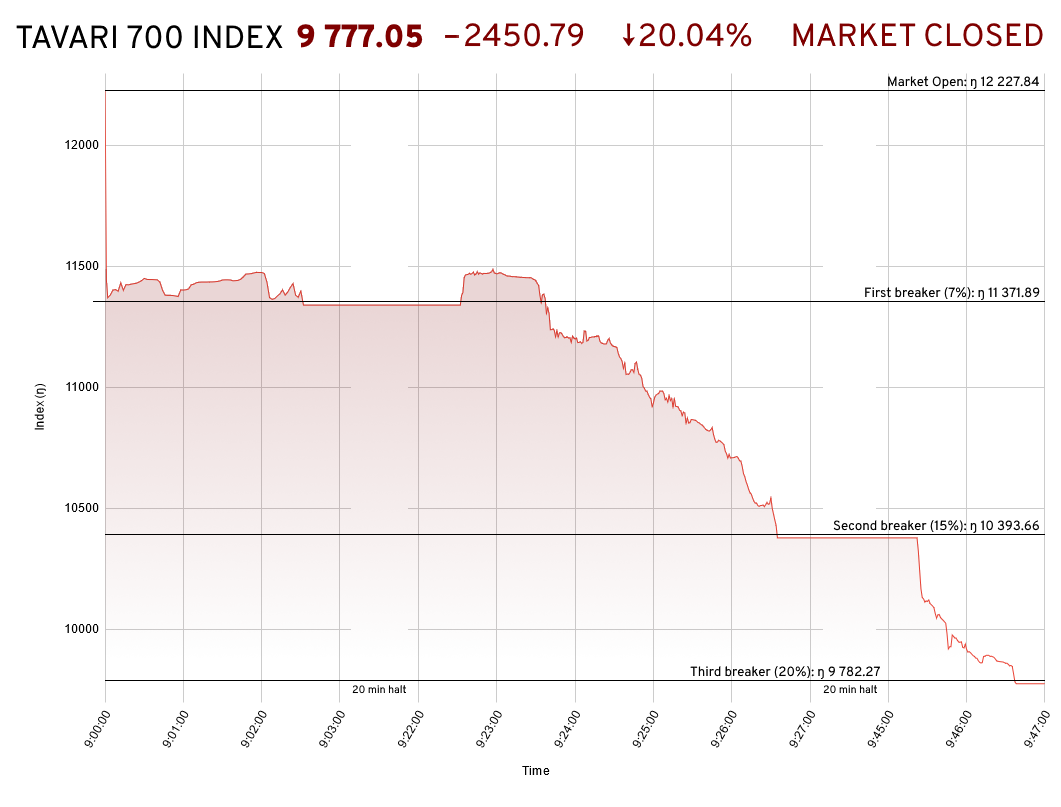
BLACK AND ORANGE MONDAY: Markets in Free-Fall on Crystal Secession Fears; Našdat Down 34%


(KYRLA ASMODEAN/The Nuvrenon News) The value of the Tavari700 index over time on Monday morning, before emergency market closure.

NUVRENON– Trading on the floor of the Nuvrenon Stock Exchange was halted within an hour of markets opening on Monday, with the news that Crystal Province intends to secede spooking investors into removing their assets from a Tavari economy that suddenly looks incredibly uncertain. At the time of the market shutdown—triggered automatically in what is known as a “circuit-breaker” designed to prevent panic selling—the Tavari700 benchmark was down by 20%.

The Nuvrenon Stock Exchange has three circuit-breakers, each of which trips when the Tavari700 benchmark reaches a particular percentage of total daily loss. The first circuit-breaker, which pauses trading for 20 minutes when the decline reaches 7%, was tripped within 3 minutes of the opening bell. After trading resumed, however, within another 3 minutes the next breaker was tripped at 15%, leading to another 20 minute pause. It took only 77 seconds after re-opening for the third and final breaker to be tripped at 20%, which caused trading to halt for the rest of the day.

The Tavari Našdat also collapsed in value on Monday within minutes of foreign exchange markets opening. The Tavari government has since the end of the Great War generally aimed to keep the value of the našdat in a narrow band between SHD $0.020 and SHD $0.022, or about 48 našdat to the dollar, and it had until now generally remained at that value consistently for the past decade. As the Tavari foreign exchange market does not have circuit-breakers in place, the našdat continues to decline, and as of press time had fallen by 34%, to $0.0155 per našdat, or about 64.32 našdat to the dollar—a figure that may decline further as the day progresses.

“The message being sent here is very, very clear. One might even say Crystal clear,” said market analyst Vatai Qovani Avrandar, principal analyst at ŽBMardan. “Investors do not like uncertainty, and the future of the Tavari economy is very, very uncertain. The result is that investors both foreign and domestic are moving their money out of the Tavari economy and into other investments that appear more stable.”

A matter of particular concern for investors, Qovani Avrandar said, was whether or not other provinces join Crystal in trying to secede from Tavaris. “Crystal Province has the most Akronists, but there are Akronist majorities in Indar, Anara, and Ranat, and Nandrat is something like 49% Akronist. The possibility of Tavaris losing the agricultural breadbasket of the Ranat Plateau, the lithium mines in Nandrat, access to the sea along western Avnatra, and even perhaps the oil fields of Metrati Anar scares investors because it effectively removes from the Tavari economy all of its current opportunities for expansion.”

The possibility of violence is also a significant concern for the economy, Qovani Avrandar said, noting that the Saturday night riot in Višara, Motai Province that burned down an Akronist temple was “in addition to being abhorrent and reprehensible, [it was] bad optics that make investors think even the Tavari government itself might not make it out of this crisis. And it is the full faith and credit of the Tavari government that backs the Našdat and, ultimately, the entire economy.”

The collapse of the stock market will have a rippling effect across the entire economy as things tied to the market such as retirement savings, pensions, and personal and business investments lose value as well. As part of Monday morning’s sell-off, the Rodoka Native Tribal Administration Sovereign Wealth Fund divested its entire share of Kataza, Inc—the mining firm that won the rights to mine the Nandrat Lode of valuable lithium—at a loss of 15%. (The owner of Kataza, Ranzalar Holdings, also owns shares of the News’ parent company.)

“We’re going to see some panicky days ahead,” said Toran Nuvo Ranzalar, CEO of Kataza and Ranazlar Holdings. “In the immediate future, there will be a credit crunch and it will become harder for businesses like mine to get loans from banks, which prevents businesses from expanding.” Nuvo Ranzalar’s advice to small business owners and investors is to “stay as calm as possible.” “Now is actually a great time to buy stocks, since their costs are now relatively low. And if you can, ride things out as long as you can. Once we know more about the political future of Western Tavaris, it is likely that markets will climb back up again.”

Prime Minister Žarís Nevran Alandar, in brief remarks to the press as she entered the Diet building for Monday’s session, said that the public should have hope. “I understand now is certainly a very uncertain time, even chaotic. But the fundamentals of the Tavari economy are actually stronger than ever, and we are more than capable of bouncing back. I expect there to be a peaceful resolution to our political situation, and with our plan to Invest in the West, ultimately I expect the Tavari economy to come out of this better than ever.”

1 Like


Motai First Councillor, Seven Others Arrested, Charged In Motai Temple Fire

MOTAI, Višara– Devran Oren Tavandra, the newly-elected First Councillor of Motai Province, has been arrested and charged with incitement of a terrorist act, the Royal Tavari Marshals Bureau of Investigation and Security (BIS) announced in a press conference on Monday. Mr. Oren Tavandra, 47, is leader of the Tavari National Party and the first member of that party to ever serve as a First Councillor anywhere in the country. In addition, BIS announced the arrest of seven people alleged to have committed the act itself, all of whom are being charged with committing an act of terrorism.

Of the seven alleged conspirators, three of them are under the age of 18 and therefore, under Tavari law, will not have their names publicly released. The named individuals charged are Nõvor Nuvo Tacandri, 19; Vandrik Movri Talavor, 18; Žavani Išdašt Kovai, 18; and Evenor Vidas Tanidri, 18. In addition to committing an act of terrorism, all are being charged with committing a religiously-motivated hate crime, and three of the conspirators—Mr. Nuvo Tacandri, Mr. Išdašt Kovai, and one of the underaged defendants—are being charged with committing a crime using a dangerous or volatile chemical substance. Per the BIS, the substance in question is gasoline used to start the fire that burned down the Višara Parish Temple on December 4th.

“This was a deeply evil act of hatred and terror, and we will act with the full force of the law to bring the perpetrators of the crime to justice,” said Major Σovacra Novra Tandatti, public information officer for the BIS Motai Branch Office, in announcing the arrests. “No one is above the law, including—and especially—elected public officials, in whom the public had placed their trust.”

Mr. Oren Tavandra was giving a speech to an assembled crowd of protestors in downtown Višara, the capital city of Motai, when the crowd turned violent and forcefully entered the temple, which was empty at the time. According to charging documents filed in Motai Province Circuit Court, Mr. Oren Tavandra is alleged to have “actively incited violent actions through deliberately chosen, inflammatory words that constituted a call to action.” Among the particular statements deemed to be “calls to action” were such statements as “we must take our country back from them [Akronists],” “we will not tolerate them,” and “resist, they will never be Tavari.” Mr. Oren Tavandra has been released on a one million našdat bond but has been ordered to surrender his passport and not leave Motai Province.

The Motai First Councillor has vigorously denied committing any crime, and emphasized that he neither encouraged a crime to occur nor even knew one was occurring—through a spokesperson, he stated that he could not see the front of the crowd from his vantage point. “The First Councillor deplores violence and deeply condemns the terrible events that occurred on the 4th, but he had nothing to do with what seven children at least a block away from him, across a dense crowd of thousands of people, were doing.” His statement defended his words on the 4th as protected speech under Article One of the Instruments of Governance and said “while people may politically disagree with [the speech], it was simply a statement of political opinion and at no time could have constituted a ‘call to action’ to commit a crime.”

The Tavari National Party in Motai released a short statement indicating that it “fully supports” its leader and “has no intention of removing the First Councillor from his duly-elected office unless and until he is convicted of a crime.” In the meantime, the party’s Deputy Leader in Motai, Navra Telan Vantavi, will assume the role of Acting First Councillor.

Of the seven conspirators, the adults are being held at the Southern Motai Justice Center without bond, while the minors are being held at the Višara municipal juvenile corrections facility. While the minor defendants must be accorded access to the juvenile justice system until a judge rules that they can be tried as adults, BIS indicated at the address that they intend to request that they be so tried. Under legal reforms in the Juvenile Justice Act of 2007, the number of crimes eligible to be elevated into the adult legal system was drastically reduced, though acts of terrorism and hate crimes were specifically exempted. At press time, no information on legal representation for the seven conspirators was on file at the Motai Circuit Court.

The arrests are the first announced actions of the Office of Anti-Religious Crime, whose existence was announced to the public by Prime Minister Žarís Nevran Alandar in a speech that was held at the same time the act of terrorism in Višara was being committed. The office, which has been in place for “a few weeks” per spokesperson Novra Tandatti, has been funded through emergency budget reallocations under the Prime Minister’s authority and will be “further expanded” in the next budget.

“Tavaris does not now and will not ever tolerate these disgusting acts of hatred,” said Mrs. Nevran Alandar in a written statement. “These arrests make the community safer, and we will proceed to prosecute these individuals to the full extent of the law through a fair trial as all defendants are entitled.”


ExtAff Minister Caught On Hot Mic Disparaging Corric Monarch’s Comments on Helslandr

CRYSTAL COAST– External Affairs Minister Endra Tivriš Žovradai was at Crystal Coast University on Thursday to speak to students about the Alliance of Northwest Gondwana and Tavari regional diplomacy, but it was comments he made before his scheduled speech that generated the most discussion. For a period of several minutes while apparently unknowing that his mic was live, the chief Tavari diplomat and former Prime Minister discussed the recent matter of King Sebastian II of Casillo and Real issuing a condemnation of the UCA for its military intervention in Helslandr—and his words were not kind.

“King Sebastian doesn’t know what he’s talking about. He’s full of crap,” said Mr. Tivriš Žovradai, apparently speaking to professor Σaqa Novandri Kanatar, Dean of the College of Arts and Letters at Crystal Coast University. Dr. Novandri Kanatar was Deputy Minister of External Affairs for Mr. Tivriš Žovradai during his second term as Prime Minister from 2007 to 2011. Dr. Novandri Kanatar could be heard making sounds of agreement but otherwise did not speak or interrupt the ExtAff Minister.

King Sebastian issued a formal condemnation of Norgsveldet in particular and all UCA members who agreed to send troops to Helslandr in general, which includes Tavaris. Prime Minister Žarís Nevran Alandar announced last week that 2,000 members of the Army Reserve based on Elatana would be sent to Helslandr to participate in the UCA military operation. King Sebastian said in his condemnation “the Constitutional Corric Kingdom condemns wholeheartedly the militarist and imperialist interventionism of the Union of Commonwealth Alliances and their controlling state the Imperial Realm of Norgsveldet. The decision to send hundreds of thousands to troops abroad to fight in the Helslandr Civil War is blatantly neo-colonialist and cannot be ignored.”

“Once again, like in Rodenia, we have someone b----ing about the UCA doing what it was designed to do, which is answer the call when a member-state has been brutally attacked! Puntalia gets invaded and overthrown and the Morst b----ed. Helslandr blows up a town in Pledonia and kills hundreds of people and here comes the King Sebastian to b---- about something that doesn’t even remotely concern him,” said Mr. Tivriš Žovradai, who is ordinarily known for a rather stoic and dispassionate public persona.

The ExtAff Minister seemed to take particular umbrage with King’s comments about colonialism. “You attack a UCA member-state, you attack all of them. Why is this so hard to understand for people? It isn’t neo-colonialism or whatever the hell he said to answer to a direct violent threat. As if we’d send two thousand Tavari souls to Helslandr to give Norgsveldet a new colony. I mean, it’s absolutely outrageous. It’s downright insulting! I mean that. I’m insulted. Spirits help this man and his country if someone ever attacks them, because clearly King Knickers-in-a-Bunch isn’t going to do anything, apparently.”

In his statement of condemnation, King Sebastian stated that Casillo and Real would effectively “freeze relations” with countries who contributed troops to the UCA military operation, disallowing any new political or economic arrangements except agreements related to ending the military intervention. He cited a constitutional requirement in Corric law enshrining non-interventionism as a priority of the state. Mr. Tivriš Žovradai characterized this as “his own personal problem” and said “If Casillo and Real doesn’t want to get involved in Helslandr, they don’t have to. No one asked them. Meanwhile, over here in the real world, Tavaris stands up for its allies and meets its international obligations.” In response to the freeze of relations, Mr. Tivriš Žovradai said “if they want to close their embassy and wait for us to come and capitulate to them, they can sit there and rot. Sebastian II doesn’t control Tavari foreign policy. How dare he think he can.”

Eventually, Mr. Tivriš Žovradai came out to present his speech, which he did without issue and without mentioning King Sebastian II or Casillo and Real. It was only in a pre-scheduled question-and-answer session that he learned that the assembled students had been able to hear him. Upon learning this, the ExtAff Minister replied “Well, it’s been nice having a job. I guess I’ll be retiring here pretty shortly.” While he said he would give no further comment on the matter, he clarified that his statements “represented [his] own personal opinion and absolutely should not be considered the official position of the Kingdom of Tavaris.”

Prime Minister Žarís Nevran Alandar echoed that last sentiment, stating “Endra’s comments were personal opinions given under the presumption that they were private. They do not reflect anything about our relations with Casillo and Real, with whom we were and are quite pleased to have recently expanded relations. Our official stance on this matter will be presented by myself directly to the Corric ambassador in the coming days, and as you can imagine, we will be sure to not make further public comment so that we can speak frankly with them.” Mrs. Nevran Alandar declined to make further comment on Tavari-Corric relations and also declined to answer questions about whether or not she would ask for Mr. Tivriš Žovradai’s resignation.


Cryrian State Visit Postponed Due to “Current Shift in Political Focus”

NUVRENON– Queen Ulrika II of Cryria will no longer be visiting Tavaris in March, the Ministry of External Affairs announced on Monday, with her visit postponed to a “currently undetermined date” expected to be in the second half of 2022. ExtAff Minister Endra Tivriš Žovradai announced in a press conference Monday that he, the Prime Minister, and representatives of the government of Cryria, had come to the “joint agreement” that the visit needed to be postponed due to the Tavari government’s “need to focus on domestic issues rather than international ones at the current moment in time,” Mr. Tivriš Žovradai said.

“The simple fact of the matter is that, in light of the Prime Minister’s ‘Invest in the West’ plan and the need to have significant resources in place to focus on working with representatives of Crystal Province and others in western Tavaris in regard to several very large items of planned legislation and constitutional reforms, it would no longer be prudent to place those on pause for the significant logistical and political work of coordinating a state visit,” he said, adding “Nor would it be fair to the Queen of Cryria to have her visit—a very important one that we sincerely look forward to having later this year—overshadowed by other issues.”

According to Mr. Tivriš Žovradai, the Cryrian state visit is an important one for Tavaris as part of its plan to further expand partnerships on the continent of Novaris. He also noted that Cryria and Tavaris—especially Rodoka—have a shared maritime heritage that is planned to be a significant focus of the visit. “We want to be able to give all of these concerns the time they deserve, which is why, ultimately, we have decided to postpone the visit.”

“The postponement of Her Majesty’s visit is an unfortunate but understandable decision,” a Cryrian Foreign Ministry statement read, “We will continue to pursue bilateral ties through regular channels and wish our Tavari counterparts good fortune in the New Year.”

Several Cryrian environmental groups also expressed disappointment at the cancellation, as there had been hopes that the two traditional whaling countries would promote improved regulations surrounding such activities, particularly in light of the Cryrian Monarch’s own support for tightened restrictions.

The postponement is a major setback in Prime Minister Žarís Nevran Alandar’s agenda. The former International Trade and Development Minister had pledged to make expanding foreign partnerships a hallmark of her time in office, extending on the work her predecessor and mentor, Shano Tuvria, had done in forming the Alliance of Northwest Gondwana. The Office of the Prime Minister had no additional comment on the matter of the Cryrian state visit, but the postponement is likely to be seen as a major sign that confidence in the ability of the Tavari government is shaking both inside and outside Tavaris. The Tavari700 index, which had been trending positive Monday since market open, moved slightly into the red on the news, down half a percentage point as of press time.


Shano Tuvria Dead at 60

RATANI, Nandrat Province– Shano Tuvria, former Prime Minister of Tavaris and Secretary-General of the International Forum, has died due to complications caused by gastric cancer, his family reported late Monday evening. Mr. Tuvria had been in a coma since October and facing “tough odds” in reawakening according to his doctors at Ratani Regional Cancer Center. “With great sadness, we report today that Shano Tuvria, who was our beloved husband, son, brother, uncle, and friend, passed away due to his struggle with cancer on Monday evening,” the report said. Mr. Tuvria leaves behind a wife, Linda Šonai Tuvria, his mother Našana Tuvria, siblings Kevrak Šonai Caσano, Evenentra Tabõnar, and several nieces and nephews. He was predeceased by his father, Caσani Šonai Tuvria, and a son, also named Caσani. He was just over a month shy of his 61st birthday. The family has stated that Mr. Tuvria requested to have a private burial without a funeral service.

Mr. Tuvria’s family described his battle with cancer as “sudden, brutal, and swift.” His diagnosis in July of 2021 abruptly ended his political career, which at that time had been ascendant as he occupied the office of International Forum Secretary-General at a time when the Forum’s relevance in international politics was stronger than ever. In announcing his diagnosis, he declined to run for re-election after a six-month term that was one of the most eventful in years. Taking over from the fraught Johanna Hirov in one of the strangest I.F. elections in history, he was the only candidate to run after every other candidate either dropped out or, in the case of former Asilican President Mario Huber, died. Mr. Tuvria was the first ever Tavari to lead the International Forum.

The International Forum achieved global notoriety—some would say infamy—during his term due to crises such as heightened tensions from Packilvania after that country, the world’s largest by population, was denied entry. “There will be no peace on this planet,” a diplomatic communique sent to Mr. Tuvria after the vote famously said. While Mr. Tuvria said upon his election he had taken the job out of “a dedication to peace,” the Forum saw more violence and more acrimony in the Spring 2021 session than perhaps any other, a trend started with the assassination of Balistrian ambassadors under his predecessor in 2020 but continued with various incidents of physical violence among ambassadors. Additionally, I.F. efforts to investigate Kyrloth and to end a Kurikian blockade of Nystatiszna were roundly ignored by the relevant countries. However, Mr. Tuvria had said he was “quite proud” of passed legislation such as a nuclear non-proliferation treaty, a global health organization, a global cultural preservation organization, and a treaty designating species-based apartheid as a crime against sapient-kind.

He will be remembered in Tavaris for his time as the 63rd Prime Minister, in a four year term that saw the Kingdom look outward in ways it had not in decades. Casting off the final dregs of post-Great War isolationism, Mr. Tuvria led the way in establishing the Alliance of Northwest Gondwana, an economic and political bloc with a common market, open borders, and even a space program. He also conducted outreach, less successful, with a bold attempt to join the League of Novaris as a full member state—a request that was soundly denied, but followed with observership. He negotiated a detente with the Federation of Bana that, briefly, saw the warmest relations the two countries had had in more than a century, before political unrest from opponents of the thaw domestically and anger from Bana at the announcement of a nuclear weapons program brought the resumption of the cold shoulder. That said, Tavaris still maintains official relations with the Federation and has exchanged full ambassadors, something that had never occurred in history.

Šano Šonai Tuvria was born on February 19th, 1961 in Ratani, a city in far south-eastern Nandrat that saw very little attention before its native son became Prime Minister. His family was of mixed religions, with his mother a devout Akronist and his father a traditionalist. Each of the three children of Našana and Caσani Tuvria ended up following a different spiritual path. His brother Kevrak is a traditionalist, his sister Evenentra an Akronist, but Mr. Tuvria—the eldest child—followed “both traditions and none,” as he once explained to a child who had asked him the question while on a school trip to the capital.

Šano married Linda Išdašt Kolotra in 1984, a niece of then-Prime Minister Bežra Išdašt Tovrenar who he credited with introducing him to politics. He was elected Delegate of Line Šonai to the Diet in 1994 and served until his resignation in February of 2021, one of that Line’s longest-ever serving delegates. Mr. Tuvria is credited with “opening the door to a whole new wave of younger politicians,” according to University of Nakaš Professor and Chair of the Faculty of History, Dr. Daronal Nevran Alandar, who had the chance to get to know Mr. Tuvria personally. “When [Mr. Tuvria] was elected Delegate at the tender age of 34, that was a practically a coup at the time.” He was the youngest member of the Diet, a famously elderly-leaning body, by 12 years. Since then, the average age of Tavari politicians has decreased by ten years, from 56 in 1994 to 46 in 2020.

In addition to his blood family, he leaves behind his close friend and former Deputy Prime Minister, Žarís Nevran Alandar, who has credited Mr. Tuvria as “my most important mentor.” It was Mrs. Nevran Alandar who inherited, literally within her first days in office, high-stakes negotiations with Meagharia that threatened the stability of an already unstable West Novaris, who picked up and pulled through a controversial legalization of cannabis that Mr. Tuvria had first proposed, and who vowed to continue the plan of expanding Tavari relations internationally.

“Speaking both personally and as a representative of the entire Tavari government, I am deeply, tremendously saddened to learn of the passing of our former Prime Minister and former I.F. Secretary-General Shano Tuvria, who was a dear friend to me, a strong and principled leader of our country, and the most prominent Tavari citizen on the world stage in a generation,” said the Prime Minister in a statement. She ordered all Tavari flags to half-mast for a seven day period of national mourning and is almost certain in the coming days to posthumously name Mr. Tuvria a Knight of the Amethyst Order, the country’s highest honor, according to unnamed sources in the Office of the Prime Minister.

Though he was not a member, Matron Vana Dandreal of the Church of Akrona also released a statement upon the news, lauding Mr. Tuvria as “perhaps the most friendly Prime Minister to Akronists that this country has ever seen.” Noting his mixed-religious background, Her Most Esteemed Beneficience said “Shano Tuvria brought an Akronist grace as well as a traditionalist Tavari steel nerve to the highest office of Tavaris. His perspective has been and will forever be sorely missed.” She cited a quote of his, one of his most famous, which he gave to the same schoolchild who asked him what religion he was: “In Tavaris, we have two native traditions of religion, and often people talk about how and why they are different. But I think it is important to think not of how they are different, but how they—and we—are the same. Akronists and traditionalists all want to wake up every morning, provide a good life for their families and themselves, do good things, and be good people. More than a traditionalist or an Akronist, what I want to be, and what I hope my legacy will be, is simply a good person.”


“YOU HAVE FAILED US AND WE ARE DONE:” MATRON ENDORSES AKRONIST SECESSION

NUVRENON– In a furious speech likely to be remembered for the ages, Matron Vana Dandreal announced on Tuesday evening that the Church of Akrona will politically support the effort by Crystal Province to secede from the Kingdom of Tavaris, as well as “any further province, community, or person who seeks to do the same in the name of Akronism.” The speech took place in the middle of regular monthly worship at the New National Parish Temple, where for the first time ever, His Majesty the King and the Prime Minister were in attendance. External Affairs Minister and former Prime Minister Endra Tivriš Žovradai was also present.

Early in the service, King Zaram V committed an exceedingly rare and exceedingly severe gaffe by arguing with the presiding priestess, Kalvra Σentorek, who is High Priestess of Nuvo Province and a highly-regarded figure in the Church seen as one of the leading contenders to be the next Matron, should a vacancy occur. High Priestess Σentorek gave brief remarks in honor of the recently deceased former Prime Minister Shano Tuvria, in which she said Mr. Tuvria’s spirit “had found peace with the Goddess.” The King apparently took umbrage to this statement and said “No it isn’t! He wasn’t an Akronist!” Mr. Tuvria was raised in a mixed-religion family and said in the past he followed “both traditions and none.” At this, the Prime Minister, seated next to him, clasped her hand to her face, to which the King responded by saying “They can’t say that, they can’t claim him like that!” and pointing at the direction of the High Priestess.

The outbursts rendered the room silent and gave the religious leaders—all seven Elders were in attendance—pause. While the regular homily proceeded without comment, and there was even a light-hearted moment as Her Most Esteemed Beneficence the Matron complimented Mr. Tivriš Žovradai on his singing voice, the Matron took the podium just before the benediction that would have concluded the service to “expand on” the High Priestess’ homily after seeing “confused faces” in the room. The High Priestess had spoken on the topics of the new year, renewal, and change. Among the things she said was “From time to time, a people will face a moment that will either make or break their future,” which the Matron repeated in her own remarks.

In increasingly severe tones as time went on, the Matron explained that while the Church had been apolitical in the past, it “could no longer remain silent.” She cited the sacred Akronist text known as the Sacred Mandate, in which the Goddess Akrona is said to have spoken to the First Elders and “all the people of [their] nation.” While since the inception of the Church, this had been interpreted to be the nation of Tavaris, the Matron announced a new Edict—a binding declaration of Akronist religious belief—that re-interpreted this to refer not to Tavaris but to the nation of “people who choose to follow the First Elders,” or otherwise put, the nation of Akronists. She then said that it was the doctrine of the Church that that nation, which she called “Acronis,” should become “a sovereign nation-state.”

The Matron did not spare words for the King, who she said “disrespected [Akronists] in our own house” despite “never inviting us to his.” “I hope you know, King Zaram, that it was your mouth that broke your Kingdom,” said the Matron. While she did thank the King and the Prime Ministers for coming, she then told them that they were no longer welcome in the temple and ordered them to leave. “You have failed us and we are done with you and your country,” said the Matron to the Tavari leadership as they were ushered from the room.

Dr. Katai Dondru, professor of political science and scholar of the Tavari monarchy as well as Akronist-Traditionalist relations at the University of Nuvrenon, said the Matron’s overturning of a doctrine held by the First Elders was “completely unprecedented. It has never happened before in the history of the Church. Her framing of the Akronist secession as part of Akronist religious doctrine and not simply a matter of politics changes everything, because now faithful Akronists are either obligated to follow the doctrine or risk losing their good standing as members of the Church.” Dr. Dondru added that the announcement “was predicted by many, but certainly not in this manner,” noting that “the absolutely uncharacteristic outbursts from the King are a severe, severe error that will truly generate a great deal of bad faith from Akronists. It isn’t unusual for Akronists to speak of any departed person, regardless of their faith, as knowing Akrona in death. It’s more a statement to comfort themselves than it is a statement to or about Shano Tuvria, who did identify to some degree with Akronism, and to interrupt the High Priestess with all seven Elders present is simply put, immeasurably rude.”

Neither the Silver Court nor the Office of the Prime Minister responded to requests for comment. One high level source in the Cabinet Office said that an emergency session was expected to be called late Tuesday evening or early Wednesday morning to discuss “damage control” and that it was almost certain that the King would be “sidelined as much as possible in the near future.” Another unnamed source, kept anonymous because they were unauthorized to comment publicly, said that “this is an unmitigated disaster that has knocked every bit of wind out of the sails the PM had been hoping to ride out of the crisis.”

At just before 7:30 (West Tavaris Time), just before this article went to press, the First Councillor of Indar Province, Vekra Oσandrõ of the Tavari Communist Party, announced her intention to “begin the process of crafting a resolution of intent to secede on the model of Crystal Province” on social networking site Pigeon. Ms. Oσandrõ commands a slim majority in the 88-member Indar Legislative Council, but if she is able to secure the support of the Goddess and Country Party as did the TCP in Crystal, the combined parties would have a majority of more than two-thirds. “I don’t really see any way back from this point,” said Ms. Oσandrõ in a text message. “All they had to do was sit pretty at a Temple meeting and smile and nod. If they won’t bother doing even that, why should we bother with them?”


Church of Akrona Coordinating “Massive Aid Effort” In Vesienväl

ETALÄÄN, Vesienväl– The Church of Akrona announced on Friday that it is undertaking what it called a “massive aid effort” in the region of Järvi, Vesienväl to address the nuclear accident there, referring it to “the crisis of our generation.” Her Esteemed Beneficence Larja Niemi, the High Priestess of the Church of Akrona in Vesienväl, held a press conference in Etalään, the nearest major city to the region, that notably did not include any government officials from the socialist country, which has been notably recalcitrant to release information about the event.

“We are called to do all we can to help those in need, and there can be no greater need than this,” said High Priestess Niemi, who said that she had been in close contact with Matron Vana Dandreal in the preceding days and that “all available resources of the Church are being leveraged.” The Church is providing busses and other transportation for use in assisting the evacuation of the Järvi metropolitan area, which is home to nearly 900,000 people, as well as opening the doors of its many hotels across the country, run by the Church-owned, for-profit company Crystal Hoteliers International, to evacuees. The High Priestess said she was “unable to say” how many people were being evacuated from the region and to what other regions, saying that “that information will be communicated by the government.” In addition to aid in evacuation, the Church is working with medical professionals under its own employ as well as from other countries and non-profit organizations to establish triage facilities in Järvi and assist local hospital staff.

The Presidium of Vesienväl issued a statement that said it was “working with the Church of Akrona as a long-established partner,” noting the Church’s assistance after their country’s civil war from 1948 until 1951. “The Church is acting under our direction and working alongside officials and teams from the Workers’ Federation as well as some teams of consultants from other countries. All efforts to address the situation in Järvi are operating smoothly and swiftly,” the statement said, but did not provide any details on what those efforts were. Officials from the Vesienvällic Ministry of Foreign Affairs and the Federation Defense Committee deferred to the Presidium’s statement when asked for comment.

Nuclear safety experts have cast doubts on the Vesienvällic government’s claims that the accident was “minor,” as was reported in Vesienvällic state media on Wednesday, the night of the event. “Very minor but still noticeable changes in background levels of radiation were detectable even hours after the event, indicating a significant release of radiation, which has only been further proven with later measurements,” said Professor Arisztid Csonka of Dropdatderp University in Mexregiona, who raised an early alarm about the disaster after making contact with an individual in Järvi through social media. “Since Wednesday, significant upticks in radiation have been noted across Novaris. In Polgarimagna, Mexregiona’s only nuclear plant experienced a radiation alarm on Thursday evening that they determined had been caused by external, not internal, radiation.” While the levels of radiation being experienced outside the country are “minimal, and not cause for panic in most sectors of the population,” she said that Mexregional government officials were distributing iodine tablets “out of an abundance of caution.”

The true concern, said Dr. Csonka, is of the people in Vesienväl, who are facing radiation levels “thousands of times higher” than elsewhere. While she said that it was most likely that most of the radiation had already peaked and is now declining, she said that if the worst possible event, a total meltdown, had occurred, “it is likely that hundreds of thousands of people will experience radiation poisoning, many of them at a level that could be fatal in days or weeks.” When asked for an estimate of possible deaths, Dr. Csonka said “without knowing the real condition of the reactor, it is impossible to make a true estimate. But by all accounts this was a severe disaster, with reports of helicopters falling from the sky an hour after the event, which to me is a stark sign of severe, severe radiation interfering with electronics or perhaps even affecting the body of the pilot that quickly.” After taking several moments to collect herself, Dr. Csonka said “When all is said and done, I would not be surprised to see a death count in the hundreds of thousands, with countless more experiencing short-term and long-term damage from radiation.” She also noted that, unable to reach the contact she had made on social media, “it’s quite likely that he has already died.”

Individuals who are interested in assisting the Church of Akrona relief effort can make donations through a Church-run website, ves-aid.com, or by calling (555) 2020 7575 (inside Tavaris) or +42 906 3419 8682 (outside Tavaris).


Anara and Indar Provinces Resolve to Secede as Referendum Legislation Passes

ANARA, Anara– The final vote in the Anara Province Legislative Council on Saturday was 65 in favor of secession and 55 opposed, one more demonstration of stunning crossbench cooperation that saw government and opposition come together. As with Indar Province on Friday, where the Legislative Council in Tovar voted 61 to 27, the Tavari Communist Party (TCP)—which forms the government in both provinces—joined forces with the right-wing Goddess and Country Party (GCP) to bring the secession resolution across the finish line. Both modeled after last month’s Resolution of Intent to Secede by Crystal Province, the two votes this week bring the number of western Tavari provinces intending to leave the Kingdom to 3 out of five. All eyes now will be on Ranat, the country’s agricultural breadbasket, governed by the TCP, and Nandrat—the industrial outlier with a Democratic National Party (DNP) government that, unlike its fellow western provinces, does not have an Akronist majority population.

Also on Saturday, His Majesty King Zaram V granted Royal Assent to the Independence Referendum Act of 2022 at the regular meeting of the Council of State that was so heavily attended by members of the media it had to be moved from its normal meeting place in the Royal Study to the much larger Queen Melora Dining Hall. Normally, meetings of the Council of State are sparsely attended by press, often only by a single reporter from the wire service TavariFax, but there had been concern that, given the constitutional nature of the Independence Referendum Act, the King may have attempted to use reserve powers to delay or even reject the enactment of the bill. No such event occurred, and the bill was enacted in the same undramatic way as every other bill that was presented to him on Saturday afternoon: a simple, silent nod to the Attorney-General to stamp it with the Great Seal of the Kingdom.

With the enactment of the bill, an independence referendum will now be held in all Tavari provinces and unprovinced territories with one question: “Should this province (or territory) become part of an independent country called Acronis?” The vote will be held on Sunday, February 27th, just more than five weeks after its enactment. The bill had seen bitter debate in the Diet, with many decrying its timescale as too short, but ultimately passed handily by a margin of 912 in favor to 260 opposed. All of Prime Minister Žarís Nevran Alandar’s DNP voted for the measure, along with the leading partner of the Official Opposition, TCP. Green Tavaris, the junior partner in the opposition coalition, saw 7 of their members defy voting instructions, with only 54 voting in favor. Joining them were 21 members of breakaway party Coalition Right (COR) and 44 members of the Socialist Party for Democracy (SPD), with those votes falling primarily on religious lines. The remainders of COR and SPD joined The Liberals, Republican Alternative, and the Tavari National Party in opposing the measure.

Many in the Diet as well as outside it have been shocked by the speed at which the debate moved from simple reforms to outright independence, with COR leader Del. Tovrai Anandra Kantažt saying in the debate “A week ago, the Prime Minister was saying in this chamber that the answer was constitutional reform and changes in funding priorities, but now the Urth has suddenly shifted and we are to, essentially, entirely abandon these provinces? It’s a damn shame. Is the Kingdom lost? Žarís Nevran Alandar would have us say so.”

Outside the Diet on Friday, where a group of protestors opposing Akronist secession had gathered, one protester who declined to give their name said “We can’t give them what they want just because they yelled at the King and made him look bad.” The protester characterized the move as a “surrender” and said “A referendum all but guarantees the end of Tavaris as we know it.”

In contrast, Akronist political leadership took the passage of the referendum bill, as well as their growing support among the provinces, much better. Leader of the Opposition Del. Atra Metravar (TCP) said “We are quite pleased with the Prime Minister for her willingness to respect the ideal of self-determination, to which all peoples are entitled. Now, the debate will move to where it belongs: among the people themselves.” Ms. Metravar said that the Cabinet has been working closely with her and the leadership of Crystal Province to “ensure that the political and governance apparatus to support secession, if it comes to pass, will be in place for a smooth transition” and said that she “looks forward to meeting the Prime Minister in the court of public opinion.”

For her part, the Prime Minister has been relatively quiet in the past few days, with statements to the media given primarily through spokespeople. Sources close to the Prime Minister say she has been “incredibly focused on making sure she gets this right,” with one unnamed source going as far as saying they are “somewhat concerned for the Prime Minister’s health,” citing a noted lack of sleep. The source, who was not authorized to comment publicly, said “she truly has dropped everything—everything—to focus on secession, and in particular, in trying to prevent it. It’s inspiring, and encouraging, to see her determination, but at the same time, a little hard to watch. She is, after all, only mortal.” The office of the Prime Minister declined comment for this story.

Additional reporting for this article was done in Tovar, Indar Province and in Nuvrenon.


Fist of the Moon Bomb in Arktorís Barely Misses Elatana Administrator

ARKTORÍS, Elatana– A bomb blast at Government House in Arktorís on Tuesday afternoon injured twelve people, two critically, just minutes after Tevri Kantõši Nolandar, the Administrator of the unprovinced territory, had ended a press conference. Minutes after the blast, the radical Ilaríst Akronist terror group Fist of the Moon declared responsibility, calling the blast a “warning shot,” one that they warned would be the only one. The blast occurred in the area in which members of the press had set up equipment for the conference, and it is unclear if the bomb would have been able to reach the Administrator had he been present.

“There is an active investigation underway and the Royal Tavari Marshals are considering this both an act of terror and an attempted political assassination,” said Maj. Vendri Tešandra, Director of Public Information, Arcturia Sector, for the Marshals. Maj. Tešandra confirmed that “most” of the injured individuals were members of the media, including both of those who are listed as in critical condition, but did not provide names for any of the injured individuals. All those injured have been sent to local hospitals for evaluation and treatment.

In their statement, the Fist of the Moon called for the replacement of Administrator Kantõši Nolandar, who like all territorial administrators is appointed by the Prime Minister and cannot be dismissed by a vote of the local Assembly. Mr. Kantõši Nolandar is a member of Žarís Nevran Alandar’s Democratic National Party (DNP) and holds the power of veto over legislation passed by the Assembly of Elatana, which is led by a Goddess and Country Party (GCP) majority government. “The governing party which calls itself ‘democratic’ has for decades smothered Elatana under its heel with disregard and disrespect without any care as to what the people here actually want,” said the statement, which ended with “We will be disrespected no longer.”

While Elatana has elected political Akronist-majority governments for the last 24 years, appointed Administrators have regularly used their veto power to frustrate political Akronist goals, such as restrictions on the sale of alcohol and, most recently, a proposal to place a tax on the animal agriculture industry, which they say would benefit the environment and encourage the growth of other industries that take up less physical land space on the small island that is one of the Kingdom’s most densely populated areas. Administrator Kantõši Nolandar vetoed the proposed tax in January, and Tuesday’s press conference had been to announce a suite of other environmental protection actions offered as a compromise to the Akronists.

“The government of Elatana does not negotiate with terrorists,” said the Office of the Administrator in a written statement. “Putting innocent lives at risk in abhorrent acts of violence will never be the way to achieve political goals.” A spokesperson for the office stated that the Administrator as well as members of the territorial cabinet had been relocated to secure, undisclosed locations “for the immediate time being.”

The blast put the military located on Elatana at high alert, in what is already the country’s most militarized jurisdiction. A massive surge of military personnel located on the island took place during the Balistrian War and has, for the most part, remained present as Elatana continues to be used as a military staging area for military operations in the Suvanias and Helslandr. The North Elatana Autonomous Zone, a quasi-independent jurisdiction of ethnic Alkari on Elatana, deployed its police force to its border crossings and has announced that they will conduct “security checks” on incoming traffic “out of an abundance of caution of the possibility that the attackers may seek to flee to our jurisdiction.” This is the first time North Elatana has deployed its police in such a way—and according to a spokesperson for the Resident Administrator of the zone, it may not be the last.

“Given the relative exclusion of North Elatana from the major conflicts of ethnic Tavari society—religious sectarianism most primarily—the Autonomous Zone has prepared several contingency plans designed to ensure our communities continue to remain insulated and secure from outside conflicts,” said spokesperson Erique Kandrovar. North Elatana’s two million residents are almost exclusively members of the Church of Xaethos, and the Church of Akrona has no organized presence in the region. When pressed on the implication that North Elatana was considering the rest of Tavari society as a security threat, Mr. Kandrovar said simply “Were you in our position, would you not do the same?”

15 March 2022


Acronis Ratifies Treaty of Sinajärv, Acknowledges Rodoka Native Autonomy on Vaalsaar

CRYSTAL COAST, Acronis– Three hundred and eighty seven years after it was negotiated between the Kingdom of Tavaris and the High Chiefdom of Rodoka, the People’s Communion of Acronis signed and ratified the Treaty of Sinajärv on Tuesday, ensuring that the areas in Acronis under the Rodoka Native Tribal Administration (RNTA) retain the autonomy they enjoyed under Tavari government. For Acronis, this is the island of Vaalsaar in the Tavari East Pacific Isles, which it legally assumed control over on Monday when the Tavari Ministry of Internal Affairs and Improvements certified the highly contested results of February’s secession referendum.

The move was welcomed by the RNTA, who had raised concerns during the campaign that should the East Pacific Isles change sovereignty, Acronis would no longer be legally bound to recognize Rodokan autonomy. “The Rodoka Native Tribal Administration is very pleased to have Acronis agree to respect our rights as indigenous peoples and as an autonomous nation,” said Ivi Puna Laar, Presiding Chief of the RNTA. Chief Puna Laar noted that Acronis also chose to retain Rodokan as one of its three official languages (alongside Tavari and Staynish-Codexian), which she called “a welcome, and even touching, recognition of our place in our shared society.” Approximately 30% of Rodoka Natives are members of the Church of Akrona according to the 2020 Tavari Census.

The island of Vaalsaar has been administered separately from the rest of the Tavari East Pacific Isles since its foundation. Unlike the rest of the archipelago, which was settled primarily by the Church of Akrona along with private Tavari merchant interests, Vaalsaar was settled by the Rodoka Natives and was called a “Rodokan colony.” The island’s name means “Whale Island,” and it was so-named because of the significant numbers of whales the first Rodokan settlers saw when they landed on its shores. Whale hunting has long held a special place in Rodokan culture; going on a whale hunt is considered to be a coming-of-age ceremony in what is believed to be a tradition more than 2,000 years old.

“We are proud to consider the Rodoka Natives our siblings and we treasure their special and unique role in our society. The RNTA has enjoyed a significant degree of legal autonomy, and it was not the intention of Acronis to rescind those rights when secession was enacted. Getting this treaty both signed and ratified as soon as possible was an utmost priority for the provisional government,” said Matron Vana Dandreal, whose ancestor-by-adoption Ilara Nevran Lendreaž, also a Matron of the Church of Akrona, was one of the original treaty’s principal negotiators. The Acronian Provisional Legislature, which includes the 316 former members of the provincial Legislative Councils of Crystal, Anara, and Indar provinces, ratified the treaty unanimously only minutes after Matron Vana Dandreal signed the treaty.

According to a statement from the RNTA, a proposed amendment to the treaty would have afforded the Acronian head of state—Matron Vana Dandreal—the title of “Co-High Chief of the Tribes of Rodoka,” a title today held solely by the Tavari monarch, but Acronis declined to endorse the amendment.

2 March 2022


Bana Behind Fist of the Moon, Tavaris Alleges

NUVRENON– In a stunning revelation that adds just one more layer of tension and intrigue into what is already the tensest situation ever to face Tavari society, Prime Minister Žarís Nevran Alandar laid the blame for the terrorist attacks by the Fist of the Moon at the feet of the Federation of Bana on Wednesday, saying that evidence gathered from the scene of their arrest on the day of the Acronis independence referendum implicates Bana as the terrorist cell’s source of funding.

“We now know that it was funding from the Federation of Bana that enabled the Fist of the Moon to acquire the resources necessary to conduct their nationwide streak of violent terrorism,” said the Prime Minister in a press conference on Wednesday. “While the entirety of the evidence cannot be released due to pending court cases, I can tell you that the Tavari government stands behind this assessment 100%. This is not a hypothesis, this is a fact.” Mrs. Nevran Alandar stated that “physical evidence” located at the scene of the arrest in the City of Nandrat as well as testimony from the accused and “information gathered from other leads the government acquired after the arrest” led to this conclusion. “This represents an abhorrent, reprehensible act on the part of the Federation of Bana to not only interfere with the democratic process of an election but to put Tavari citizens in real danger of life and limb, and there will be immediate, brutal consequences.”

The Federation of Bana fiercely denied any involvement, with Premier Ninalowo Abeo herself responding to the allegations in a scathing press conference of her own. “These allegations are entirely untrue and the Federation of Bana will not stand to be a scapegoat for Žarís Nevran Alandar’s grievous failure to secure her own country. Tavaris has presented absolutely no solid evidence of anything. Zero Banian citizens have been charged, arrested, or even implicated. Tavaris has no other option but to flail pathetically in our direction, despite the Federation having—foolishly, in retrospect—graciously welcomed and reciprocated every recent olive branch Tavaris extended, only to see that branch ripped back out of our hands the very moment Tavaris was presented with a politically difficult situation. Bana has no interest—absolutely no interest—in actively destabilizing the nuclear-armed power on its immediate border. To do so would put our entire country, as well as the entire region, in dire jeopardy. The Federation of Bana had absolutely nothing to do with the Fist of the Moon and Žarís Nevran Alandar will rue the day she made her flimsy claim otherwise.”

Both Tavaris and Bana have recalled their ambassadors from the other country, and both have ordered the embassy of the other to immediately close. This represents a sudden end to what was hailed as a diplomatic victory as recently as two years ago, and yet another return to bitter acrimony between the two states that have fought six wars across the Strait of Vaklori in the past four centuries. Sources inside the Tavari Ministry of External Affairs have indicated that Tavaris is almost certain to seek the expulsion of Bana from the Alliance of Northwest Gondwana, a regional economic and free-trade bloc that currently prevents Tavaris from imposing most kinds of economic sanctions on Bana.

The allegations once again cast a harshly negative light on the Tavari intelligence community, which has faced criticism from several different sides in the past few years for perceived failures to anticipate, prevent, and apprehend the Fist of the Moon, as well as failures to monitor the Tavari far-right and to foresee the civil war in Ni-Rao. The Bureau of Intelligence and Security (BIS), a “civilian division” of the Royal Tavari Marshalls that coordinates both external and internal intelligence operations for the Tavari government, declined comment for this story. Unnamed sources within the office of the Prime Minister indicate that BIS is to bear the brunt of the blame for failing to prevent or detect foreign involvement in the election and in the country more generally.

“The entire Bureau is going to be thrown out and get remade from scratch, likely outside the military hierarchy,” said one source close to the Prime Minister who the News agreed to keep anonymous because they were not authorized to comment publicly. “The perception is that the failure of BIS to see or stop this has genuinely jeopardized national security, and it leaves the Prime Minister with egg on her face after openly advocating for closer ties with Bana this whole time.”

The sixteen individuals apprehended on the 27th of February are all being detained at His Majesty’s Prison at Olara, the country’s highest security prison facility, and have not yet been formally charged. Under the terms of the Sedition and Treason Act of 1677—a law dating to the Fourth Tavari-Banian War when Tavari collaborators were alleged to have conspired to allow Banians to burn down the city of East Harbor—individuals who are held on “suspicion of directly conspiring to bring down the government of the Kingdom or otherwise place in mortal peril the existence of Tavari society” may be held separately from other prisoners (interpreted in the modern day to be “solitary confinement”) and may be held for up to twelve years without charges being brought. The Kingdom of Tavaris has invoked this law only three times in history, the most recent prior to the current cases being in 1909, during the Great War. Their names have not been released to the public.