Diplomacy: An Article
By: Burndt Jamb (Millenhaal); Published 2024
Diplomacy is a uniquely fascinating board game because it offers a microcosm of actual geopolitical relations, all placed within the format tabletop gaming. Wil Wheaton once said “Diplomacy wounds run deep, and take a lifetime to heal.” Yes, Diplomacy is a game primarily about betrayal. How long will you keep those closest to you? Can you really trust them? When your closest ally is wheedling you for a specific course of action, how do you know that they’re not planning to stab you in the back? That’s Diplomacy, and it’s a reason why the game has been an enduring favorite of strategy-inclined masochists since the late '50s. Today, we’re going to be going over the rules of Diplomacy and what makes it so frustratingly enjoyable.
In Diplomacy, you take control of a great power at the start of World War I. There are seven: England, France, Germany, Italy, Austria-Hungary, Russia, and Turkey. The game board is shown below:
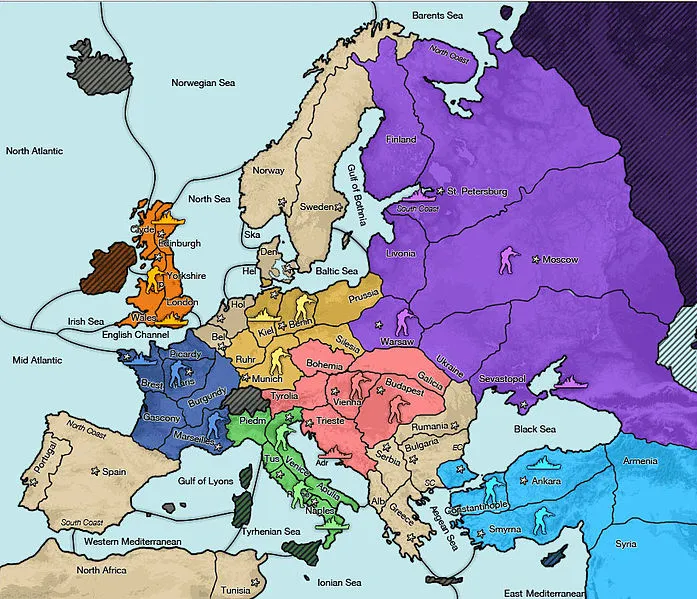
You play the game by taking actions with your units, aiming to take control of eighteen supply centers, which are provinces marked with stars. There are two types of units in Diplomacy, armies and fleets, and only one unit can occupy any one province at a time. Armies can move into any adjacent land province, whilst fleets can move into any adjacent water province or coastal province. There are four move types any unit can make, with move examples being given from the starting map above:
A move order moves a unit from one province to another. For example, the army in Constantinople could move to Bulgaria (In Diplomacy’s notation, A Con - Bul).
A hold order simply commands that unit to stay where it was and do nothing. Let’s say England really didn’t want to move that army in Liverpool, so they just held it there (A Liv H).
A support order supports a unit from one province into another province. All units are equal in Diplomacy, meaning that one unit and another unit cannot overpower one another without help. If the French army in Marseilles tried to move into Piedmont, but the Italian army in Venice did as well, they would simply “bounce” and return to their provinces of origin. This would also happen if that Italian army moved into Trieste while the fleet there held, because the army isn’t strong enough to dislodge it. Supports add the strength of that unit to the supported unit, allowing it to outmatch units that do not meet that strength, but bouncing with those that do. Supporting units must be able to move to the province they are supporting another unit into. For example, Russia moves their army in Warsaw into Galicia (A War - Gal), but Austria foresaw this. They order their army in Vienna into Galicia (A Vie - Gal) and order their army in Budapest to support it (A Bud S A Vie - Gal). Austria would succeed whilst Russia fails. Additionally, support from a province can be “cut” if another unit moves into its province.
A convoy order is the most complex order in diplomacy. This entails an army moving from one province to another province across sea tiles using a ship (or ships) to move it there in one turn. Posit that England has an army in Clyde and a fleet in the Norwegian Sea. They could convoy that army in Clyde into Norway (A Cly - Nrw; F Nrg C A Cly - Nrw). The army will have moved multiple spaces in one turn. This can even be done with multiple ships forming a chain.
There are no turns in Diplomacy for individual players, but two turns where everyone acts, these being the Spring and Fall. Fall is the most important turn, because its when supply centers change hands if a foreign unit is there, provided it is held through the turn. It’s also when you can build new units. In Diplomacy, you always have the amount of units that you have controlled centers. That’s why all nations have three except Russia, who starts with four. Units can only be built in “home centers”, i.e. ones that you start the game with.
[hr]
These are the general rules of Diplomacy. You might think it’s just another wargame, one that could be better simulated by a computer akin to those put out by Paradox Interactive, but Diplomacy is less about the units and their management and strategy, and much more about your employment of cunning diplomatic tactics, as the name might suggest. In Diplomacy, you are given ample time to talk with your fellow players about what you intend to do in the game. This is the crux of the game. You need to maneuver yourself diplomatically, because you can’t win without the help of others, nor can you win without crushing them underfoot. You might promise to one player that you’ll assist them in attack against another at the same time you’re plotting with that very same player to kill your supposed ally.
Sound interesting? Well, you’ll be glad to know that this December TEP is hosting it’s very own game of diplomacy! You don’t even need to be a member of the discord to participate, as it’ll be occurring on the diplomacy site playdiplomacy.com. If this teaser has you excited about the game, then telegram or ping me, Burndt Jamb about your interest!
I look forward to a fiendishly good session with you all…