Flag:

Nation Name (long): Imperial Federal Republic of Jakun
Nation Name (short): Jakun
Native Language official: 武和華光国 (Buwa-kakō-koku)
Native Language Common: 華光 (Kakō)
Population: 31.84 million
Total GDP: 974373916
GDP per Capita: 30604
Currency: Jakunese Yen (JKY)
Demonym: Jakunese
Language: Jakunese
Species: 97%Human, 2%Elves, <1% others
Religion: National Religion: 霊環道 (Washindo), others < 10% (of that mostly Akuanism)
Capital: Daikyo (大京)
Largest City: Daikyo
Government Type: Federal Parlamentary Democracy
Leader(s):
- Emperor: Kawaguchi Nagakage
- President: Nakata Hidekazu
- Vice President: Yuuma Sachi
- Chief Justice: Mae Nobuo
- Speaker of the low House: Ito Ayumi
Legislature: Jakunese Federal Assembly
- Upper House: House of Councillors
- Lower House: House of Representatives
Two-Letter Code: JK
Three-Letter Code: JKN
Motto: 平和、正義、自由 (Peace, Justice and Liberty)
National Anthem: 和の御世
National Animal: Hawk
National Plant: Jakun Orchid
Historical Summary:
Jakun’s early history starts officially around 400. During that time, many small city-states on the islands, today known as Jakun, formed a loose union. Some of these towns still exist to this date, like Shizumi (now known as Daikyo) and Ena. Over decades, the Union had grown in power and was starting to become more centralized. Around the year 800 some of the cities tried to regain sovereignty, which caused a large backlash within and eventually led to the “Inner Jakunese War,” which lasted from around 840 to 860. After the conflict, the Union was reestablished as the Kingdom of Jakun. Most of the former regions still held a decent amount of self-governing ability, while most “traitor” regions either got merged with a loyalist or stood under direct control of the federal government. The City of Shizumi became the capital of this new country and got renamed to Daikyo (lit: large capital), and Ena became the second capital.
The following years were stable. And the nation was thriving. In 1397 the first isolation period started. Many wars in the years leading up to the end of the 14th century led to a growing discontent of the general public with the actions performed by the emperor. This, in addition to growing foreign influence on the islands, led to a full closure of all Japanese islands and harbors for all foreign vessels. This full isolation policy was in place until 1608. First, only a single harbor on the Harbor of Kurodai, located on the 3rd largest island, was opened for selected vessels. The name Jakun also originates from this time. A (idk, whoever is willing to become the namegiver of the nation for writing it is Canada for now) Canadian trading ship was one of the first to land in said harbor. Due to the long isolation period, they were all familiar with neither the language nor the actual name of the country. A misunderstanding led to the sailors accidentally mistaking the Jakunese word for “house” for the country. Upon their return they reported this as the name, and it got adopted by the global community.
The following years, the Jakun started to become more famous for their craftsmanship and art. During the first isolation, a distinct art style was developed that quickly became popular in neighboring countries. The opening also brought huge problems for the country. The once again growing contact with other countries also introduced new religions, similar to the Nation, which caused fear of a loss of the native religions. On top of that, the trade weakened significant parts of the national economy. This eventually led to Emperor Tenyu ordering the closure of all ports with the “Ports Order” from 1683. The only exception was the City Kurodai, which was still open to the world, but access was very strictly monitored, and less than 10% of arriving goods passed customs inspection. Strict censorship was in place for all notes, and foreign languages were almost always declined. Only goods meeting both economic and spiritual standards were permitted to proceed to the inland and/or main islands.
During the second isolation period, Jakun saw a major cultural flourishing. When the nation was finally reopened after strong pressure on the emperor by foreign delegations in 1827, Jakun had a large technology gap to catch up on. Due to the long isolation period, it missed most of the Industrial Revolution. The next years were characterized by a quick modernization and a quick jump in wealth. This was possible by recruiting foreign advisors. The advisors helped create a modern industry and military almost from scratch. The founded companies were then sold to private families. Many are still known today.
One of the first military successes for the newly reformed military was in 1910 with the win against Jastoria, which was one of the largest nations of the time.
In 1941, the first steps towards a modern democracy were made by Emperor Kensho. The first National Assembly, in the beginning only in an advisory role, which had elected officials, was signed into existence. These first steps lead to other reforms until 1952, when Kensho signed away full imperial power and made Jakun officially a democracy, with him only staying ideological head of state and religious leader.
From the 2000s on, Jakun experienced a huge tech boom and stabilized its global position as an international education and tech superpower.
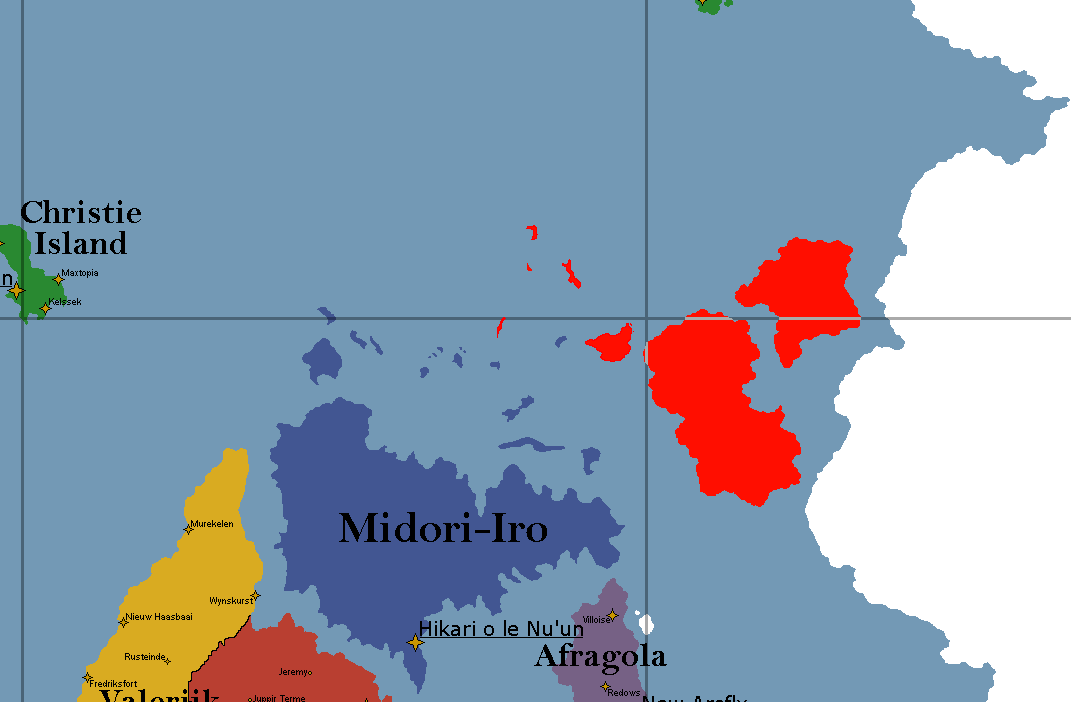
Jakun in red