Flag:

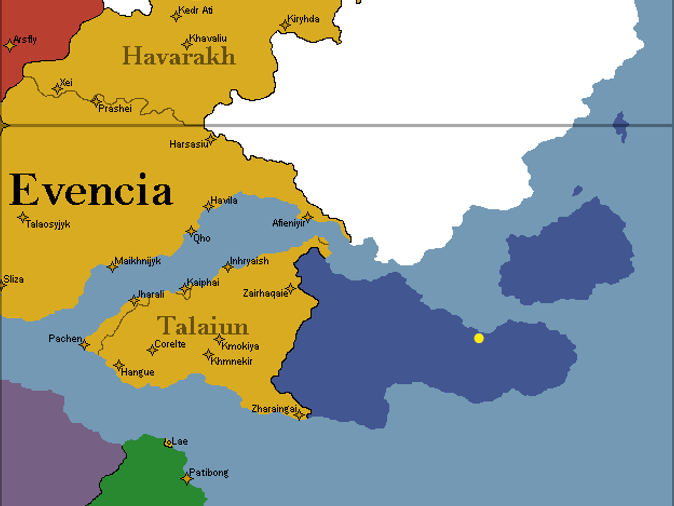
Map claim: The territory in blue would be the claim, the yellow dot is the capital (Ideally, I’d like the country to have a subtropical or tropical climate, so if there are better areas for that, I don’t mind changing locations; I just prefer the territory to be roughly the same size)
Nation Name (Long): Kingdom of Siaram
Nation Name (Short): Siaram
Motto: “Onward Siaram”
**Population: (**2025 estimate) 40,867,198
Denonym: Siaramese
Species: Human
Capital and largest city: Phakat
Language: Phakram (Conlang based in thai script)
Total GDP: 490.4 billion SHD
GDP per capita: 11.998.53 SHD
Currency: Siaram Dollar S$
Goverment type: Unitary parliamentary constitutional monarchy
Leaders: King Anurak II, PM Dara Sosak
Legislature: Siaram National Assembly
- Upper House: Senate
- Lower House: House of Representatives
ISOO 3166 Code: SI, SIA
Internet TLD: .si
National Animal: The rusty-spotted cat (Prionailurus rubiginosus)
National Reptile: Monitor lizard (Varanus)
National Plant: Tembusu Tree (Cyrtophyllum fragrans)
Historical Summary: (This is just my general idea of the nation’s history, and I intend to make it more detailed and extensive, as well as adapt it or relate it to neighboring countries)
The history of Siaram begins with migrating tribes, ancestors of the modern Siarames, who descended from the northern highlands to settle in the fertile alluvial plains. Early Siaram was not a single country, but a collection of city-states. Power was fluid; smaller cities swore allegiance to a “Great King” in exchange for protection, but retained their own local customs.
With the merging of the city-states, a powerful dynasty emerged from the central plains, establishing a capital city, Phakat. This era marked Siaram’s rise as a regional hegemon; it also became known for its specialized warfare, using armored war elephants to dominate the dense jungle corridors.
With the arrival of traders from distant lands, Siaram began to open up to the outside world, and a visionary monarch realized that, to maintain its sovereignty, Siaram needed to resemble a modern state. He abolished debt slavery, reformed the bureaucracy and invited foreign advisors to implement modern reforms.
The absolute power of the God-King eventually gave way to a series of internal unrest, culminating in a sudden revolution that transformed the nation from an absolute monarchy to a constitutional one. This resulted in a complex political landscape where the army and the palace remained the two pillars of stability.
In the modern era, Siaram transitioned from a predominantly agrarian economy to one dominated by industry and an ever-growing service sector. Its capital became a sprawling metropolis where ancient shrines and temples, along with traditional architecture, stand side by side amidst modern skyscrapers.