Good afternoon, Magisters. Today, I wish to do two things: expose an issue by uncovering how certain systems in place are detrimental to our region, and propose changes I deem adequate to avert this unfortunate situation in the future. As you all know, in our Ministry of World Assembly Affairs, hereinafter referred to as “WAA”, our Minister and their Deputies have the authority to set up Discord threads for all residents of The East to convene, discuss, and decide how our Delegate votes on World Assembly (WA) resolutions. This system, which displays our full pledge to democracy and East Pacifican participation in executive decisions, enables anyone to dictate our voting policy and influence The East’s stance in the game-play landscape.
Now, anyone can receive the “Resident” masking simply by joining our Discord and clicking on the option that allows this, as there is no verification bot or process in place to get the role. Consequently, this means that everyone — whether a longtime East Pacifican citizen or a simple opportunistic outsider — can, after self-masking, view and participate in our WAA channels. Verily, we’ve left the gates wide open for anyone at all to influence how we vote as a region.
Perhaps some might contend that this is not grave, that our WAA channels do not contain sensitive information. However, this is not only an issue in this specific ministry; residents can, for instance, view the #magisterium channel, where we all assemble and occasionally debate — sometimes in a heated manner — matters concerning our citizenry, discussions that should not be left exposed to foreigners.
For clarity, for the rest of this thread, let me define “foreigner” as an individual who is masked as a “Resident” on our server but doesn’t hold citizenship in our region and does not have their WA nation in The East Pacific. If we take a moment to review our last sixty internal votes held in the WAA threads channel (Fig. 1), we can observe the following: in bright red, thirty-five of these sixty decisions had fifty per cent or more foreigner participation. In two shades of green in the “PER CENT FOREIGN VOTES (%)” column, only six of sixty saw fewer than one-third foreigner participation. On average, across all sixty votes, the participation rate of foreigners was just above forty-seven per cent. On top of this, if we add all Citizen votes and compare them to the sum of all foreigner votes, we can note that there are more of the latter (101 as opposed to 105), too. These numbers are as incredibly high as they are concerning.
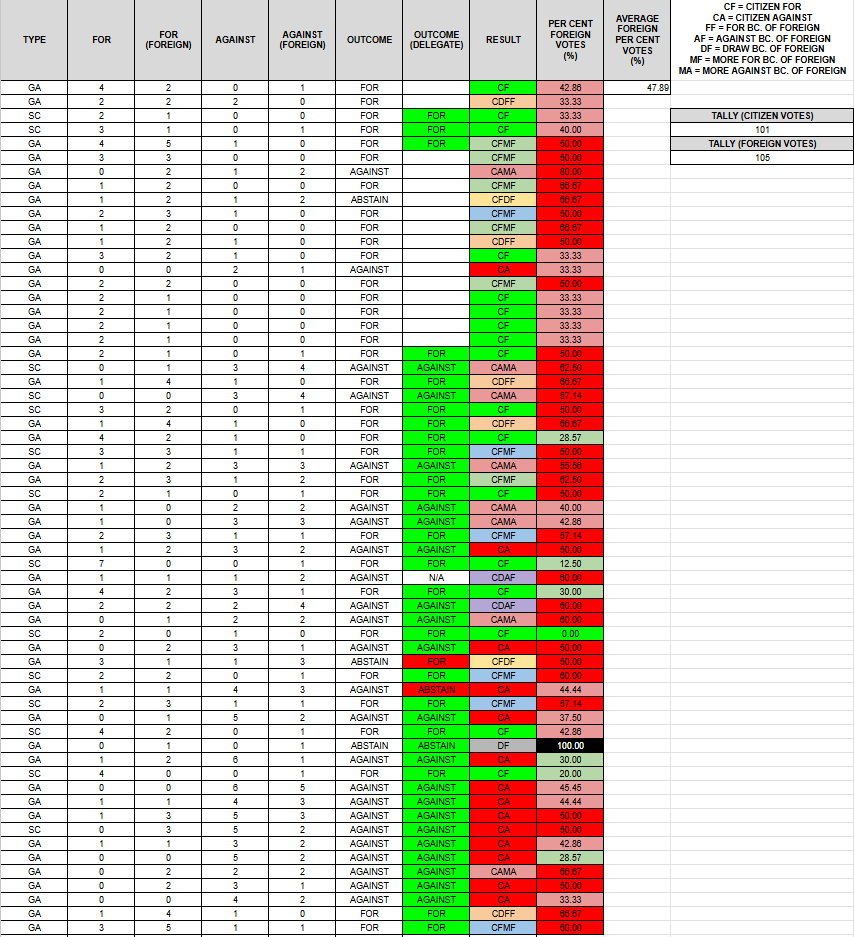
Fig. 1: Results of the census of the last sixty World Assembly Affairs threads.
It’s worth keeping in mind that the vote of the Minister or Deputy of WAA was only counted in this census when explicitly declared; otherwise, it is presumed to be an abstention. For my own calculations, I was careful to count myself as a Citizen only after my formal acceptance into The East (from the 12th of September onwards), and followed a similar method for all our WAA voters. Now, in the spirit of transparency, mistakes are possible. Perhaps someone’s citizenship expired yesterday and I counted them as a foreigner because they voted, as a Citizen, on a WAA proposal in August. Taking this into consideration, I’ve tried to be as thorough with my research as possible, both on our forums and on NationStates, so I expect the margin of error to be small if not entirely negligible.
Back to the matter at hand. Whilst it’s true that Citizens and foreigners often reach similar conclusions, this doesn’t eliminate the considerable risk posed by such unregulated influence in our policy. In fact, foreigners have been the decisive tiebreaker in seven of the last sixty resolutions, tipping the balance as Citizens were torn on a resolution at vote. Moreover, even when their stance doesn’t outright determine our vote in the World Assembly, their heavy involvement could affect voter opinions and discussions. Let me be clearer. When foreigners comprise a majority or even half of the internal voting bloc, their voices become just as loud, if not louder, than those of our Citizens. Perhaps by voting early — coincidentally, granted, as these foreigners are not part of some coordinated faction and belong to antipodally opposed regions — foreigners establish a very visible stance that could sway later Citizen voters. Effectively, these reported “Residents” drown out our regional voice.
To combat this, I propose a straightforward solution, Magisters. We should push for the introduction of a new Discord role, “Citizen”, which would grant access to the Capital Plaza category of channels (#government-pizza🍕, #world-assembly-β, #world-assembly, #executive-hub, and #magisterium) or, at the very least, the WAA channel*. Only those recognised as Citizens (easily verifiable due to mandatory forum registration as opposed to having to inquire and ask individually for nation names and routinely check that they don’t cease to exist) would be permitted to view, send messages, and vote on how they believe our Delegate should vote**. Thus, we would ensure that the collective voice guiding our Delegate’s vote truly belongs to The East Pacific itself and those of us who are committing our sole WA slot to the region.
In the meantime, however, an apt substitute for the “Citizen” role would be to simply limit viewership permissions to the “Residents [WA]” role, which, whilst not up-to-date, already would stop a crushing majority of foreigners from interfering with our WA policy.
*Non-Citizens in our government and WAA should keep access.
**An obvious exception should be made for #join-the-government, which should remain visible for “Residents”.