Separating Delegate and Head of Government

My fellow Magisters, we have a long discussion to be had. A discussion that’s been had in depth among some individual circles — Praesidium, Creative Magisterium, etc. — over the past few years, and which we finally need to have as a full region. That discussion is HOGS — Heads of Government.

The idea, one which is reflected in a few GCRs already, is to separate the Head of Government position from the Delegacy. This fights some of the passive loss of endorsements and influence that we see too often, lessens cases where Delbumps are viable, and wards us against coupability by preventing the requirement for our coveted executive power to simply be political savvy. It strengthens our security and removes a lot of the awkwardness of government transitions. There’s a lot of good reasons to do it.

There are also reasons to hesitate, I admit, although I’m personally in favor. I’ve heard in the past that the achievability of being Delegate is a big political motivator for new folks. I’ve also heard that it helps for the head honcho gameside to be the head honcho gov-side, since it’s the big obvious person to both contact and look up to. I’m sure there will be other points raised. These feelings are valid.

I am hoping to have a wide-ranging conversation with high participation from all Magisters, but also non-Magisters. I will not put forth a solid proposal until I see such occur. We need to all consider this deeply and discuss it lengthily. If we don’t give this the attention it deserves, it’ll be brought up again a year from now whether or not the eventual amendment is made.

So discuss!

Previous Threads:
1 Like

Staunchly disagree. I strongly believe that delegate as HOG is a powerful motivator.

I’m curious as to whether you had a response to the argument that being an RO or the elected Head of Government is already a big political motivator due to its prominence, power, and prestige, or the fact that the Delegacy could still be technically achievable as a separate position gained through extensive government service?

My response would be that Feeders (and now frontiers to a lesser extent) have the very special feature that being the delegate is visibly the sign of power with all those endorsements.

If one wanted to be a normal Head of Gov, any other UCR stronghold could offer that. But as a GCR feeder, we specialise in the fact that we command all these endorsements, giving the opportunity for the HOG to both wield power onsite through endos in addition to being a normal leader.

If we separate the delegacy as a separate position under the viziers, for the sake of security, we’re talking about changing the holder as little as possible. Sure it would be attainable, perhaps once every 5 years. We’d be killing those with ambitions to command those endorsements.

…and nobody wants to be stuck doing the job of GCR WAD, one way or another, for 5 years.

Honestly, my main concern is similar to LL’s. In general I like the security benefits this provides, but I also feel like we don’t have a whole lot of Delegate candidates per election - which is normal but I’m unsure how much removing the incentive of being feeder delegate would affect people seeking being HOG.

A good idea may be a poll asking anyone who ever ran seriously in an election on whether they’d have run for “Delegate” if “Delegate” was just HOG w/o the in-game Delegacy.

That being said, I think another benefit that was unmentioned is that some Delegates do struggle with keeping up endorsement counts alongside the rest of their duties. granted this is probably a very strong minority of Delegates, but notable nonetheless.

I don’t want to be exclusionary here, far from it, but do we WANT government leaders who are only in it for their name at the top of the region? To Luck’s point, I can see the delegacy changing every 1 or 2 years, which would be a lot better than every four months. I’d also say that the uniqueness of GCRs’ delegates having immense on-site power coupled with low interest in the Delegacy is exactly why we might want to raise the bar. We don’t want an untested and uncontested candidate holding all the cards on site. Not just because someone with bad intentions could do a lot of damage but because someone with good intentions could still do the same just because they’re not ready yet. I’m not dying on this hill but I don’t think these arguments quite convince me at this time.

I think that the low interest in the delegacy is due to us holding the delegacy in high esteem. People don’t want to go down in history as a bad delegate. Yes one wants to be at the top of the page, but one also wants to make the history books and not in a bad way. We do a pretty good job at timelessly shaming those who have had bad delegacies.

We also talk about the delegacy “holding all the cards”, but we know that TEP has a very robust system of checks and balances.

Overall I’m not too worried

I don’t believe these facts are inconsistent with the separation perspective, to be fair. I actually think it would lower the pressure if we had a more stable office in the seat of Delegate, absorbing the interregional attention and lessening the pressure on the office of HoG. It also lowers the workload – no more endotarting or security considerations in the Executive – and makes more people less hesitant to try new leaders. Re: checks and balances, most of those are assuming the Delegate complies with our legal system. The only check on the in-game power of the Delegate is the Praesidium, which sees staunch opposition if it wants to utilize any of its powers and which many seek to reduce in size and therefore influence anyway. The Praesidium is strong in-game but politically weak, and the Delegate is strong politically and in-game. I’m not saying that right now TEP is coup-able, but I do think this option is safer overall, without much of a cost at all.

only in it for their name at the top of the region?

Not really only in it for sure, but being an on-site GCR Delegate could be a strong enough contributing factor to push someone over the threshold, even if they have other contributing factors to wanting to run. And if I had to guess I’d probably say that capability of on-site GCR Delegacy is a strong motivator to be Delegate during peaceful times, but not the only one.

I also have to add that I think it’s a little of a moot point on whether we want someone to be Delegate if a strong factor was holding the in-game Delegacy, if the alternate option is having no Delegate at all or having an oldie run for Delegate again.

In any case, for full disclosure, I’ve sent out a google survey to former Deleagtes and “serious” Delegate candidates as to why they ran for the Delegacy since 2020 - excluding anyone whose left TEP or rando newbs who I don’t recognize 5 years after the fact. I got 5 responses so far but I’ll wait for like 3 days and post the results here.

So far though, I’ll note 2 former delegates indeed note they wouldn’t have ran for Delegacy if the Delegate did not control the in-game Delegacy.

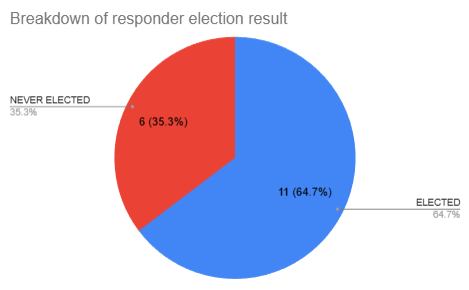
Alright - here’s the shake. There were 17 responders - 11 have been elected Delegate (verified since I know their names) and 6 were never elected (also verified since I know their names).

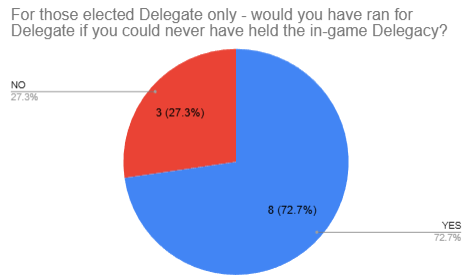
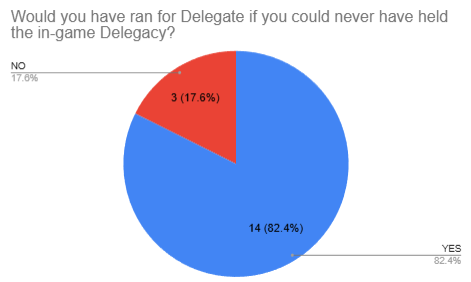
To keep it simple, the most important question was the third: “Say that in theory, at the time when you ran for the Delegacy, only appointed Viziers could hold the on-site World Assembly Delegacy of TEP and that the Delegate was prohibited from holding the on-site World Assembly Delegacy of the East Pacific. Would you still have ran for Delegate at that time?”

The answer results:

If we focus on only those who won election:

Of those who didn’t get elected as Delegate, 100% answered YES to question 3 - so Google Sheets wouldn’t let me make a chart, LOL.

Extra Charts if you're interested

Question 1: Were you elected Delegate of the East Pacific at any point of time?

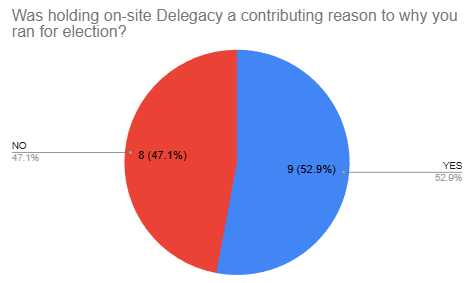
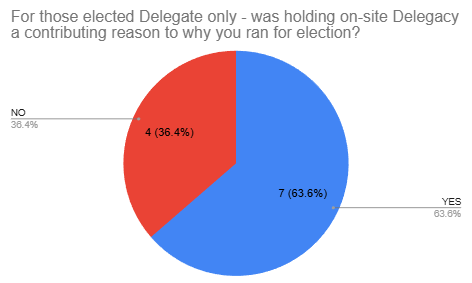
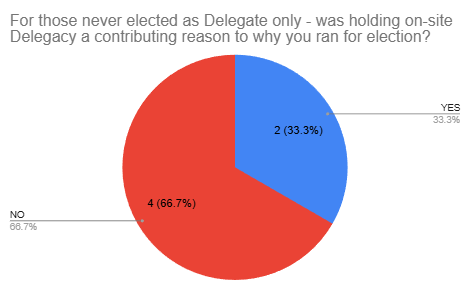
Question 2: When considering to run for Delegacy, was the fact that being Delegate included the ability to hold the on-site World Assembly Delegacy of the East Pacific a contributing factor to why you decided to run?

Combo results:

Delegates only:

Non-Delegates only:

Basically question 2 was asking if holding the on-site Delegacy was A reason for seeking Delegacy, even if not the main one. For both groups, it was more commonly A reason, but not THE deciding factor. Pretty interesting!

I should note for transparency that I also inputted myself as a former Delegate - I answered yes to Q2, no to Q3.

Anyways, the conclusion is pretty numerically clear. If we treat all responders as equal, ~80% (14) would still have ran while ~20% (3) would have not. However, the plot twist is that those 3 were actually former Delegates, which IS interesting but since this is such a tiny sample there could be a billion biases or smth idrk. However, I’ll note a former Delegate who said NO to Q3 also still noted concerns that splitting HOG could reduce attraction to the Delegacy. I should also add there is a likelihood people may have recall bias (i.e. may not remember how they felt when they ran) or even (though unlikely) have said NO to Q3 (cuz lets be honest, saying yes to Q3 could be a bit of a loaded answer - but also you have to be pretty tough to run for elections and I doubt TEPers would lie on a survey, which is why I find this pretty unlikely).

Anyways, based on the survey I will say that I don’t think HOG would unilaterally destroy our Delegate candidate pool. However - it IS true that the on-site Delegacy is clearly a pretty important deciding factor that we could expect to slash our future # of candidates by 20%, perhaps, if HOG gets enacted.

Not sure what it means that all 3 were former Delegates - that’d require a full on academic study.

Also - here’s the link to the data (names were erased and there’s no version history with the names): Public HOG sheet - Google Sheets

1 Like

Apologies for not contributing to this discussion earlier, I’d intended to but got sidetracked and it left my mind. I’ll follow Zuk and note for the sake of transparency that (if memory serves) I answered that the WAD position was a contributing factor to me running for delegate two years ago, but it wasn’t the contributing factor.

I think I’m probably in the same boat as most respondents, from what I can see, wherein the delegacy seat was a cool feature of being elected, but I would’ve run regardless. Like most, my main aspiration was to lead the region and work on policy and projects, not simply to hold the most endorsements and show off the shiny badge.

While I initially shared similar concerns that a HOG system might deter some from running for delegate, it’s fairly clear from Zuk’s survey (thank you zuk) that it’s probably not going to be as big an issue as I’d guessed. While I imagine it’ll deter one or two people every once in a while, I’d argue that’s probably worth the clear security benefits a HOG system presents.

Given how much overtime the Praesidium has had to work in recent times compared to previous years, I think adopting a HOG system, where we don’t have to worry about the constant threat of coup or deltips would be a welcome change.

My thoughts would now shift to what changes could be made to the HOG position to make it more appealing.

1 Like

Omg I wish I knew about this sooner. Seperate head of government position sounds great. Yes it spices up the regional flavour but it also adds to our meritocratic value that we hold as a community. While the biggest merit is being elected among peers to serve as the Delegate, a lot of IMPORTANT work gets done on behalf of the executive.

Running from my October 2025 campaign, I feel like the imagination of being elected Delegate was dauntin, while rewarding. I wasn’t ambitious enough in my proposed reforms but the introduction of an official HOG position would’ve been one of them if I didn’t shy away from being so instrumental. Nonetheless, all of the reasons a HOG system would benefit the region, especially in such uncertain times, have already been stated. It provides a strong extra layer of coating that we’ve already seen other GCRs adopt.

So i’m all for and would be happy to support and further advancements on the matter.

I’m in favor of HOG.

On the question of how, I think the best bet is to make it so a Vizier is nominated by the GV and confirmed by the magisterium, and then an auto-reconfirmation vote occurs every year. Also grant the Conclave the ability to remove the WAD for standard abuse of power or dereliction of duty. RO appointments should only be made following regional law and, if law has nothing to say, the head exec. The WAD should also only cast their vote in following with the head exec. For COI purposes the WAD should not be an Arbiter, though idrk if it matters if they’re a magister or not since realistically under this system the position has little discretion. Also, the WAD job should include gathering endorsements and influence. and WAD should have cabinet access so they kinda know what’s going on I think.

That’s my overall take on the system.

I have made my thoughts over the last few days as well, and can only say that I continue to support the idea more and more. At first, it was too much of a brave step for me, thinking about other regions and how they handle it, but there are certain advantages you have. Though I reserve more judgment for later, when more details are to be thought of.

I’m not supposed to be here right now, but I am, and I’m saying stuff. And then I’ll run away before anyone has a chance to reply. I’m like a drive-by shooter but for words.

The words in question:
There’s been a lot of discussion of how this could disincentivize people from running for HOG. Fair enough. I need to point out that it will also encourage people who would not otherwise run! Staying on top of endotarting can be the straw that breaks the camel’s back, when the camel already has irl commitments (as pretty much everyone does). I believe this factor currently discourages some potential HOGs from running, despite their passion for other facets of the Delegacy as-is.

1 Like

Hopping into this place to bring my proposal from #government-pizza:

First, I fully support this proposal, I’ve done for years, and I think we should get it done at the earliest. It will save us many worries and troubles, and we can do it in ways that don’t make the office lose appeal.

About the latter, some of us have advocated in several places and moments for a higher correspondance between TEP and its RL geographic counterpart. We have an opportunity to name one of our most relevant government positions in such a way. We could use the “Inca” title, for example, which is recognisable enough for a position of major leadership. I’ve been doing a quick research and Inca’s meaning and etymology is complex, but it should either mean something like “primus inter pares”, a “ruler” that stands among the rest, or a name for the nobility among which the “sapa inca” (“the only ruler”) or “capac” (“king/emperor/more-than-king”) would be the main one (you can read more at the Spanish Wikipedia.

I think, for the sake of my proposal, that we could keep it as Inca for simplicity and recognisability purposes, but I’m really open for more suggestions that suppose a boost for potential candidates and help us establish a recognisable and distinct theme from the rest of NationStates.

Polynesian titles are your best bet.

After a little bit of research some titles come to mind:

  • Kovana (Samoan / Tongan, lit. “Governor”)
  • Palemia (Samoan / Tongan, lit. “Prime Minister”)

Another thought I had was something like Grand Lugor of the East - “Luga” just means “high” or “upper” in Polynesian languages and I added on an -or to make it sound a bit more grandeous if that makes sense.

1 Like