Flag:
Nation Name (long): The Most Serene Islands of Talvezout
Nation Name (short): Talvezout
Population: 10.5 million people
Total GDP: $307,554 (by million)
GDP per Capita: $47,175
Currency: Tavare (₮)
Demonym: Talvezian
Language: Talvezian (Talfossian as a minority language)
Species: Humans, Vulpines, Ailurlines, Ursines, etc
Religion: Creefe (indigenous animism)
Capital: Sephrada
Largest City: Sephrada
Government Type: Federal semi-presidential plurinational republic
Leader(s): President (head of government): Palomba Solis (Farmer Labor Worker) |
Prime Minister (head of state): Nydia Torres (Independent)
Legislature: Tricameral Legislature (National Assembly, National Council, National Tribunal)
Two-Letter Code: TZ
Three-Letter Code: TVZ
Motto: Una Nación Para Todos/A Nation For All
National Anthem:* “Un vals de ls-islas”
National Animal(s): Monk Seal
National Plant: Flor de Oro
Historical Summary:
The oldest signs of anthropological life from the Talvezian Islands date back to the Nuvepiedre Age, with charred fish and avian bones containing cut marks constituting the first clear evidence of sapient life on the islands, dated to around 7,500 BCE. Archaeological evidence points to various forager and hunter-gatherer groups visiting the islands throughout the successive centuries, but there remains only scant evidence of any major attempts at permanently settling the Talvezian islands, up until the 4th millennium BC. Archaeological excavations on the island of Anthrovezia have revealed evidence of slash-and-burn agriculture on the island, as well as the remains of wooden and stone huts along the coastlines of Anthrovezia.
It is theorized that the settlement of Talvezout happened in waves, with the theoretical first settlers of the Talvezian islands hopping from island to island, spreading to the south from Anthrovezia. It is estimated that most, if not all, of the archipelago was visited by sapient life by 3,400 BCE, with the oldest permanent inhabitants of what is now modern-day Talvezout being theorized to be nomadic hunter-gatherers, subsisting off the natural and aquatic resources of the islands.
Oral tradition states the first thousand years of life on the Talvezian islands were filled with competition and strife, as these nomadic groups fought for resources and control over the varying parts of the islands. These stories state that these bloody and violent centuries only ended with the first major unification of Talvezout, estimated to have occurred around 2,300 BCE; tradition states that a group of chiefs from the varying tribes of Talvezout voluntarily chose to unify, as a means of ending the violence. Exactly why these tribes decided to unify has never been fully understood; common theories include droughts, starvation, volcanic eruptions, disease, or some combination of all of the above serving as catalysts to this first unification of the islands. Under the leadership of the semi-mythical human chiefess Talvesia, the Talvezian islands enjoyed decades of prosperity and peace, during what is now known as the First Talvezian Golden Age.
The Union of Talvezout, as it is known now, spread across the various Talvezian islands, establishing colonies all throughout the archipelago. The polity made multiple trading and exploratory expeditions to nearby islands and continents, with multiple sites dotting across the seas bordering the Talvezian islands. The first written documents on the Talvezian islands are also dated to around this time, with the oldest texts dating to around 2,200 BCE. Some of the oldest and continuously-inhabited cities in Talvezout (Phoda, Ylfa, San Marcos, Aguasbendigas, etc) were also founded during this time period.
The First Talvezian Golden Age came to an end, following a series of natural disasters that befell the islands. In particular, the localized climate change caused by the Lloviendo eruption, a catastrophic volcanic eruption that occurred around 2,000 BCE, destroyed the Arbolesviejos settlement site, in addition to devastating the various other settlements across the islands. The Talvezian written record of the time captures the mass destruction and chaos that was wrought by the eruption and the ensuing natural disasters, as really as the political collapse that followed. The next few centuries saw the Union of Talvezout devolve into a scattered bunch of kingdoms and other polities, as the Talvezian islands returned to a state of warring nations against one another. Various empires and kingdoms vied to reconquer the entirety of the Talvezian islands, but none would succeed during the 2nd millennium BCE. The Union of Talvezout itself would be reduced to a rump state on the Isla Gran, only controlling the lands around the Bay of Sephrada and scattered parts of the Talvesia Highlands.
Around 850 BCE, the Empire of Talvezout would form from the ruins of The Union of Talvezout; under the leadership of Piedra-Dure I, the empire would gradually expand across the Isla Gran. The introduction of irrigation and other agricultural techniques in 750 BCE would aid in the expansion, with the empire controlling the entirety of the Isla Gran by 500 BCE. With the end of the 1st millennium, the Empire of Talvezout had expanded to full control over the islands of Talvezout, with the empire forming a complex web of trading networks and colonies across the archipelago. Multiple external factors (natural disasters, crop failures, droughts) and politicking would bring the islands into the fold of the empire, with the Empire of Talvezout claiming control over all of the islands by 12 BCE. The Imperial Confederacy of Talvezout would be established in 10 BCE, cementing the empire as a plurispecific nation of multiple species and peoples living under the imperial ruling body. The states of the empire would receive a high degree of autonomy, with some form of local rule being enacted for the islands. The empire would grow into a minor regional powerhouse, exploiting the abundant natural resources of the Talvezian islands in trade and other forms of industry. Expeditions would be launched to nearby locales during this time as well.
Political and civil strife would plague the Imperial Confederacy of Talvezout, with the end of the 1st millennium bringing in multiple conflicts that would threaten the power of the empire. A wide multitude of causes have been proposed for this violence, including imperial corruption, crop failures, and increased desire for local autonomy. Multiple civil skirmishes would end with the Imperial Palace being placed under siege by a rebel group of merchants, farmers, mining guilds, and defecting soldiers; after two weeks of violence, the imperial body would surrender and grant the rebel groups increased rights and powers in 890 CE. The First Talvezian Civil War would mark the beginning of the decline of the imperial powers of Talvezout, as the following centuries would see the imperial ruling body be slowly reduced to simple figureheads. A notable event in this erosion was the establishment of a legislative body, the Synántisi-Reunión-Talvesia in 990 CE. The SRT, which evolved into the modern Legislature of Talvezout, was a mass meeting of the empire’s powerful leaders; any person of means and ability to travel were also allowed to attend these meetings as well.
The SRT would mark the beginning of the legislative arm of the Talvezian government, with the body ruling in conjunction with the imperial ruling body for the ensuing centuries. Independent assemblies would pop up across the islands, with these levels of local devolution resulting in an imperial attempt at establishing unitary control in the 1700s. This attempt would fail miserably, leading to the imperial ruling body rapidly losing any actual power by the end of the 19th century. The rise of collectivist politics within the empire would amplify the growing calls to dissolve the imperial house by the early 1900s. The defection of the Crown Infanta Eufemia to the Collectivist League in conjunction with the imperial family massacre in 1941 would spell the end of the royal house, with the ruling body being abolished in 1943.
In addition to the imperial house, the Talvezian Confederacy would separate in 1944, with home rule being returned to the Talvezian islands. The economy of Talvezout (located on Isla Gran) would soar throughout the latter-half of the 20th century, thanks to increased investment in shipping, shipbuilding, and trade. Tourism would also rise throughout the islands, with the 1960s and 1970s marking an increased interest in the history of the archipelago. Economic downturn throughout the islands (with the exception of Talvezout), alongside political strife and civil war on multiple islands would lead to various calls for the archipelago to be united again throughout the 1980s and early 1990s. 1995, with the conclusion of fighting throughout the Talvezian islands, would mark the founding of the Union of the Most Serene Islands of Talvezout, with multiple islands gradually joining in the union throughout the decade. Guijio would be the last state to join the union, with the island joining in 2002. 2003 - 2007 would see increased political and civil strife, as governmental instability and tense relations would engender calls for the union to be dissolved again.
Emergency state reforms throughout 2008 to 2011 would bring a cooling of tensions, with the 2012 snap elections being the first relatively peaceful elections since 2001. The 2010s and early 2020s would see political stability and economic success in Talvezout, as increased investment in local industry alongside a rise in tourism would lead to higher levels of quality of life in the archipelago. The 2025 elections would mark a sea change in Talvezout; the leftist electoral alliance (Amanecer) would experience record-breaking success in the elections, with the Farmer-Worker-Labor party being the first political group since the 1940s to achieve a majority in the Assembly of Talvezout.
Map Claim
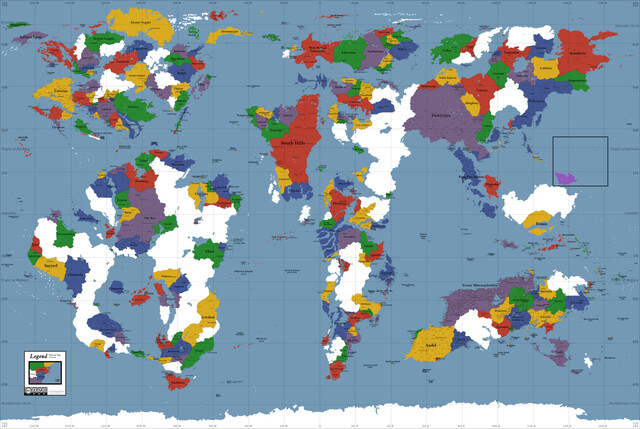
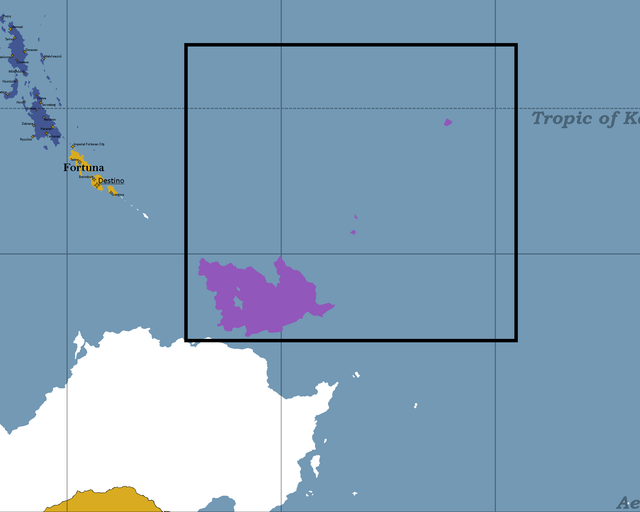
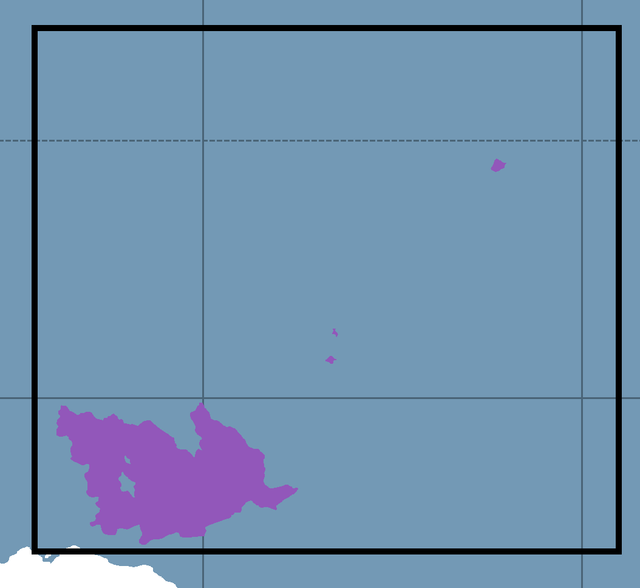
*Important note: The black square is not my claim; the landmasses highlighted in purple are. The black box is purely to help highlight and center what might would the map claim(s) for Talvezout.