Map (showing cities & internal provinces):
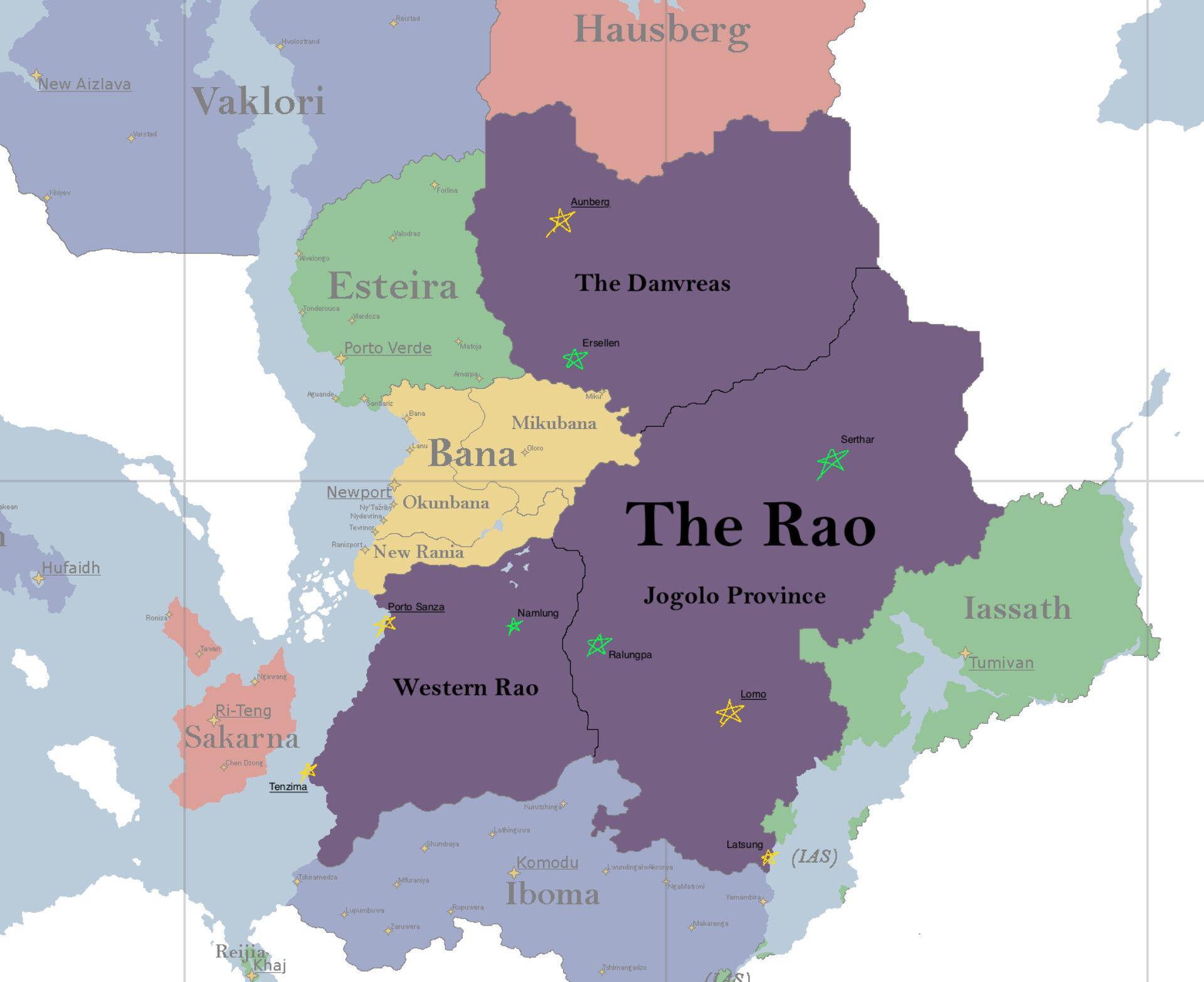
Yellow Stars + Underlined name = Capitals
Yellow Stars = Largest cities
Green Stars = Second largest cities
Map (showing civil war divisions):
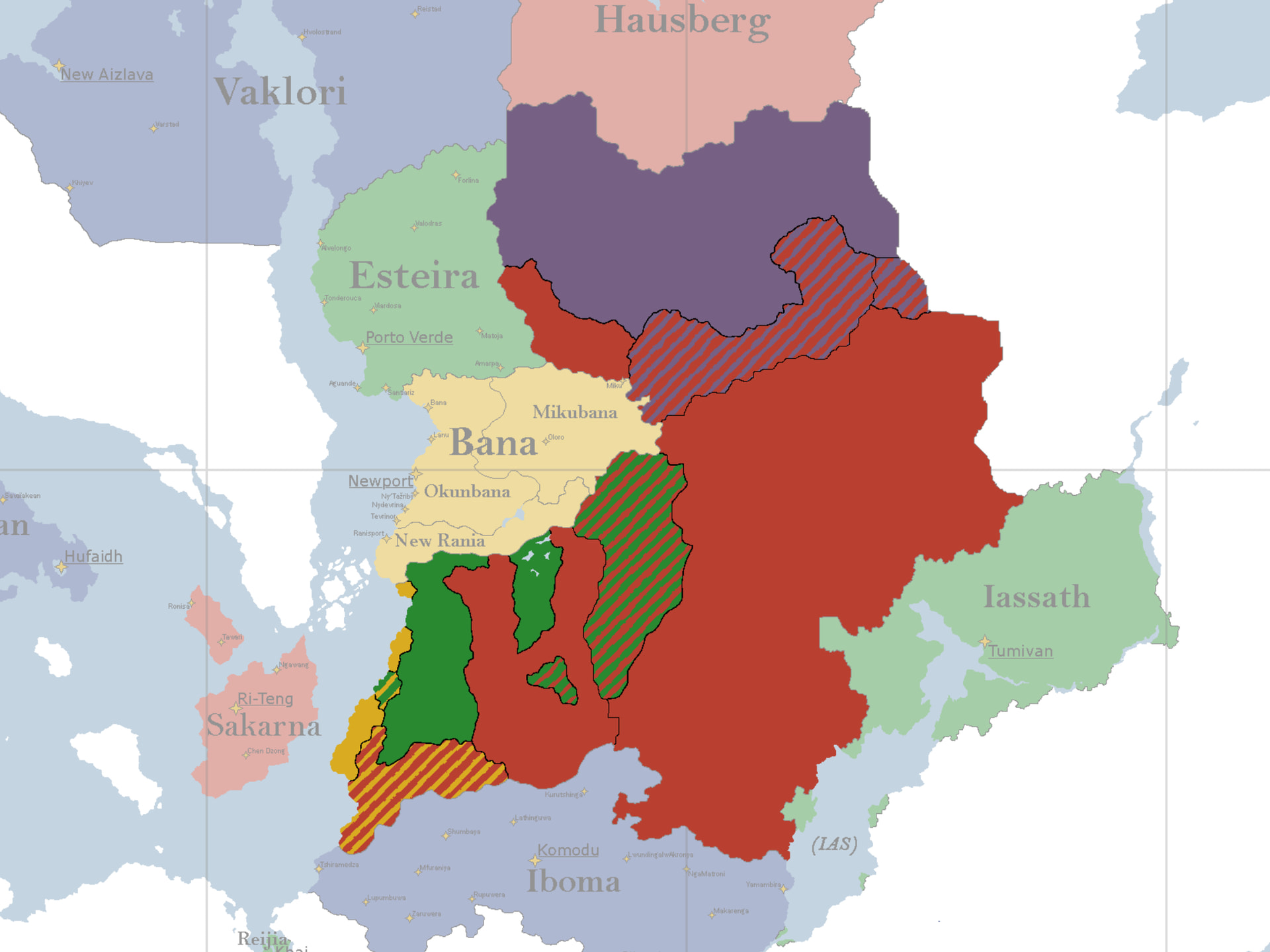
Red = Democratic Republic of the Rao
Yellow = Republic of the Rao
Green = Raonite People’s Army
Purple = Danvrean Liberation Movement
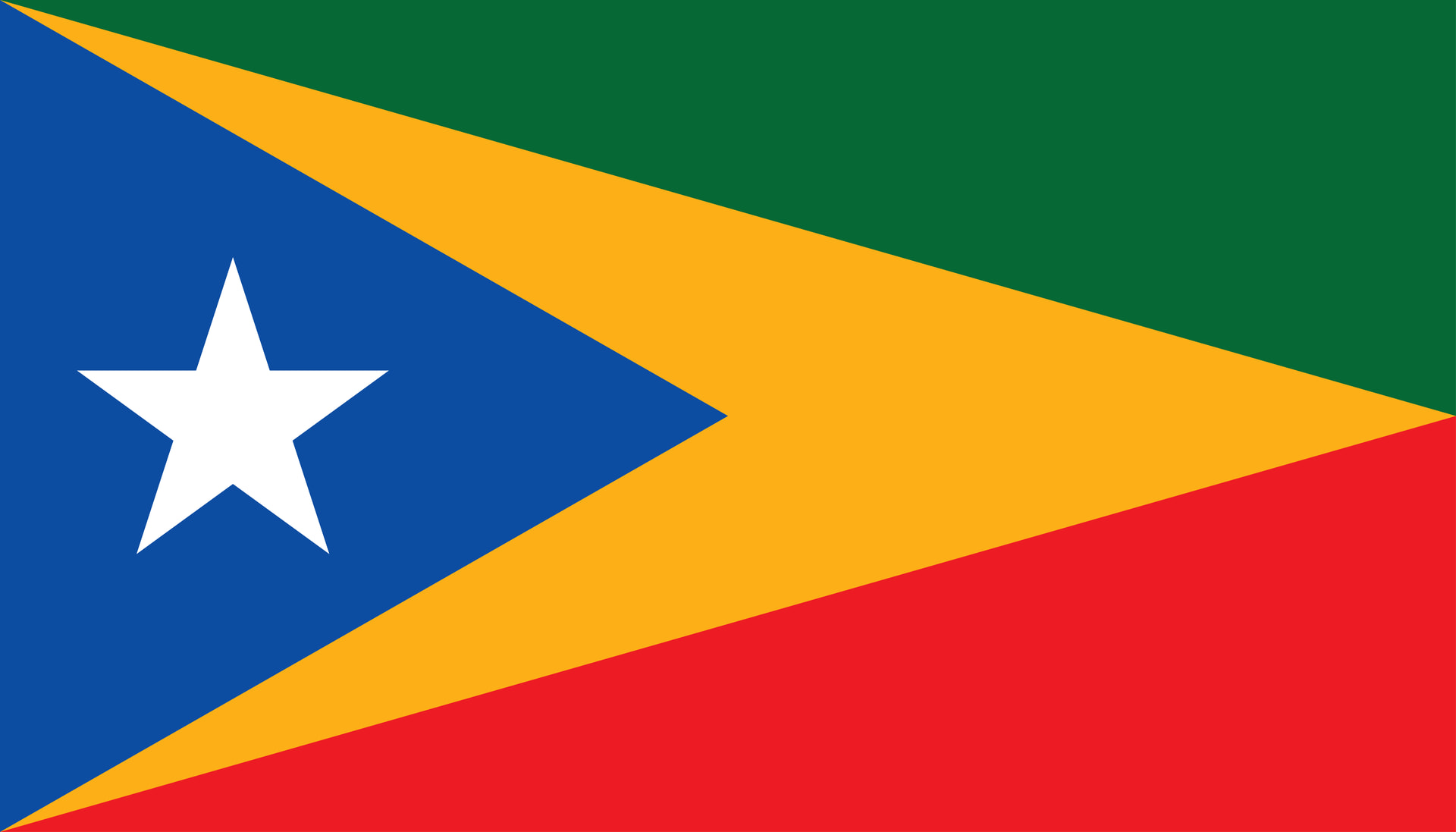
Flag (of the Democratic Republic):
Nation Name (long): The Democratic Republic of the Rao
Nation Name (short): The Rao
Population: 85,000,000 (2025 estimate)
Total GDP: 71,570,000,000 SHD
GDP per Capita: 842 SHD
Currency: Raonite Pound (ᵲ)
Demonym: Raonite
Language(s): Raonan (majority), Sakarnese, Reiktic, Norvian, Tretridian
Species: Orc (majority), Human, Vulpine
Capitals:
- DRR: Lomo
- RR: Tenzima
- RPA: Porto Sanza
- DLM: Aunberg
Largest City:
Lomo
Government Type:
- DRR: A center-right dictatorship posturing as an elective democratic republic.
- RR: An elective coastal republic.
- RPA: Currently functions as a militia group, but ideologically wants the Rao to be a one party socialist state.
- DLM: A militia group comprised of varying ideologies united behind the shared goal of declaring independence for the Danvreas.
Leader(s)
- DRR: Sonam Kelsang
- RR: Tempa Choezom
- RPA: Jamma Gurung Nyelung
- DLM: Silvio Hans
Legislature:
- DRR: Congress of the Rao
- RR: Assembly of the Rao
- RPA: N/A
- DLM: N/A
Two-Letter Code: RO
Three-Letter Code: RAO
Historical Summary: For most of the Rao’s history, the region has been sparsely populated by native Orc clans related to the Sakarnese (with the exception of the Danvreas). Beginning around 1450, however, the coastal empire of Lapinumbia began to meddle around the western Raonite coast, drawing in the attention of Sakarna as well. The two states constantly fought over control of the region, never really settling in one spot until 1680, when Tretrid, beginning to see Lapinumbia as a rival, struck a deal with the Sakarnese to partition the Rao between them so long as they both worked together to kick out the Lapinumbians, which by the early 1800s they were mostly successful in doing.
In 1815, Tretrid bought Sakarna’s territorial holdings in the Rao in order to gain access to more raw goods, which were needed for Tretrid’s rapid industrialization that was happening around this time period.
By the end of the Tretridio-Lapinumbian War in the 1870s, Lapinumbia’s remaining holdings in the Rao were taken by Tetrid and incorporated into its colonial holdings.
During the Lapinumbian-Reiktic War in the 1880s, Tretrid takes advantage of the weakened Reiktic Empire to invade the Danvreas region. While Reiktica didn’t officially control the Danvreas, it had significant influence there, which Tretrid sought to undermine through its invasion of the region and incorporation into its greater colonial system.
During the Great War, the Rao followed Serramal in its footsteps. While it was originally under Tretridian control, over the course of the Great War, internal rebellions would bring the colonial system to its knees. Following the end of the Great War in 1917, the Rao would officially gain independence. The Rebels who had revolted against Tretrid during the Great War established what is now referred to as the First Raonite Republic.
For about 60 years, the Republic of the Rao was relatively stable, although as the decades went on it became increasingly corrupt, until 1984 when Tangpa Udinesi ousted congress from power, establishing what he called the Democratic Republic of the Rao. Shortly after Udinesi came into authoritarian power, a socialist revolutionary uprising in the western jungle would rise up and explode the country into the First Raonite Civil War, a war that was primarily between the Udinesi Loyalists and the Socialist. The war would come to an end in 1992, with Udinesi’s forces coming out victorious.
The decade of war had ruined the Rao’s economy, and the region that was especially receiving the brunt of the economic hardship was the Danvreas. Being geographically isolated from the rest of the Rao meant that they were, for the most part, being ignored by the Federal government, and the profits from the region’s primary industry, mining, usually lined the pockets of government workers from the Udinesi regime. When Udinesi died in 2020, he left behind a power vacuum as multiple groups around the nation began fighting again for power, starting the Second Raonite Civil War, which is still ongoing to this day. The socialists, who were repressed under Udinesi’s rule, came back; the people of the coastal big cities were fed up with the corruption of the Udinesi Regime and opted to revolt against the Democratic Republic in an attempt to establish what they called the Second Raonite Republic; and the Danvrean separatists took the opportunity of the chaos to try and gain independence.
Udinesi’s Advisor, Sonam Kelsang, took power after his death and currently leads the Democratic Republic in the Civil War. The DLM is sent aid by Hausberg, which funds the militia in that region.